A Pocket-Sized Source of Quantum Light express
Ordinary light is a stream of photons flying every which way: sometimes more, sometimes fewer, and in that chaos, measurement precision gets lost. Physicists have learned to "tame" this stream by creating squeezed light — where the noise in one characteristic drops below the vacuum level. It's like tightening a string: it still vibrates, but it doesn't flop around.
In the new work, squeezed light is born right inside a glass cell filled with rubidium vapor heated to 120 degrees. A laser beam passes through the vapor and, interacting with atoms, generates pairs of photons — a signal photon and an idler photon. Their intensities are so tightly correlated that the difference between them fluctuates 6.3 times less than in ordinary light. The device, the size of a palm, runs on 300 milliwatts, like a laser pointer.
Such a source is needed for quantum sensors: for example, a magnetometer based on rubidium atoms could sense fields thousands of times weaker than Earth's magnetic field. And the narrow emission bandwidth, just a few megahertz, allows direct interfacing with quantum memory, where photons are stored in a cloud of cold atoms. This is a step toward a quantum internet, where information is transmitted via light protected by the laws of physics.
Original abstract
as written by the authors arXiv:2601.13939
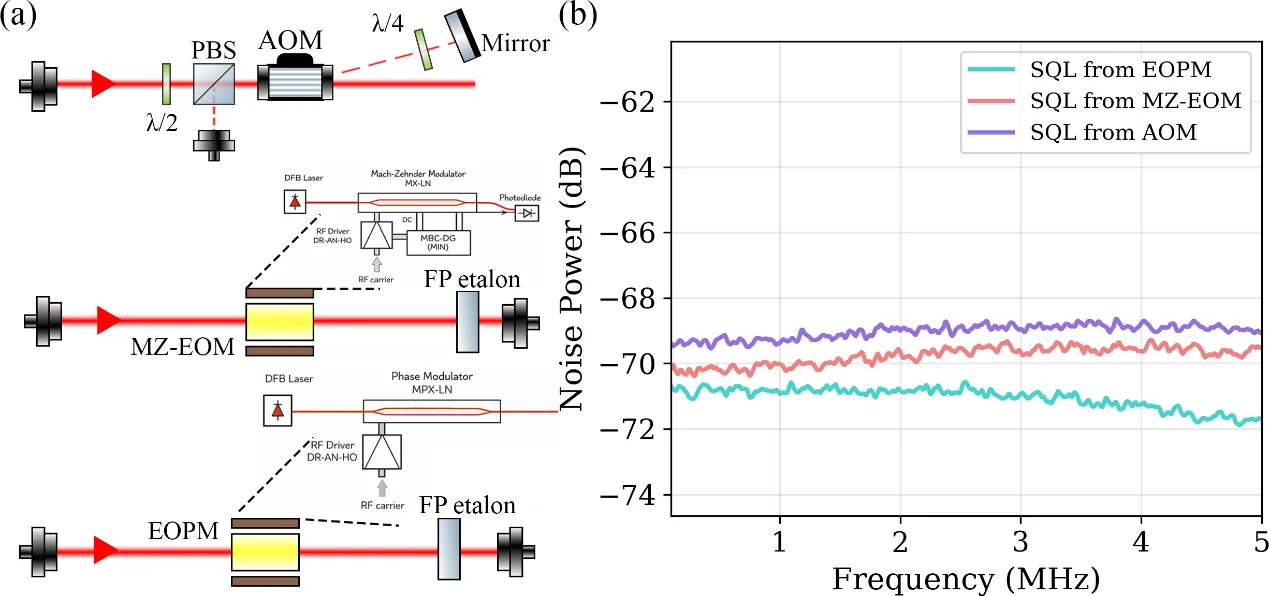
Quantum-correlated states of light, such as squeezed states, constitute a fundamental resource for quantum technologies, enabling enhanced performance in quantum metrology, quantum information processing, and quantum communications. The practical deployment of such technologies requires squeezed-light sources that are compact, efficient, low-cost, and robust. Here we report a compact narrowband source of two-mode squeezed light at 795 nm based on four-wave mixing in hot 85Rb atomic vapor. The source is implemented in a small, modular architecture featuring a single fiber-coupled input, an electro-optic phase modulator combined with a single Fabry-Perot etalon for probe generation, and two free-space output modes corresponding to the signal and conjugate fields. Optimized for low pump power, the system achieves up to -8 dB of intensity-difference squeezing at an analysis frequency of 0.8 MHz with a pump power of only 300 mW. The intrinsic narrowband character of the generated quantum states makes this source particularly well suited for atomic-based quantum sensing and quantum networking, including interfaces with atomic quantum memories. Our results establish a versatile and portable platform for low-SWaP squeezed-light generation, paving the way toward deployable quantum-enhanced technologies.
In rubidium vapor at 120 degrees, atoms move at about 300 meters per second — faster than sound, but thousands of times slower than light.