One-Sided Fountain from a Young Star express
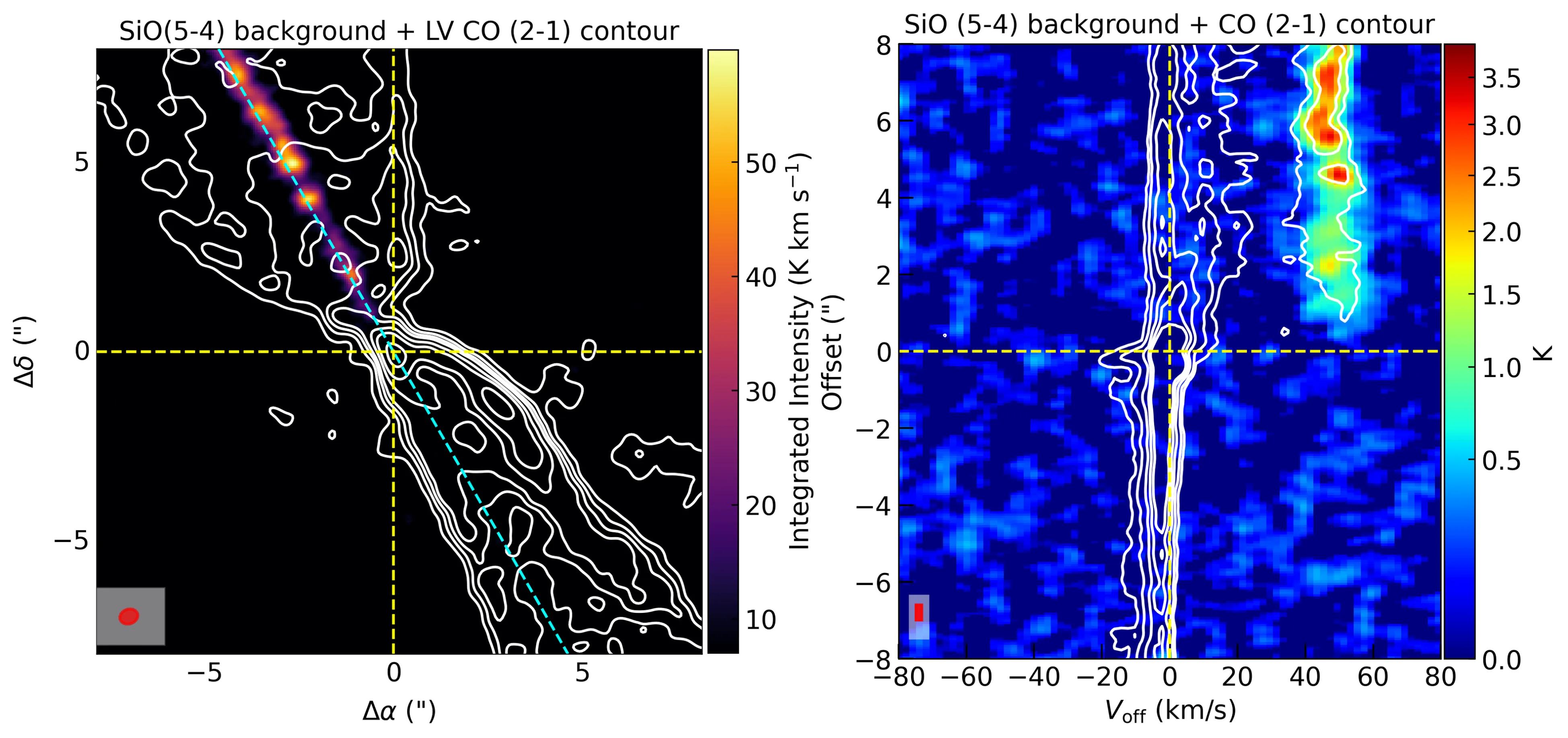
A young star that hasn't yet ignited its thermonuclear furnace is surrounded by a rotating disk of gas and dust. To gain mass, it needs to shed excess rotation — otherwise, material won't fall onto the star but will keep orbiting. Usually, this excess is carried away by two narrow gas jets that shoot from the star's poles in opposite directions, like two fountains.
But for the protostar HOPS 10 in the constellation Orion, the ALMA telescope saw only one fountain. The high-speed jet, moving at velocities from +44 to +66 km/s, is directed only to one side, while the other half is missing. Meanwhile, the slow gas outflow (from -20 to +30 km/s) is observed on both sides, as expected. The disk is almost edge-on to us, and there's little dust in the way, so the second jet can't simply be hidden behind a cloud. Shock wave signatures in SiO molecules confirm that the jet is real, not a random gas cloud.
Astronomers suspect that the disk's magnetic field lines are unevenly loaded with material: on one side, more gas accumulates, and that's what shoots out as a jet. It's like a double-barreled shotgun firing only one barrel — the charge was only there. Such asymmetry can reveal a lot about how young stars gather mass and lose rotation.
The jet of HOPS 10 reaches speeds of 66 km/s — faster than a rifle bullet, but hundreds of times slower than light.