A 17 MeV Ghost Particle express
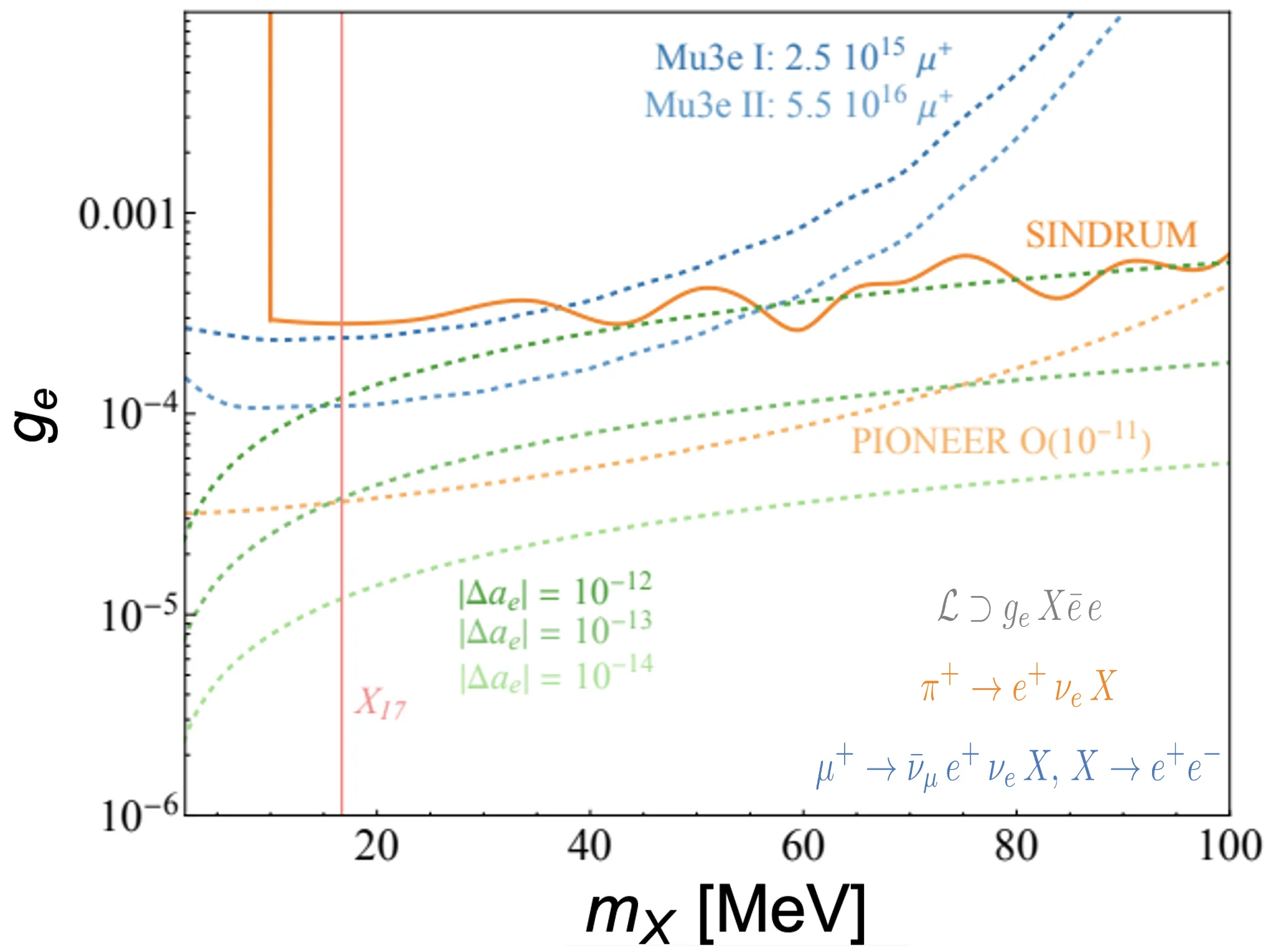
In nuclear transitions of beryllium-8, helium-4, and carbon-12, physicists from the ATOMKI collaboration have been seeing extra events since 2020—as if, when an excited nucleus decays, something else is sometimes born besides the usual photons. The energy of this "something" is always the same: about 17 million electron-volts. In 2025, a similar excess was spotted by the PADME experiment near Rome, but in collisions of positrons with electrons. Two different detectors, two different processes, yet the extra events appear at the same energy.
The simplest explanation is a new particle, dubbed X17. It would have to be very light, neutral, and short-lived: born inside the nucleus, it immediately decays into an electron and a positron. If X17 is real, it doesn't fit into the Standard Model — our best guide to elementary particles. We'd have to extend it.
The author of the work asks: what if X17 isn't just an exotic curiosity, but a bridge to the hidden sector? That's what physicists call a world of particles that feel neither the strong nor the weak nor the electromagnetic force — only gravity. It's from such particles that dark matter might be made. If X17 can talk to both ordinary particles and the denizens of the hidden sector, it could explain why dark matter is so abundant, yet we can't see it directly.
So far, no experiment has conclusively confirmed X17: other facilities, like MEG II, see no anomalies. But the coincidence of ATOMKI and PADME results makes us look more carefully. We might be on the brink of a discovery that connects two of physics' greatest mysteries — the nature of dark matter and the workings of the world beyond the Standard Model.
Original abstract
as written by the authors arXiv:2602.17620
Recent experimental observations, most notably those reported by the ATOMKI and Positron Annihilation into Dark Matter Experiment (PADME) collaborations, have hinted anomalies that may indicate the presence of a new resonance with a mass around $$17\,\text{MeV}$$, potentially interacting with both nucleons and electrons. Since 2020, ATOMKI has observed this resonance in nuclear transitions from excited to ground states in $${}^{8}\mathrm{Be}$$, $${}^{4}\mathrm{He}$$, and $${}^{12}\mathrm{C}$$. More recently, in 2025, PADME, operating at the Laboratori Nazionali di Frascati, has also hinted a similar excess, in this case in the $$e^{+}e^{-}$$ final-state events originating from positron annihilation on fixed-target atomic electrons of Carbonium. This concordance strengthens the case for a common underlying origin, potentially involving a new boson, conventionally referred to as $$X_{17}$$. Despite these intriguing developments, the global experimental landscape remains highly dynamic, particularly in light of recent MEG~II constraints, and a definitive confirmation or exclusion of the $$X_{17}$$ hypothesis is still lacking. Within this evolving and exciting context, this thesis investigates whether a hypothetical $$17\,\text{MeV}$$ particle, coupled to electrons as suggested by the PADME observations, could function as a mediator between the Standard Model and previously unexplored hidden sectors. Such a mediator could, in principle, offer a novel pathway toward addressing one of the principal outstanding inconsistencies of the Standard Model: the nature and origin of dark matter.
The name X17 comes from the particle's presumed mass, about 17 MeV, but since no one knows what it is, it gets just an "X" instead of a proper name.
The idea of a hidden sector that communicates with our world through an intermediary particle echoes stories of parallel universes, where contact is possible only through special portals.