Light as Water: Seeing the Electric Field of a Pulse express
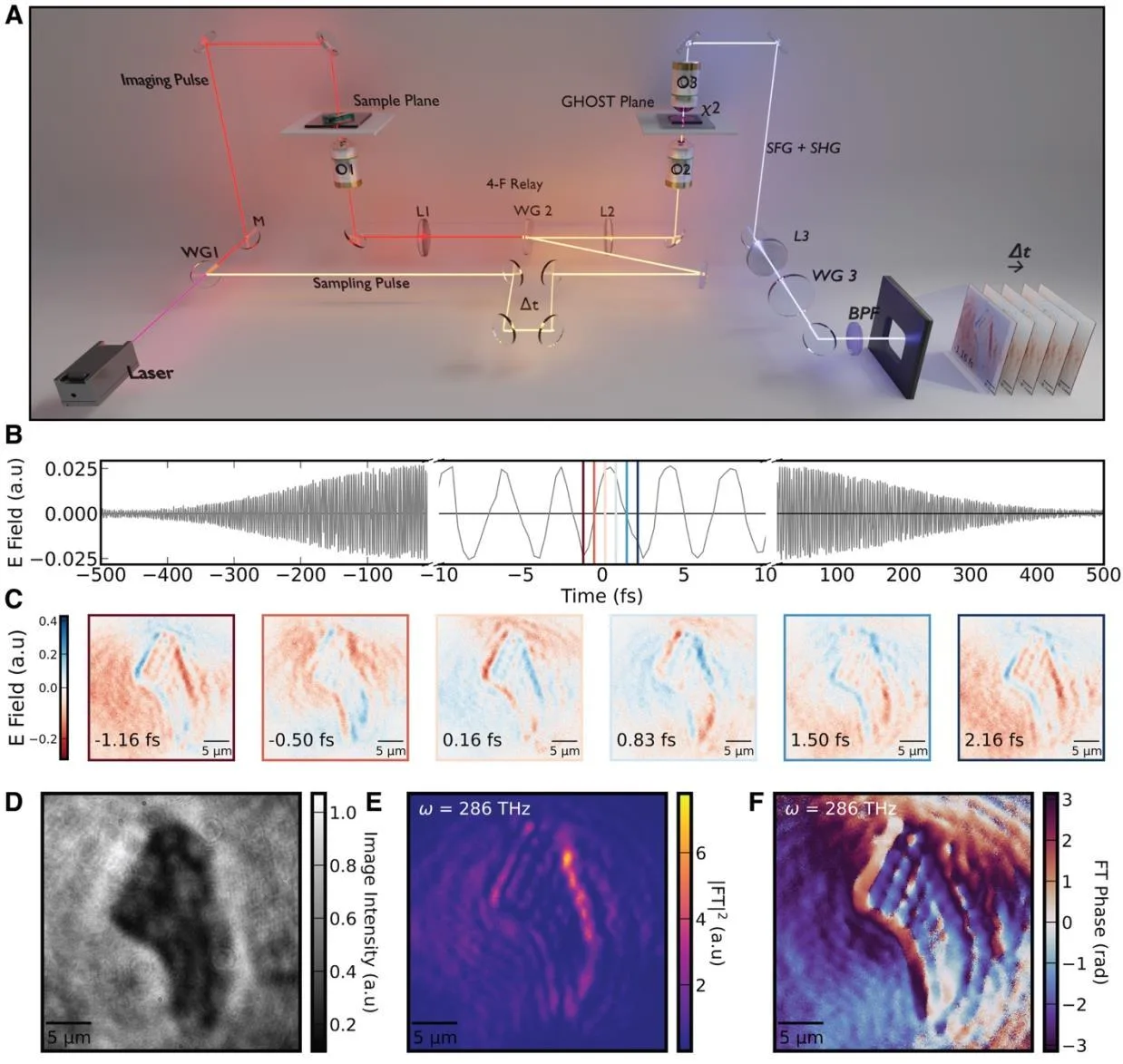
Light is not just a beam but a wave with an electric field that changes at a speed unimaginable to ordinary clocks. Until now, this field could only be measured at a single point, like taking temperature with a single thermometer. Now researchers have created a method that shows the entire field at once, like a thermal imager showing a heat map. They direct a light pulse onto a thin crystal and capture how the field changes around and inside it.
With this technique, scientists saw that light passing through a crystal does not scatter instantly but with a delay, and the pulse stretches in the process. Such details are not visible in ordinary simulations. They also traced the electric field lines as the pulse bends around the crystal's edges. It's like watching water flow around a rock, but instead of water, it's the invisible field of light.
This method paves the way for creating more precise optical devices and microscopes, where it's important to know how light behaves inside a material. Now engineers can see what they previously only calculated.
Original abstract
as written by the authors arXiv:2603.02362
Visualizing the spatiotemporal evolution of the electric field of light is fundamental to optics, from designing photonic devices to developing next-generation microscopes. However, we lack the experimental tools to directly access the electric field of light in the sample plane of an optical microscope. Here, we introduce an all-optical imaging modality that resolves the electric field of light in the plane of a traditional widefield transmission optical microscope with 100-attosecond temporal and 200-nanometer spatial resolution. With this we demonstrate the delayed buildup of scattering contrast and pulse broadening through and around a thick MoTe2 flake - dynamics inaccessible via standard simulations. We showcase our technique's versatility by additionally resolving the full in-plane vector electric field lines during photoexcitation as the optical pulse propagates through and around the MoTe2 flake.
100 attoseconds is one ten-billionth of a billionth of a second. If you stretched one second to the age of the universe, 100 attoseconds would become less than a minute.