Black Holes Sing Gravitational Songs express
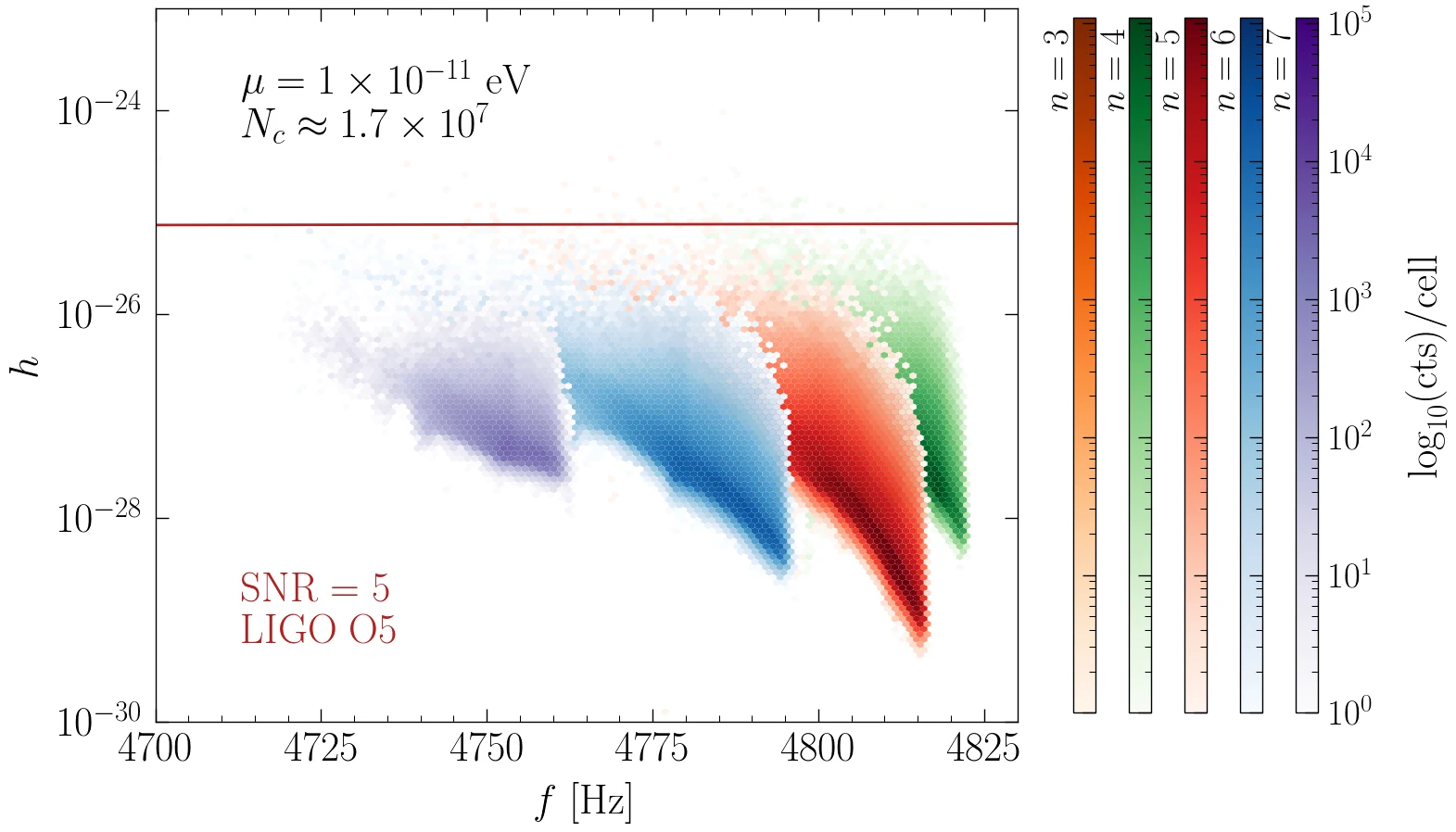
Black holes aren't silent abysses, but nature's tuning forks. Their rapid spin, predicted by Roger Penrose, makes spacetime itself sing, producing a stream of the lightest particles — axions. These accumulate around the hole, like sound in a concert hall, and begin to oscillate in unison. Thus a cloud forms, radiating gravitational waves of a single unchanging note — a cosmic tuning fork sounding for millions of years.
Previously, scientists tried to catch such a song from individual holes by monitoring their spin. Now they've taken into account that in our Milky Way alone there are about a hundred million such tuning forks. Their combined choir produces a hum that detectors built by Rainer Weiss (LIGO) can already pick up. The next generation of instruments, like the Einstein Telescope, will be able to distinguish notes from even lighter axions, bringing us closer to solving the dark matter puzzle.
Original abstract
as written by the authors arXiv:2603.15734
Black hole superradiance is a powerful probe of ultralight axions. If nature contains a boson with a mass of order $$10^{-12}\,$$eV, $$\textit{mere vacuum fluctuations}$$ will lead to its efficient production around spinning stellar mass black holes, forming a gravitational atom that both drains the black hole spin and decays to produce near-monochromatic gravitational waves. Existing superradiance constraints derive primarily from spin measurements of a handful of identified black holes. Here we instead present a detailed study of the population level effect: gravitational waves arising from both the 100 million black holes in the Milky Way and the stochastic signal from axion clouds throughout the universe. We study the impact of a broad range of systematic uncertainties on the black hole properties and compute the projected axion sensitivity for LIGO, as well as the future instruments Einstein Telescope, Cosmic Explorer, and a high-frequency Magnetic Weber Bar. We demonstrate that LIGO can robustly probe axion masses from roughly $$10^{-13}\,$$eV to $$4 \times 10^{-12}\,$$eV. If the black hole population extends to masses slightly below $$5\,M_{\odot}$$ - as hinted for by LIGO inspiral observations - LIGO would approach $$10^{-11}\,$$eV. Under that same assumption we show that a future high-frequency detector could push considerably higher, potentially beyond $$10^{-10}\,$$eV in the most optimistic scenarios, reaching towards the lowest masses within the projected sensitivity of axion dark matter searches.
The gravitational waves from axions are astonishingly pure, like a tuning fork note sounding for millions of years without a single flaw.
In 'Interstellar,' gravitational waves served as a bridge across time; here, we're catching the real melody sung by black holes.