Popular

Black Holes Sing Gravitational Songs ⚡ экспресс

Original: "Crowdsourcing Gravitational Waves from Superradiant Axions"
Rotating black holes transform their energy into clouds of dark matter that sing a gravitational song.
Abstract

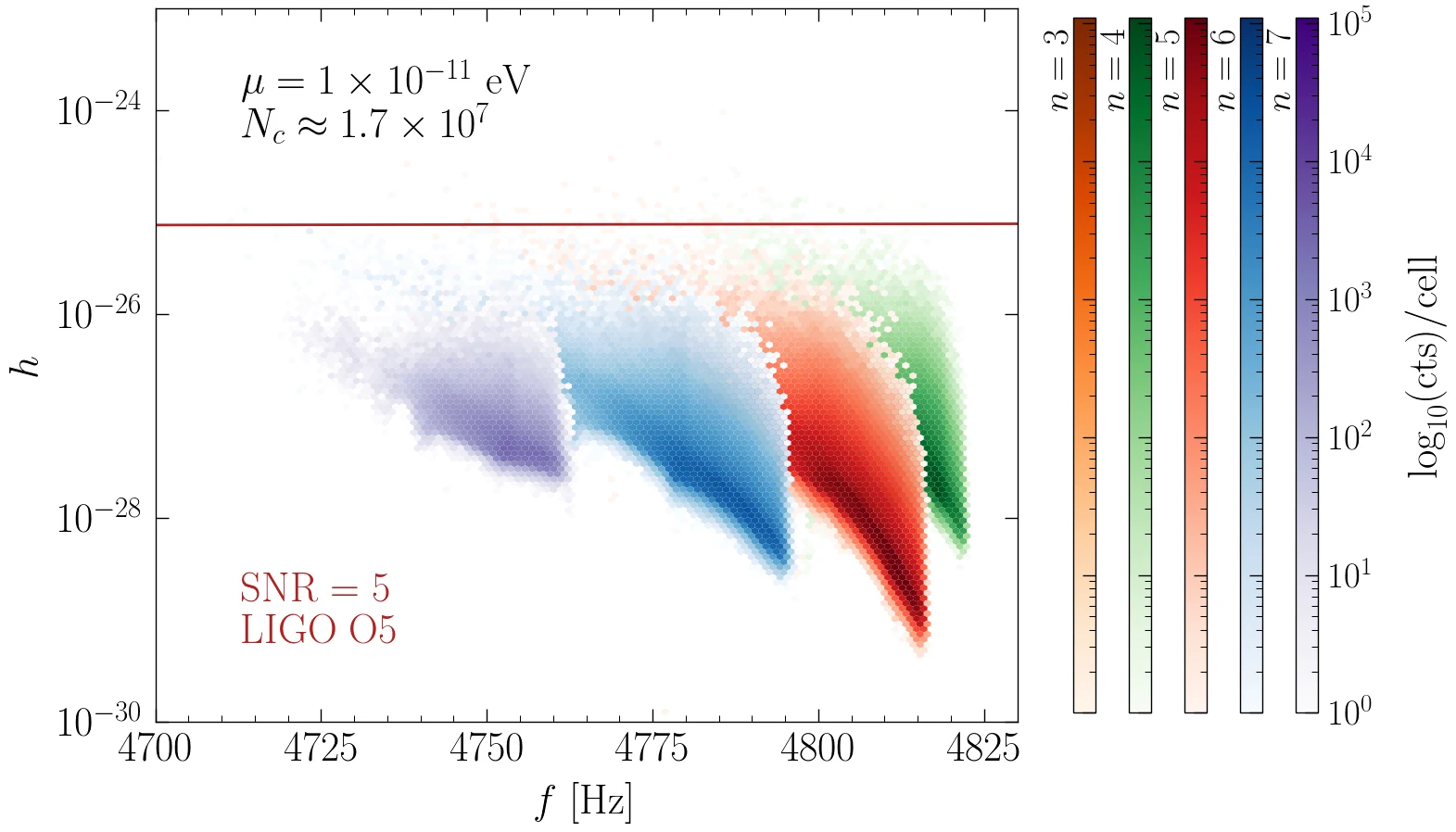
The spin of black holes can trigger superradiance — a process that generates clouds of ultralight axions (dark matter candidates). These clouds act like gravitational atoms, emitting monochromatic gravitational waves. For the first time, a study has estimated the combined signal from hundreds of millions of black holes in the Milky Way and the background radiation from axion clouds throughout the Universe. Calculations show that LIGO can search for axions with masses between 10⁻¹³ and 4·10⁻¹² eV; if black holes can be slightly lighter than 5 solar masses, the range extends to 10⁻¹¹ eV. Future detectors like the Einstein Telescope could push even further, bridging the gap with direct dark matter searches.

Links in the knowledge graph 1

📄 Showing the "Simple" version — "Popular" is not ready yet. Add it to favorites to help prioritize it.

Black holes aren't silent abysses, but nature's tuning forks. Their rapid spin, predicted by Roger Penrose, makes spacetime itself sing, producing a stream of the lightest particles—axions. These accumulate around the hole, like sound in a concert hall, and begin to oscillate in unison. Thus a cloud forms, radiating gravitational waves of a single unchanging note—a cosmic tuning fork sounding for millions of years.

Axions are prime suspects for dark matter particles: nearly invisible, they give themselves away through this gravitational music.

Previously, scientists tried to catch such a song from individual holes by monitoring their spin. Now they've taken into account that in our Milky Way alone there are about a hundred million such tuning forks. Their combined choir produces a hum that detectors built by Rainer Weiss (LIGO) can already pick up. The next generation of instruments, like the Einstein Telescope, will be able to distinguish notes from even lighter axions, bringing us closer to solving the dark matter puzzle.

🎯 The gravitational waves from axions are astonishingly pure—like a tuning fork note sounding for millions of years without a single flaw.

🎬 In 'Interstellar,' gravitational waves served as a bridge across time; here, we're catching the real melody sung by black holes.

Scientists
Stephen HawkingJacob BekensteinAlbert EinsteinFritz ZwickyVera RubinBernhard Riemann
Tags
black hole gravitational waves dark matter spacetime curvature
Laws
Hawking radiationgravitational lensingBekenstein-Hawking entropyEinstein field equationsequivalence principlevirial theorem
Original: arXiv:2603.15734 · CC BY 4.0 · bridge42worlds