Light That Runs Twice as Fast Along Crystal 'Rails' express
Inside a barium titanate crystal, there's a built-in electric field, like a permanent magnet, but for charges. When a flash of light hits it, electrons are knocked loose and start darting around, colliding with atoms. But the crystal isn't the same in all directions: it has an axis along which the field is strongest.
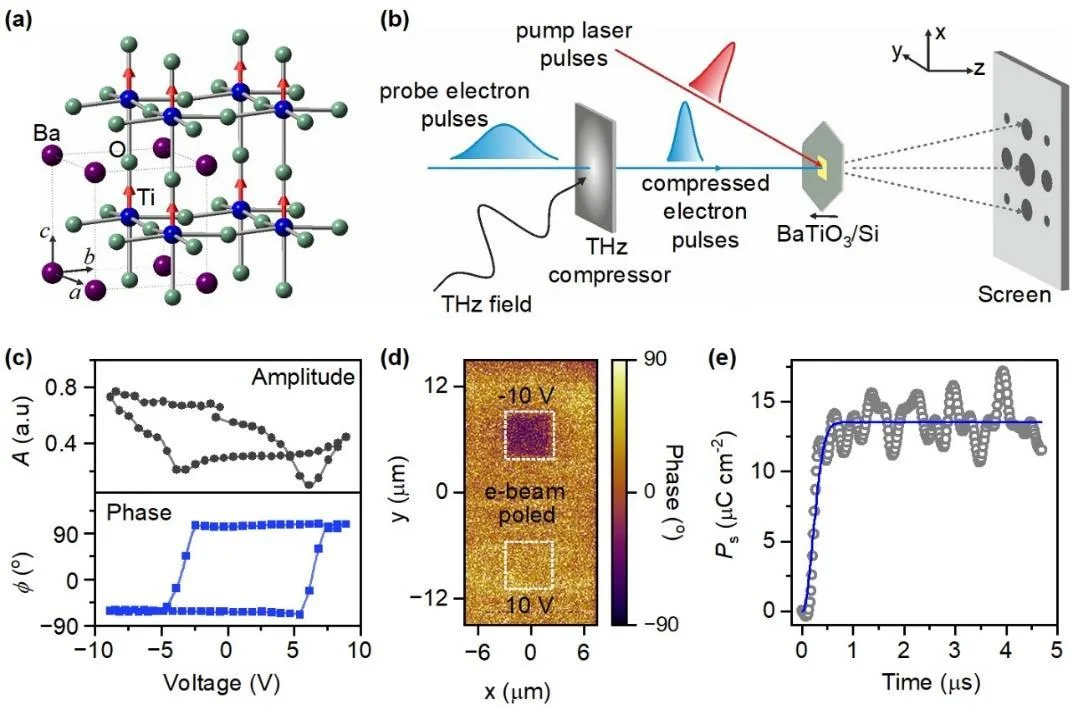
Scientists aimed a laser pulse at the crystal and simultaneously tracked two things: how the atomic lattice vibrates (ultrafast electron diffraction) and where the charges move (field electron microscopy). They found that when the light oscillated along that special axis, electrons transferred energy to the lattice vibrations twice as fast as with perpendicular polarization.
Then, the electrons and holes (the empty spots where electrons used to be) separated by the light run apart under the built-in field, like a couple being pulled in opposite directions on a dance floor. This creates a voltage that can be harvested. This stepwise path, from photon to lattice vibrations to charge separation, explains why barium titanate is so good at converting light into electricity.
So in this crystal, light works like a courier who first pushes through the crowd (the atoms), then guides couples (charges) to different exits. And if the courier takes the main street (along the field), the crowd parts faster.
Original abstract
as written by the authors arXiv:2603.25521
Ferroelectric materials with built-in electric fields are useful for ultrafast electronics and conversion of light into electrical energy, yet the interaction of carrier motion with ultrafast relaxation processes remains nontrivial. Combining ultrafast electron diffraction with electron microscopy of electromagnetic fields, we capture ultrafast lattice dynamics and nanometer-scale carrier transport in ferroelectric BaTiO$$_3$$. We discover that BaTiO$$_3$$ reacts to light with an anisotropic electron-phonon coupling that depends on the optical polarization of the excitation light. Excited electrons relax two times faster into phonons when the optical electric field aligns to the ferroelectric symmetry break. Furthermore, ultrafast electron electrometry captures the motion and separation of photo-excited electron-hole pairs in the presence of the ferroelectric field. These combined results provide insight into the tangled and anisotropic interaction of photons with phonons and the ferroelectric field, producing phonons and voltages in a stepwise reaction path.
Barium titanate is the material used to make capacitors in every other circuit board: it stores charge like a sponge soaks up water, and when squeezed or heated, it generates a voltage on its own.
In 'Star Trek,' dilithium crystals control antimatter reactions; here, a ferroelectric controls light — almost like a warp core, but on a tabletop scale.