The axion-photoncoupling is a fundamental parameter that quantifies how strongly hypothetical particles called axions interact with light. Axions were originally proposed to solve a deep puzzle in particle physics—the strong CP problem—but they also emerge naturally in string theory and are a leading candidate for dark matter. This coupling determines how readily an axion can convert into a photon (and vice versa) in the presence of a magnetic field, which is the key to nearly all experimental searches for these elusive particles.
History
The concept was introduced in the late 1970s and early 1980s by Frank Wilczek and Steven Weinberg, who independently realized that the axion, proposed by Roberto Peccei and Helen Quinn in 1977, would necessarily interact with two photons.
How it works
In a magnetic field, an axion can transform into a photon and a photon can transform into an axion, a phenomenon known as the Primakoff effect. The strength of this conversion is directly proportional to the axion-photon coupling constant. Experiments exploit this by placing strong magnets in front of sensitive detectors: if axions exist, some of them should convert into detectable X-rays or radio waves. Conversely, powerful lasers shone through magnetic fields could produce axions that escape, leaving a slight dimming of the light.
In practice
The coupling is the central target of experiments like ADMX (Axion Dark Matter eXperiment), which searches for dark matter axions converting to microwaves in a resonant cavity, and light-shining-through-a-wall experiments that look for photons regenerated from axions created on the other side of a barrier.
Fun fact
The axion-photoncoupling is so weak that a single axion would travel through a light-year of lead with a 50% chance of interacting, making it one of the most weakly interacting particles ever proposed.
Units by system: SI: 1gev · CGS: 1gev · Planck: 1gev · natural: 1gev
In the basement of the laboratory, an 8 tesla magnet hums. Inside it, like a bell in a bell tower, hangs a hollow copper cylinder tuned to a single note. If an axion, a dark matter particle, flies by, the cylinder responds with a faint ring. The trouble is that ordinary copper muffles this ring: at high frequencies, current flows only through a thin skin of the metal, and losses grow.
The early Universe resembles a boiling cauldron, where particles and antiparticles are born and die in equal numbers. But today, all around us is only matter — stars, planets, ourselves. How did a tiny excess of one part in a billion emerge from the initial equality? One answer hides in the oscillations of a heavy field, like a rock that the tide alternately submerges and exposes.
Light from the hottest stage of the universe has been traveling toward us for nearly 14 billion years. This is the cosmic microwave background — a faint glow filling the entire sky.
In the first fraction of a second after the Big Bang, the universe expanded at an unimaginable rate. The engine behind this expansion could have been a field that behaves like a slowly rolling ball — the axion. What makes the axion special is that, like a conductor, it can drive electromagnetic waves, creating them literally out of nothing.
In the first moments after the Big Bang, the universe expanded at an incredible rate — a phase known as inflation. Even the vacuum was restless back then: quantum jitters shook the fields like wind rustling through a wheat field.
Some 123 parsecs from Earth, in the constellation Corona Australis, drifts the neutron star RX J1856.5-3754. Its diameter is about 12 kilometers, smaller than Moscow's Ring Road, but its surface temperature reaches 460 000 kelvin. The star emits a slow, almost inaudible exhalation.
A lighthouse at sea doesn't just rotate: its lamp itself dims and brightens on its own. Magnetic white dwarfs, the ultra-dense remnants of stars like our Sun, behave in much the same way. Their powerful magnetic fields can convert light into axions — hypothetical particles that could explain the Universe's hidden mass.
Imagine a green beam that, passing through an ingenious optical setup, twists into a three-dimensional funnel of light — an optical vortex. At its heart, like in the eye of a hurricane, the intensity drops to zero. It is there that photons disappear.
Since Saul Perlmutter and his colleagues discovered the accelerated expansion of the universe, physicists have been scratching their heads over the nature of dark energy.
The standard model of cosmology, based on the field equations proposed by Einstein, describes the Universe as a cocktail of dark matter (discovered thanks to Vera Rubin) and dark energy in roughly a 1:3 ratio.
In the early Universe, tiny black holes could have been born — mountain-mass but atomic-nucleus-sized. Today they could serve as factories for dark matter. There are two mechanisms: the familiar evaporation (Hawking radiation) and the lesser-known superradiance.
Imagine a perfectly tuned orchestra, where every instrument is adjusted with flawless precision, trying to play in a noisy hall. That noise is quantum gravity — the microscopic ripples of spacetime. It constantly threatens to throw the musicians off.
A pebble drops into a pond, and ripples spread across the water. But one wave suddenly doesn't spread out: it clings to an invisible fold on the surface and runs only along it.
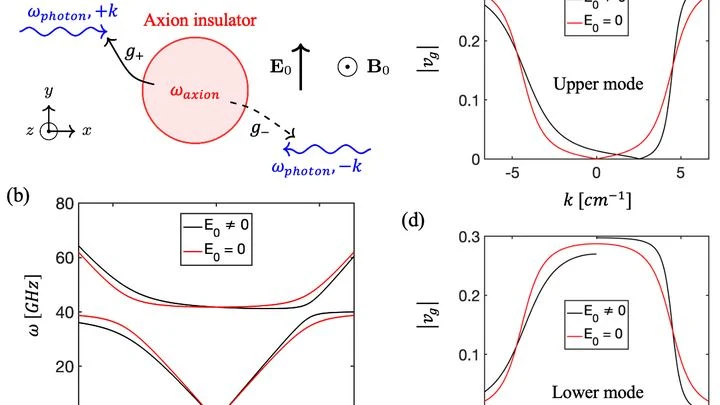
A regular flashlight shines equally forward and backward. But in magnetic crystals, a axion appears — a ghostly excitation, like a wave going around a stadium: atoms pass a magnetic impulse to each other. When light meets an axion, a hybrid forms, whose fate depends on electric and magnetic fields.
Atomic nuclei are not always like billiard balls. Some are elongated, like cigars, others are flattened. But xenon-129 resembles a potato — a bumpy triaxial ellipsoid.
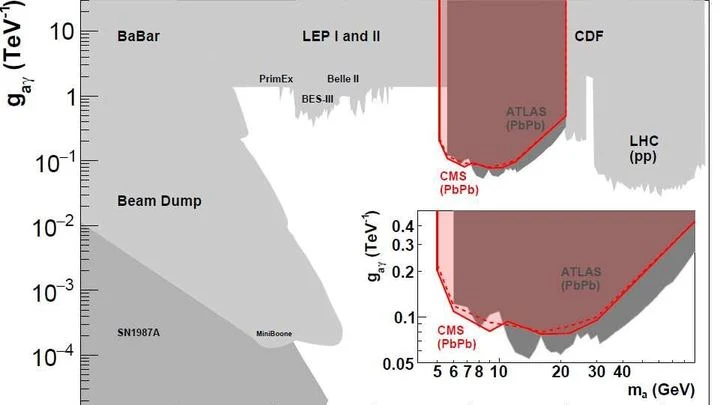
At the SuperKEKB accelerator, electrons collide with positrons, and among the debris, B-mesons are found. These heavy particles live briefly and break apart into lighter ones. Recently, the Belle II detector recorded a suspiciously high number of cases where a B-meson transforms into a K-meson (kaon) and something invisible—2.7 sigma more than expected.
In the first moments after the Big Bang, the universe was a boiling cauldron. But then, according to a new hypothesis, it suddenly cooled dramatically — far more than previously thought. In this icy world, dark matter particles, like tiny pendulums, froze and did not begin their oscillations.
A thick rubber band is twisted tighter and tighter. At some point, it can't take it anymore — it snaps and whips around, releasing the stored energy. That's roughly how magnetic fields inside neutron stars — the ultra-dense remnants of exploded stars — behave.
A tiny ring of superconductor, cooled to near absolute zero, could feel the touch of a particle billions of times lighter than an electron. We're talking about the axion — a hypothetical particle that might make up the dark matter filling the universe.
In a dark room, an invisible lamp flashes. Its light is unlike anything familiar: it has no steady brightness, only rare but powerful bursts. This is bright squeezed vacuum — a state of light with no ordinary wave but strong quantum fluctuations. It is with such light that physicists bombarded xenon atoms.
When a massive star dies, a supernova explosion occurs, so powerful that a single flash outshines an entire galaxy. In this fire, billions of axions are born — invisible particles that leave almost no trace. Every second, trillions of these tiny things fly right through each of us, completely unnoticed.
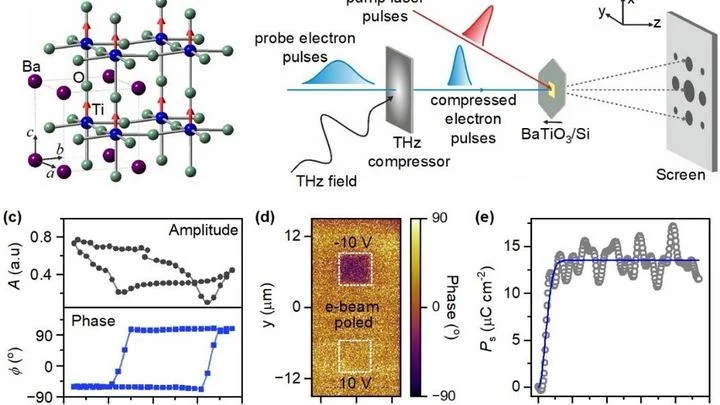
Inside a barium titanate crystal, there's a built-in electric field, like a permanent magnet, but for charges. When a flash of light hits it, electrons are knocked loose and start darting around, colliding with atoms. But the crystal isn't the same in all directions: it has an axis along which the field is strongest.
In the kitchen, two flashlight beams pass through each other without noticing. Light barely interacts with light. But if you accelerate particles to enormous energies, two photons can collide and give birth to something new.
A neutron star the size of a city spins thirty times per second. Its magnetic field is trillions of times stronger than Earth's. Such conditions could spawn a cloud of axions around the star — light particles that no detector has caught yet, but which neatly explain the hidden mass of the Universe.
A thin film of indium arsenide on an insulating substrate behaves like a double-walled thermos: the electrons inside barely give off heat to the surrounding crystal. In an ordinary metal, electrons quickly exchange energy with atomic vibrations, so their temperature is always close to that of the sample.
At the Large Hadron Collider, physicists accelerate protons to nearly the speed of light and smash them together. Usually, the protons themselves take part in such collisions, but sometimes they pass close by without touching, and it is their electric fields that interact.
At Hungary's Institute for Nuclear Research, ATOMKI, physicists noticed something odd: in the decays of excited atomic nuclei, pairs of electrons and positrons sometimes fly apart at an unusual angle. It's as if an invisible mediator particle briefly appears and disappears between them.
Ordinary light is a stream of independent particles: photons fly through each other without noticing their neighbors. But in superconducting circuits cooled to near absolute zero, the situation changes. There, photons travel along narrow metal tracks, and if tiny elements called Josephson junctions are embedded in these tracks, light begins to 'feel' itself.
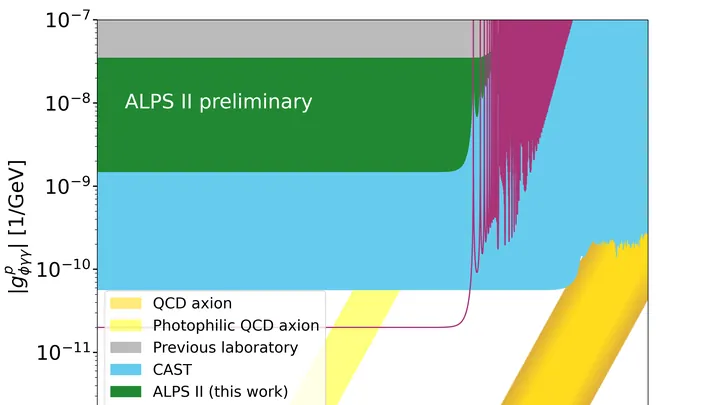
At the DESY lab, the ALPS II experiment was launched to hunt for axions — hypothetical ghost particles that might make up dark matter. This invisible mass acts like a skeleton, preventing galaxies from flying apart due to their spin.
Data from the DESI galaxy survey hint: dark energy was more powerful in the past than today. This 'phantom' behavior threatens the Universe with a Big Rip — a finale where even atoms disintegrate. But the KMIX model explains this as an illusion. Two fundamental fields — like a distorting mirror — warp our picture: constant energy appears variable.
Inside every living cell, chemical transformations are constantly taking place. Some of them create unstable particles whose electrons behave like paired magnets. Their interaction resembles a dance: each movement of the pair responds to external magnetic fields, as if to a changing rhythm.
The ARCADE2 radiometer on a high-altitude balloon detected an excess radio emission, while the ground-based EDGES experiment found an anomalously deep trough in the hydrogen spectrum at 21 cm. Both signals do not fit the standard cosmological model and point to an unknown source of soft photons.