Rethinking Light Distribution Reveals the Invisible express
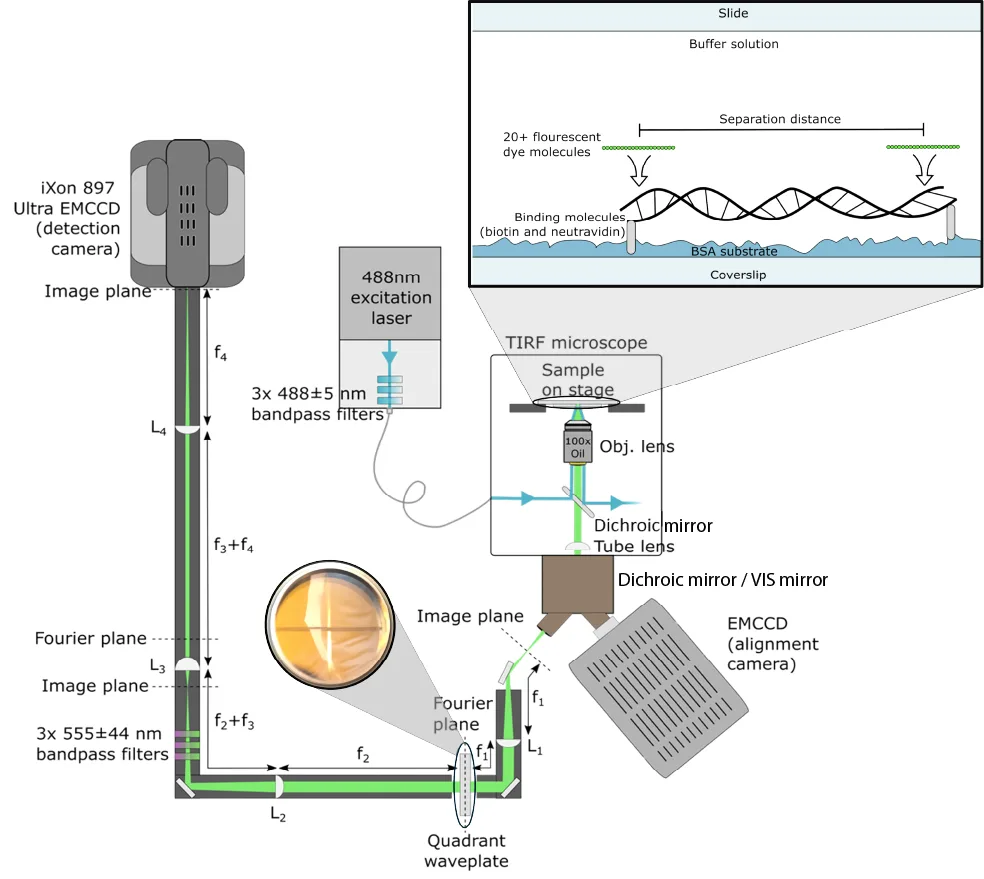
A conventional light microscope hits a fundamental limit: it cannot distinguish two points closer than 200 nanometers — roughly the thickness of a soap bubble divided by a hundred. To see deeper, scientists have made molecules in the sample blink or fade, but these tricks are slow and harmful to living cells. The new device, called the Structured Detection Microscope, takes a different approach.
It doesn't touch the sample itself; instead, it alters the shape of the light spot captured by the camera. Light from neighboring molecules that would normally merge into one blurry spot is spread across different parts of the sensor. It's like recording two voices in a noisy room not with a single microphone but with two placed in opposite corners: each picks up its own share. As a result, the device can distinguish labels on DNA rulers spaced 50 nanometers apart and achieves clarity down to 40 nanometers — five times better than the limit.
This approach paves the way for observing living cells without phototoxicity — the light-induced damage that degrades cells under a microscope. Now biologists can track proteins and DNA in real time without fearing that a bright beam will kill the cell.
The optical resolution limit that the authors overcame was described back in 1873 by Ernst Abbe. It was considered insurmountable for nearly a century and a half.
In the series 'The Expanse,' ultra-precise sensors allow ships to see through asteroids. The new microscope is a step toward seeing through cell membranes without destruction.