Non-destructive imaging spectroscopy combines spectroscopy with imaging to create detailed maps of a sample's composition and properties without damaging it. This is crucial in medicine, archaeology, and materials science, where the object of interest is valuable or fragile. The technique uses light of different wavelengths to probe the sample, and the resulting spectral information is used to construct an image that reveals hidden structures, chemical gradients, or defects.
History
The concept dates back to the early 20th century with the development of X-ray spectroscopy, but non-destructive imaging spectroscopy became practical with the advent of digital detectors and computers in the 1970s and 1980s. The use of quantum-correlated light for imaging is a recent development from the 2010s.
How it works
The approach typically involves illuminating the sample with light (or other radiation) and measuring the reflected, transmitted, or emitted spectrum at each point. For example, in near-infrared spectroscopy, light penetrates tissue and is absorbed differently by bone, fat, and water, allowing a 3D map of bone density to be built. In X-ray fluorescence, the characteristic X-rays emitted by different elements are used to map their distribution in an artifact. Advanced methods, like quantum-correlated spectroscopy, use entangled photons to enhance sensitivity, allowing detection of tiny amounts of material, such as microplastics in water, without altering the sample.
In practice
Used in medical diagnostics to assess bone fragility, in archaeology to analyze pigments in ancient artifacts without sampling, and in environmental science to detect microplastics in water.
Fun fact
A technique called 'photoacoustic imaging' uses a short laser pulse to heat tissue, which then emits ultrasound waves — the resulting image can show blood vessels in real time, and the same principle is used to detect tumors.
Light that never reaches the camera still leaves its mark on it. That's how the new imaging method works: you illuminate the object with one color, and the picture is assembled from another. Inside the crystal, light waves mix, and information about the invisible transfers to a visible beam.
In the experiment, they used a silver thiogallate crystal.
After a merger, the newborn black hole emits a fading tremble — gravitational waves, similar to a ringing bell. By analyzing the overtones of this signal, spectroscopy can determine its mass and spin rate.
Two dice always land on the same number, no matter how far apart you toss them. In quantum physics, this behavior is called entanglement, and it's the key resource for future computers and secure communication. The trouble is, not all entanglement is easy to spot.
A neutron spectrometer is like a blind geologist who taps on rock and guesses what's inside by the sound. It sends a beam of neutrons into a crystal and watches how they scatter. From this pattern, you can deduce how atomic magnets, spins, oscillate. But where exactly to dig and how long to listen used to be decided by a human.
Now, the TAS-AI algorithm has taken the helm.
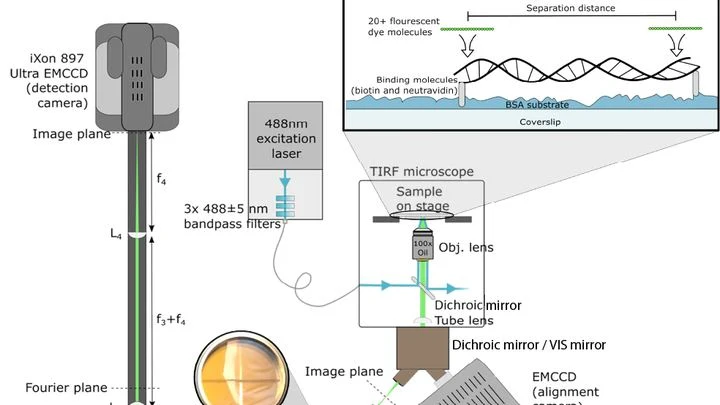
A conventional light microscope hits a fundamental limit: it cannot distinguish two points closer than 200 nanometers — roughly the thickness of a soap bubble divided by a hundred. To see deeper, scientists have made molecules in the sample blink or fade, but these tricks are slow and harmful to living cells.
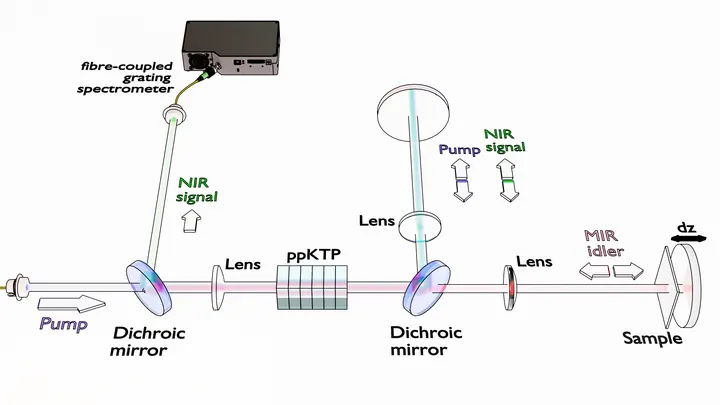
Microplastics, tiny fragments of synthetic polymers, are now found everywhere, from mountain glaciers to food. The traditional analytical approach, spectroscopy, which relies on light interacting with matter, has long required costly detectors to register invisible infrared radiation.
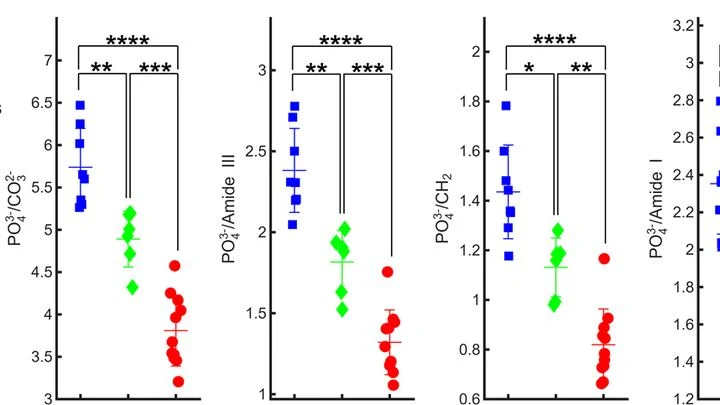
A finger is illuminated with a laser beam, and some of the light returns after traveling inside. That's how Raman spectroscopy works: molecules in bone and skin alter the color of the reflected beam differently, leaving their chemical fingerprints. But skin, muscle, and fat are noisy: their signal drowns out the bone's, like a crowd's chatter overpowering a single singer.
The edge of a magnet works like a guitar fret: a string pressed near the edge sounds different, with a richer set of overtones. Magnetic waves in a thin strip of nickel and iron behave in much the same way.
A glass marble in a glass of water is nearly invisible, but if you look through it at a checkered tablecloth, the lines behind it appear distorted. Transparent cells behave the same way: light passes through them but is slightly slowed and changes direction.
A firefighter with a thermal imager can see the source of a fire through smoke. But how do you see a radiation source that has no smell, no glow, and no heat? Gamma cameras solve this problem: they capture gamma rays emitted by radioactive materials and overlay their 'trace' onto a regular photograph. The result is an image showing that the source is, say, behind the far door.
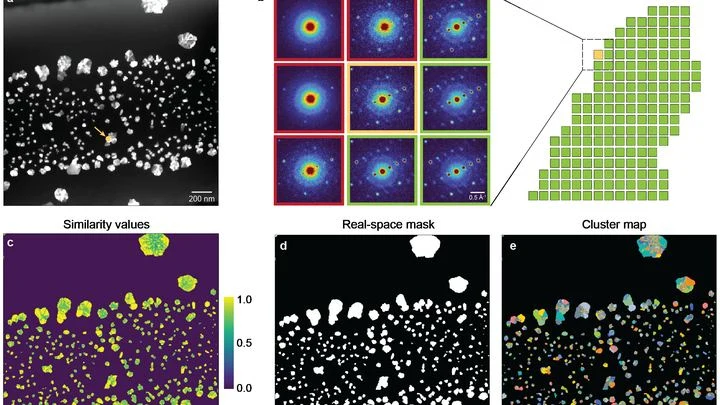
An electron microscope scans a sample and records how electrons scatter off atoms at each point. The result is a giant stack of images — one for every point. These images encode information about how atoms are arranged: in neat rows or with a tilt, the orientation of the crystal lattice, and whether there are internal strains.
Graphs are considered identical if their 'terrain' matches. Imagine two maps with mountains and valleys: even if drawn differently, the heights and steepness of slopes can be the same.
Open systems exchange energy with their surroundings, like a guitar string fading into the air. Scientists built such a system out of light, twisting the beams into corkscrews and forming an artificial lattice — a maze where losses can be controlled at every step. Light in this maze always moves at the maximum possible speed, but its energy can fade or grow.