How Curvature and Spin Shape a Black Hole's Shadow express
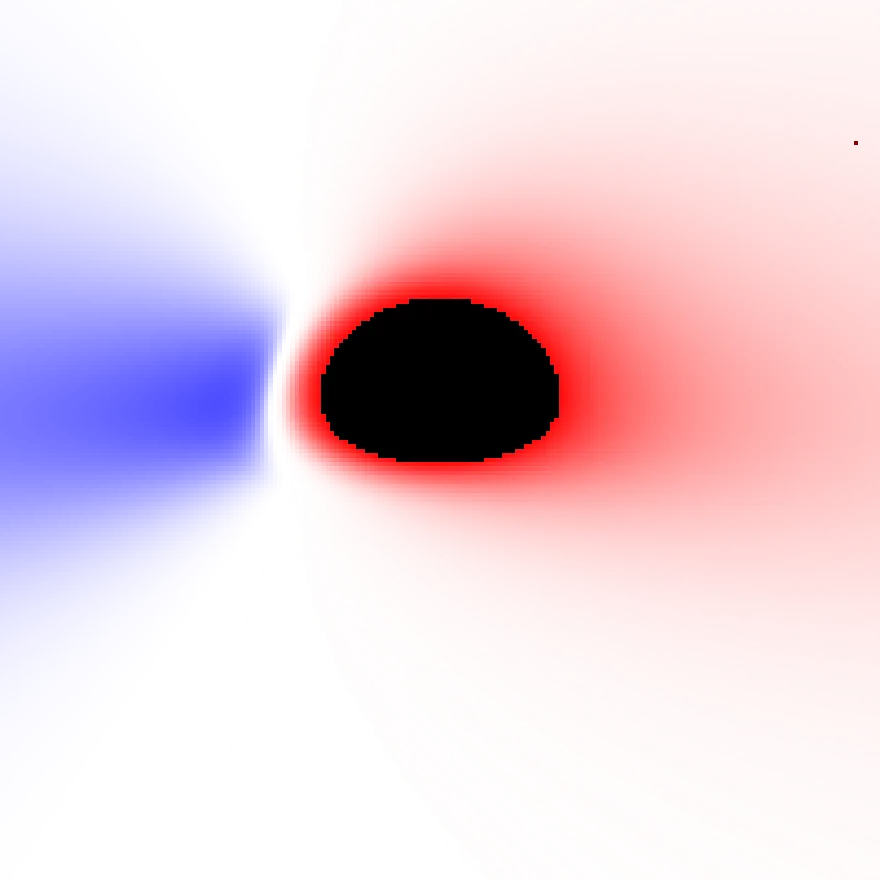
Light passing by a massive body bends around it, like a stream of cars swerving around a deep pothole in the road. The steeper the pothole's slopes, the more the trajectories curve, and the fewer straight paths remain to the observer. That's how a black hole's shadow is born: a region from which light can no longer escape.
The authors of the new study added another layer of asphalt to this road picture — the so-called Gauss-Bonnet curvature, which only matters in spaces with more than four dimensions. In our world, it manifests through a single parameter α that controls the extra bending. As α grows, the pothole deepens for the same mass — the shadow shrinks, and its edge becomes more angular. Rapid spin (parameter a) acts differently: it drags space itself along, causing the light ring around the shadow to lose symmetry and stretch in the direction of rotation.
To test the model, the researchers recreated the conditions under which the famous images of M87* and Sagittarius A*, the supermassive black holes at the centers of our and neighboring galaxies, were captured. It turned out that allowed values of α are very small; otherwise, the shadow would look different. This doesn't rule out extra curvature entirely but confines it to a narrow range — much like adjusting a headlight that you can only turn a couple of millimeters without blinding oncoming drivers.
Original abstract
as written by the authors arXiv:2604.18628
This study investigates the visual characteristics of a rotating black hole (BH) within the fabric of $$4$$D Einstein-Gauss-Bonnet gravity illuminated with two illumination models, such as a celestial light sphere and a thin accretion disk. To visualize the BH shadow images, we use a recent fisheye camera model and ray-tracing method. And then, we focus on investigating the impact of the coupling parameter $$\alpha$$ and the spin parameter $$a$$ on the shadow images. The results exhibit that the shadow radius decreases, while the shadow deviation increases with the aid of $$\alpha$$. However, with respect to $$a$$, the shadow radius is slightly increased compared to the corresponding shadow deviation. For a celestial light sphere, the increasing values of $$\alpha$$, lead to a decrease in the corresponding photon ring, while the space-dragging effect becomes more prominent with increasing $$a$$. For a thin accretion disk, we enhance its inner edge to the BH event horizon, and the particle motion is different in the regions inside and outside the innermost stable circular orbit. The result demonstrates that the shadow becomes progressively asymmetric with $$a$$, while the overall size of the inner shadow gradually decreases with the variations of $$\alpha$$. Subsequently, we also investigated the distinct features of red-shift configurations on the disk for both direct and lensed images. Additionally, we used the latest observational data from M87* and Sgr A* to impose certain parameter constraints on $$\alpha$$; the results depict the consistency of our considering the BH model.
The shadow of M87* in the 2019 image is comparable in size to a tennis ball viewed from 13,000 kilometers away.
In Michael Crichton's novel "Sphere," characters encounter a curvature of space that alters familiar laws of physics — much like the extra parameter α subtly reshapes gravity around a black hole.