How Curvature and Spin Shape a Black Hole's Shadow express
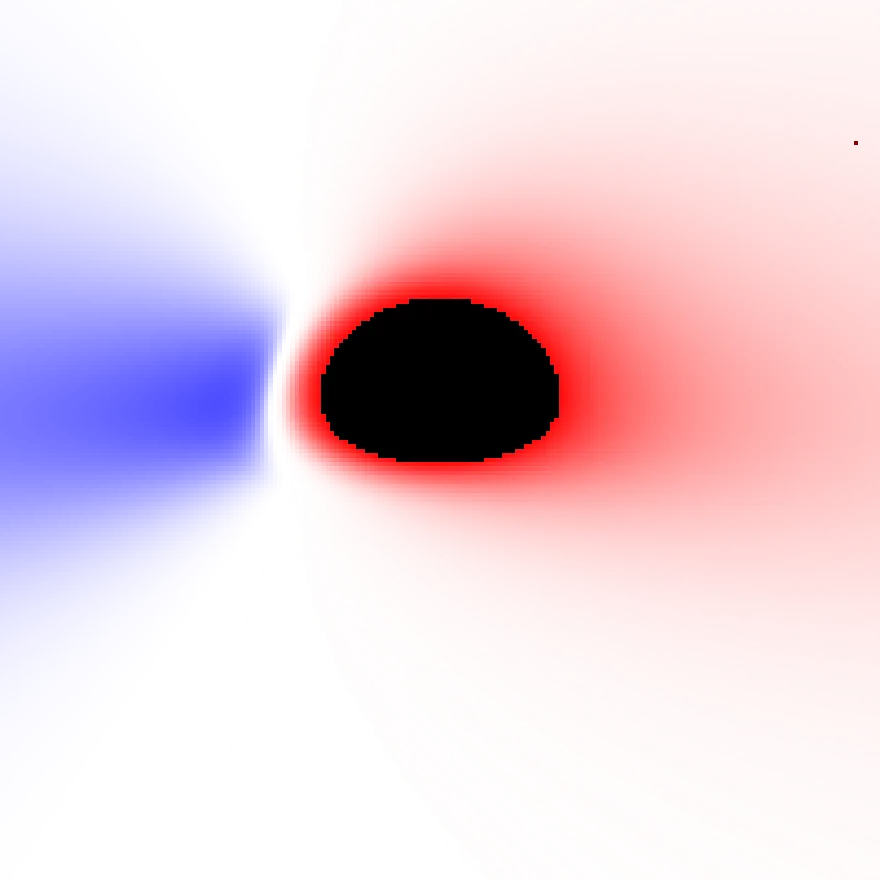
Light passing by a massive body bends around it, like a stream of cars swerving around a deep pothole in the road. The steeper the pothole's slopes, the more the trajectories curve, and the fewer straight paths remain to the observer. That's how a black hole's shadow is born: a region from which light can no longer escape.
The authors of the new study added another layer of asphalt to this road picture — the so-called Gauss-Bonnet curvature, which only matters in spaces with more than four dimensions. In our world, it manifests through a single parameter α that controls the extra bending. As α grows, the pothole deepens for the same mass — the shadow shrinks, and its edge becomes more angular. Rapid spin (parameter a) acts differently: it drags space itself along, causing the light ring around the shadow to lose symmetry and stretch in the direction of rotation.
To test the model, the researchers recreated the conditions under which the famous images of M87* and Sagittarius A*, the supermassive black holes at the centers of our and neighboring galaxies, were captured. It turned out that allowed values of α are very small; otherwise, the shadow would look different. This doesn't rule out extra curvature entirely but confines it to a narrow range — much like adjusting a headlight that you can only turn a couple of millimeters without blinding oncoming drivers.
The shadow of M87* in the 2019 image is comparable in size to a tennis ball viewed from 13,000 kilometers away.
In Michael Crichton's novel "Sphere," characters encounter a curvature of space that alters familiar laws of physics — much like the extra parameter α subtly reshapes gravity around a black hole.