A Giant Cosmic Ring express
The night sky sometimes throws up riddles that take your breath away. One of them is a ring of galaxies stretching across a third of the horizon. Astronomers have named it the “Giant Ring on the Sky”: a cluster of galaxies stretched into a thin filament and closed into a circle about 400 megaparsecs in diameter. If you lined up 1300 Milky Ways end to end, you'd get roughly the same length.
The ring lies 7 billion light-years away, in a region where two other super-large structures, the Giant Arc and the Big Ring, had already been spotted. The new formation seems to embrace them, linking scattered arcs into a single outline. The left side of the ring splits into two: one path is more elongated, the other almost perfectly circular. It looks like two ellipses superimposed and seen at a slight angle.
Such rings force us to reconsider conventional ideas about the distribution of matter. The standard model says that matter is spread evenly, without sharp contrasts on large scales. But these structures remind us that the cosmic web from which the universe is woven still holds many surprises. And that ring spanning a third of the horizon is just one of its patterns that we have yet to understand.
Original abstract
as written by the authors arXiv:2604.17534
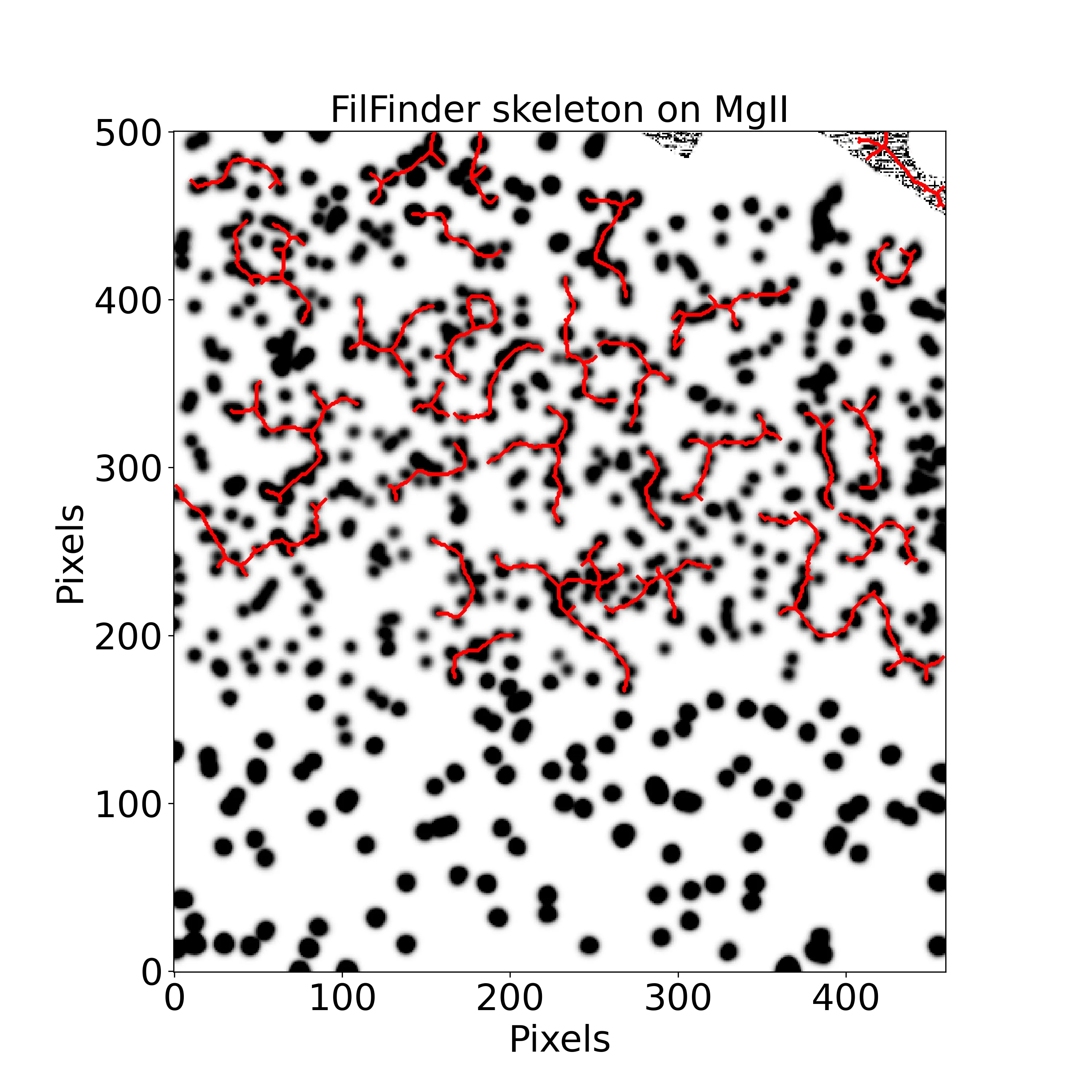
We present the discovery of `A Giant Ring on the Sky' (GR); a ring-like, ultra-large-scale structure at z~0.8, located in the same field that contains the previously-documented Giant Arc (GA) and Big Ring (BR). The GR was predicted from the presence of a Northern Arc (NA) filament (noted in previous work), which looked like it could, with more or enhanced data, connect with the GA to form a giant ring that encompasses the BR. There is now much evidence to support the reality of a GR. There appear to be two overlapping versions of the GR which differ by only the left-hand-side trajectory; this branching in the LHS of the GR was identified with the FilFinder algorithm and appears to correspond to both the GR prediction (the extended, elliptical, GR from the GA+NA ellipse), and the visually-identified ellipse (the visually-impressive, almost contiguous, roughly circular, GR which is enhanced by a tilted viewing angle). The branching in the GR seems to be hinting at multiple, overlapping ring features. The GR consists of a thin, filamentary northern region, a clustered, ambiguous southern region (including the members of the GA), and filamentary branching towards the LHS. Statistical assessment with elliptical shells, and optimum elliptical-shell-matching, identified two $$> 4\sigma$$ ellipse features corresponding to the GR prediction and to the visually-identified GR. Additionally, the 2D Power Spectrum Analysis identified significant ($$3.5 \sigma$$) clustering on scales ~320Mpc. We also applied our statistical assessments to random data and to FLAMINGO-10K simulated data. The results demonstrate that, while superficially `significant' elliptical shells can be reproduced in random data with the optimum ellipse-matching method (many trials giving the `look-elsewhere' effect), with 2D PSA all of the random fields, and FLAMINGO-10K fields, were found to be entirely consistent with random.
The diameter of this ring is about 400 megaparsecs. If you were to fly through it at the speed of light, the journey would take more than a billion years.
Such superstructures echo the “Ring” from Larry Niven's novels — except there it was artificial, while here it is crafted by nature itself.