How Chaos Governs the Chemistry of Giants express
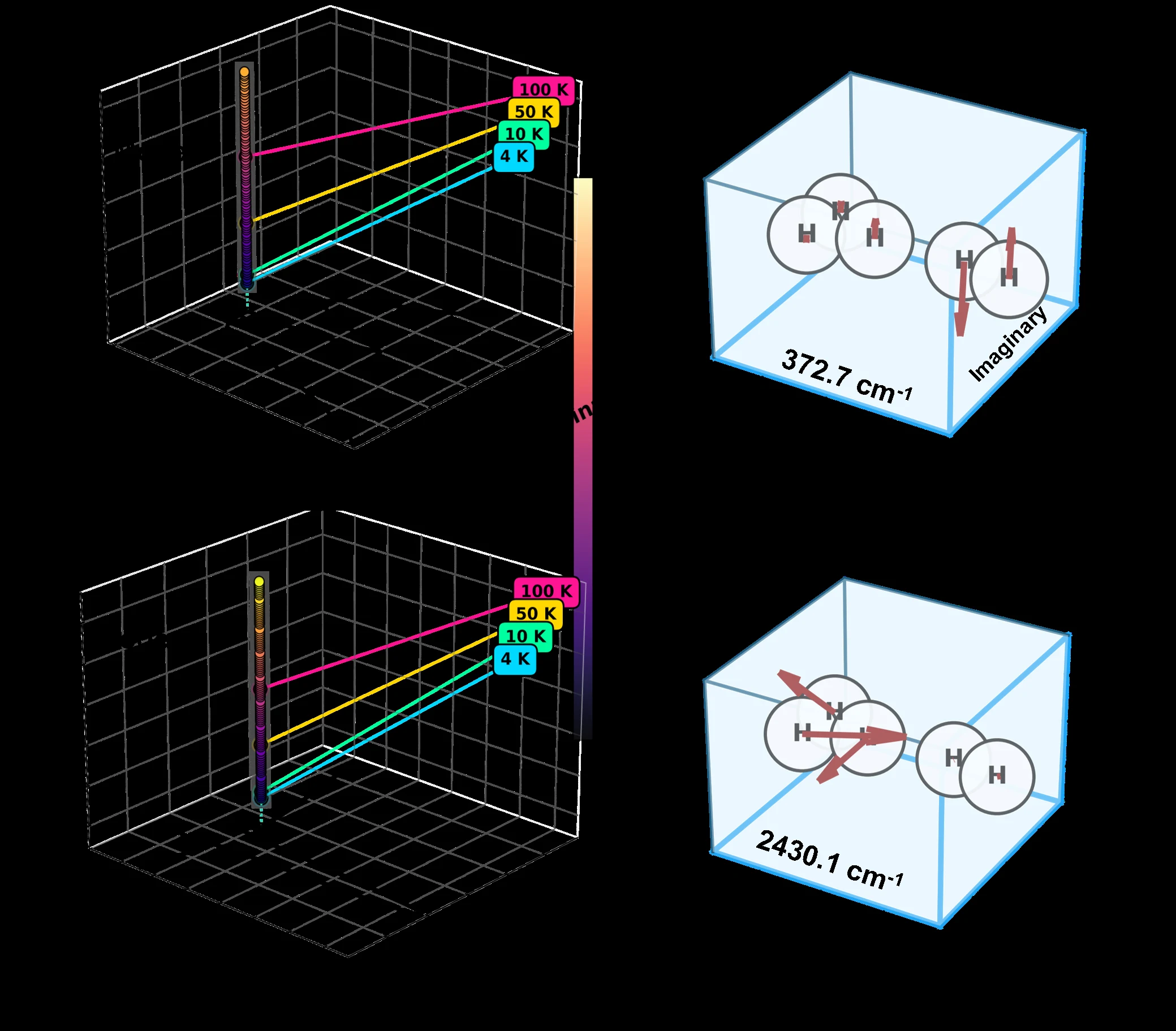
A chemical reaction resembles passing through a turnstile: a crowd creates chaos and gets stuck, while an orderly line moves. In the quantum world, however, when the jostling subsides, the barrier can become ghostly — a particle passes through it as if the turnstile has vanished. This tunneling governs the chemistry of giant planets.
Research has shown: in the transition state, when molecules are about to transform, chaos quiets down. It is then that hydrogen ions seep through barriers, forming molecules critical for Jupiter's atmosphere.
Scientists introduced a "fragility index": it predicts which molecular vibrations return chaos and break the tunnel. The most surprising part: without this brief lull, even the strongest collisions would not trigger the reaction. Thus, in the cold depths of Jupiter, it is the suppression of chaos, not heat, that ignites the auroras.
Original abstract
as written by the authors arXiv:2604.21005
Accurate modeling of ion-molecule reaction networks is essential for understanding the chemical evolution of planetary ionospheres, particularly for giant planets where proton-transfer chains drive atmospheric composition. However, predicting reaction rates in these ultracold environments remains a challenge due to the non-trivial interplay between vibrational dynamics and quantum tunneling. In this work we present a chaos-diagnostic framework that integrates multireference electronic structure theory, Adiabatic Gauge Potentials (AGP), and Random Matrix Theory (RMT) to characterize the microscopic dynamics of proton transport. Using the formation of H+3 and the proton-bound cluster H+5 as representative model systems relevant to Jovian atmospheres, we demonstrate that the transition state acts as a dynamical bottleneck where quantum chaos is notably suppressed, effectively enhancing tunneling probabilities. We introduce a fragility index based on the AGP slope to quantify how specific vibrational modes reintroduce chaos and suppress reactivity. This diagnostic approach offers a generalizable, data-driven metric for identifying vibrationally gated pathways in complex astrochemical networks, providing a theoretical basis for refining kinetic models of planetary and interstellar plasmas
The H3+ ion is not just abundant in Jupiter's atmosphere — it ignites its auroras.