Hairy Black Holes Pop Like Soap Bubbles express
Imagine a soap bubble with electricity trapped inside and walls made of an invisible field: that's roughly what a black hole with 'resonant hair' looks like. This isn't real hair, but a cloud of scalar field held around the hole by its own interactions. The field itself resembles an invisible elastic foam: it doesn't fly apart because its particles are slightly attracted to each other.
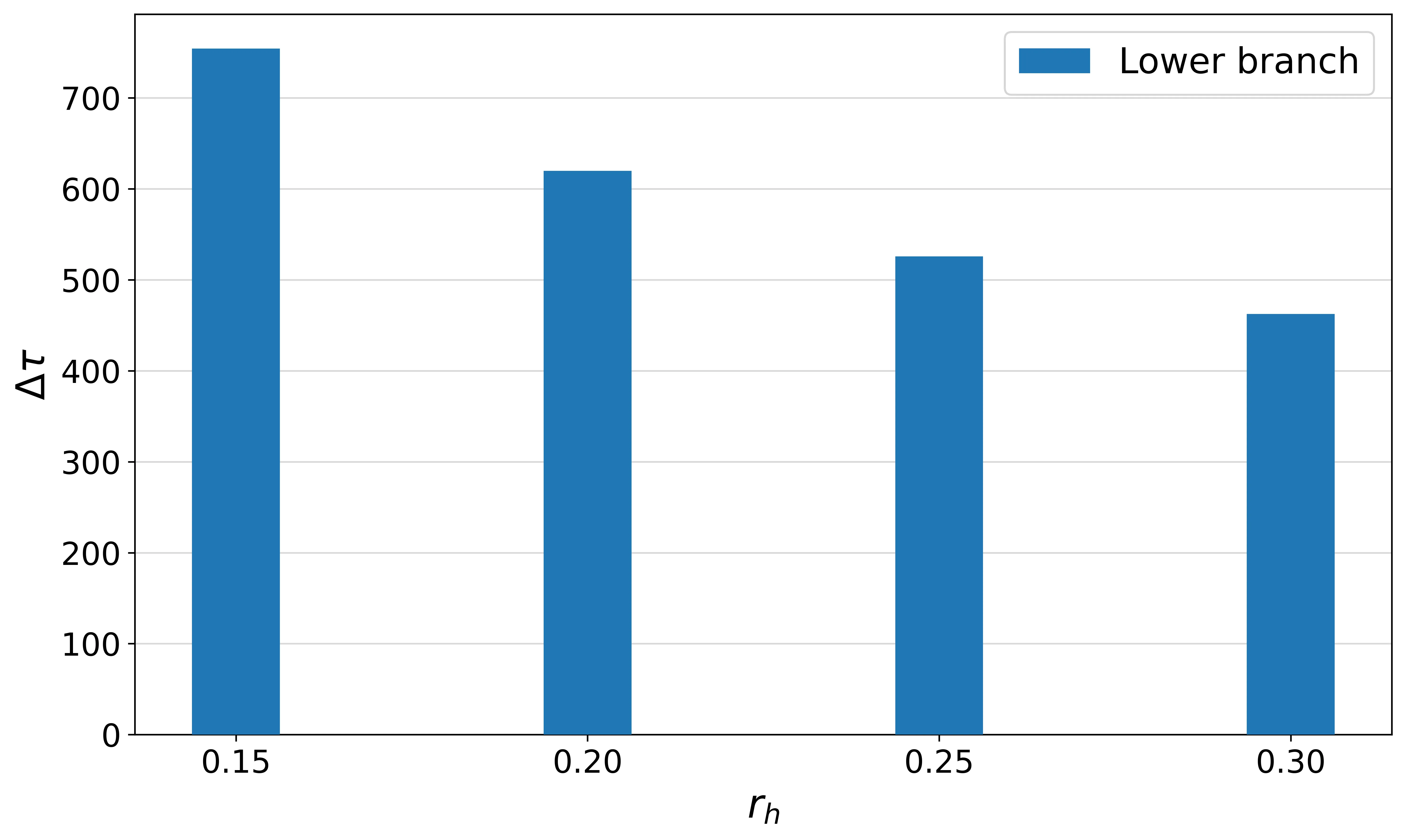
For a long time, calculations suggested such a structure could live forever — at least if you compress and expand it perfectly uniformly. But the moment you let the bubble become even slightly lopsided, everything goes haywire. In the new work, physicists simulated the full three-dimensional picture and saw two scenarios. In the first, the bubble bursts: the field tears off and flies away, leaving behind an ordinary black hole without hair. In the second, the field is entirely sucked inside, and the hole goes bald.
The key role was played by non-sphericity. Even a tiny asymmetry, like a dent on the side of the bubble, triggers a chain reaction. The field's energy flows into that dent, it grows, and eventually the whole structure collapses. The authors tested two different models of field self-interaction and found instability in both. This seems to be a general property: a black hole won't tolerate 'hair' unless it's perfectly combed from all sides.
So spotting such an object through a telescope is unlikely: it's far too finicky. But the very idea of a 'hairy' black hole has helped us better understand how strictly nature follows the rule: a black hole either sheds or swallows anything extra. It's like a soap bubble — beautiful while perfectly round, but it doesn't stay that way for long.
Original abstract
as written by the authors arXiv:2604.22437
Black holes with resonant hair are static, spherical, electrically charged solutions of the Einstein-Maxwell-(gauged-)scalar system. Scalar self-interactions are mandatory for their existence. Initial dynamical studies restricted to spherical symmetry suggested stability; more recently, fully non-spherical dynamical studies revealed instabilities, at least for a particular class of self-interactions. Here, we provide a more detailed study of this instability together with a different decay channel, depending on the chosen solutions. Moreover, considering a second model, we provide evidence that the instabilities may be generic for different classes of self-interactions. We conclude these solutions are dynamically unstable and split into a bosonic lump and a bald black hole (via fission) or implode to the latter (via absorption). In both cases, the non-spherical dynamics seems to be key.
Scalar fields are not just a theorist's invention. The Higgs boson, discovered in 2012, is a quantum of a scalar field. So 'hair' made of scalar field has quite real relatives in particle physics.
In Peter Watts's novel Blindsight, alien ships disguise themselves as black holes using exotic fields. The instability of 'hairy' holes hints that such a disguise would be extremely unreliable.