The Universe Sings: Resonance of Dark and Ordinary Matter express
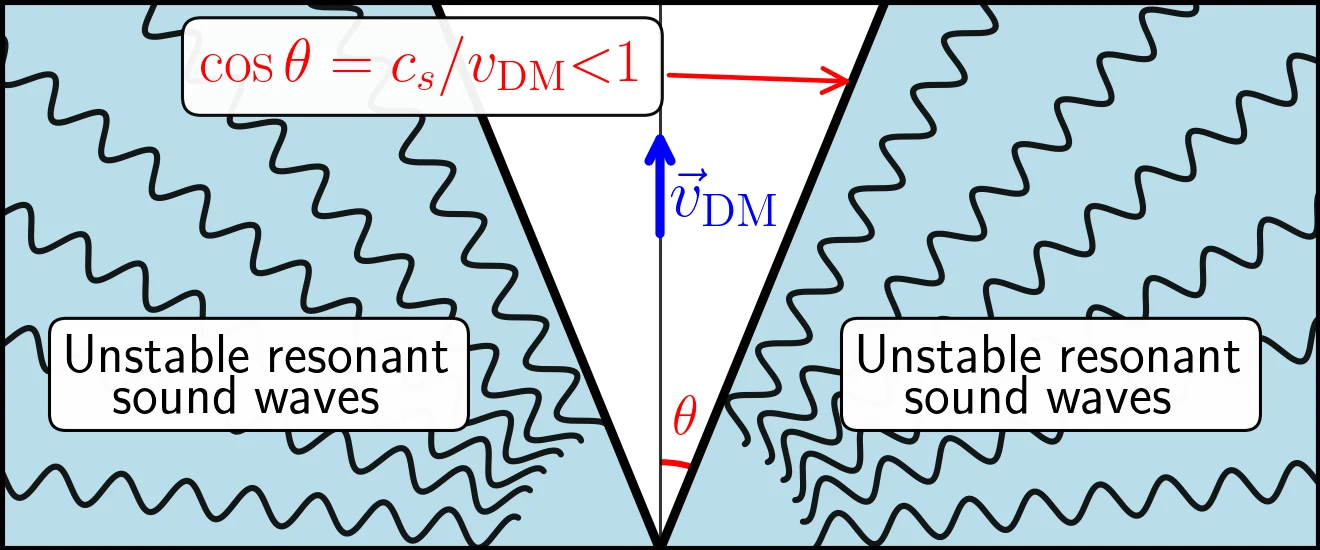
After the Big Bang, dark matter and ordinary matter (mostly hydrogen) went their separate ways in terms of speed. Their gravitational pull acts like a bow gliding across a string: when frequencies match, resonance occurs, and sound waves start to rapidly grow in ordinary matter.
This cosmic duet sounds everywhere and happens swiftly: from a few years to tens of millions of years — a mere blink compared to the life of galaxies. The discovery, building on the work of Fritz Zwicky and Vera Rubin, explains mysteries: why spiral arms don't fall apart and why gas in clusters is hotter. Thanks to the expansion of the universe, discovered by Edwin Hubble, dark matter is forever in motion, and its resonance is heard on all scales — from protoplanetary disks, where it heats up newborn planets, to galaxy clusters.
Original abstract
as written by the authors arXiv:2604.22665
Dark matter and baryons acquire a relative velocity after decoupling in the early Universe. Baryons are gravitationally unstable only above their Jeans scale, while cold dark matter (CDM) is unstable on all scales. We show for the first time that their relative drift triggers a resonant gravitational instability that drives sound waves in baryons. When the projected DM drift is subsonic, the stable oscillatory branch of baryons resonates with the Doppler-shifted DM mode, producing exponentially growing perturbations whose growth rates exceed the intrinsic CDM growth rate. The instability peaks below the baryon Jeans scale and, in baryon-dominated environments, opens a window of complete stability between the Jeans scale and the resonance. Supersonic drift suppresses growth, as previously noted. The resonant coupling also transfers momentum between the species, creating a non-viscous, collisionless drag. We derive an accurate analytical approximation for the growth rate at resonance and show that the associated timescales range from years to tens of millions of years across diverse environments -- planets, protoplanetary disks, stars, molecular clouds, galaxies, and galaxy clusters -- typically much shorter than their ages. In an expanding FLRW universe, the instability enhances baryon density perturbations at different redshifts for appropriately oriented modes while suppressing the growth of those aligned with the DM stream. The universe thus sings across all scales, and this resonant mechanism provides the means to listen: it offers a novel probe of dark matter through its seismic imprint on astrophysical objects and may explain long-standing puzzles such as the persistence of spiral arms and the heating of the intracluster medium in galaxy clusters.
Dark matter resonance may influence planet formation by heating protoplanetary disks around young stars.
The image of a 'singing universe' echoes science fiction, such as Arthur C. Clarke's novel 'The Songs of Distant Earth'.