Popular

The Universe Sings: Resonance of Dark and Ordinary Matter ⚡ экспресс

Original: "The Sound of the Universe: A Resonant Gravitational Instability Driven by Baryon-Dark Matter Relative Drift"
· Mohamad Shalaby, Avery Broderick
arXiv:2604.22665 · 2026-04-24 · CC BY 4.0 · ⏱ 1 min · Galaxies Cosmology Exoplanets Instrumentation Stellar
The difference in speeds between dark and ordinary matter creates a gravitational resonance that amplifies sound waves in space.
Abstract

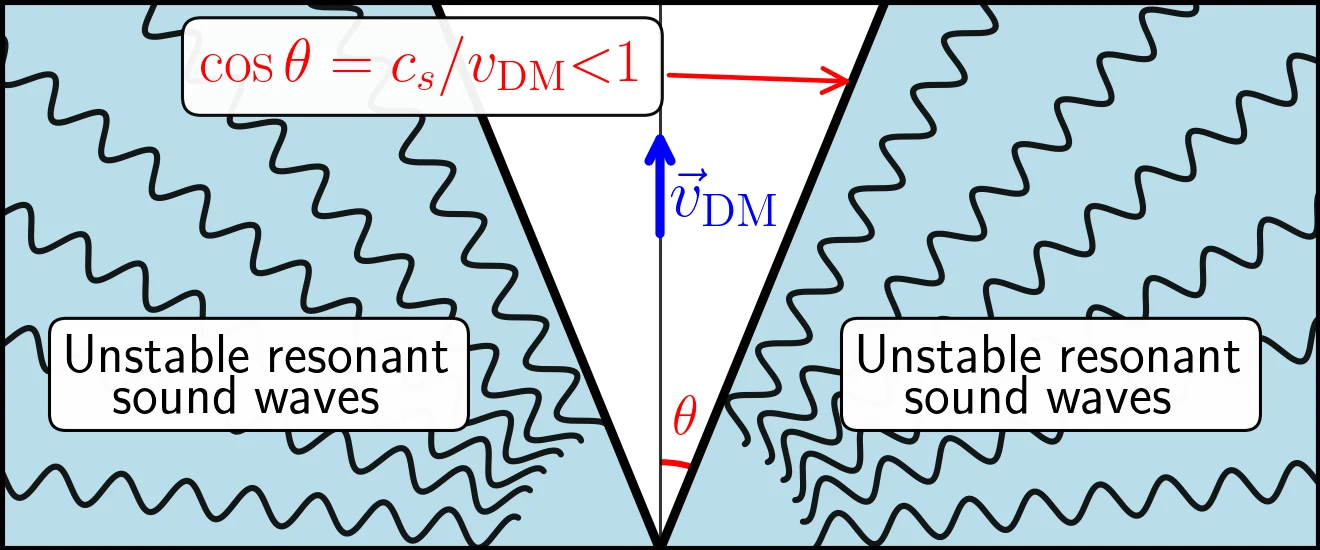
In the early Universe, after decoupling, dark matter and baryons (ordinary matter) acquired different velocities. It is shown for the first time that when their relative motion is slower than sound, a resonant gravitational instability occurs: sound waves in the baryons resonate with Doppler-shifted modes of dark matter, causing perturbations to grow exponentially—faster than standard clustering. This effect peaks on scales smaller than the baryonic Jeans length. Remarkably, the mechanism operates everywhere—from planets to galaxy clusters—making the Universe 'sing' and offering a new way to probe dark matter via its seismic imprint.

Links in the knowledge graph 1

📄 Showing the "Simple" version — "Popular" is not ready yet. Add it to favorites to help prioritize it.

After the Big Bang, dark matter and ordinary matter (mostly hydrogen) went their separate ways in terms of speed. Their gravitational pull acts like a bow gliding across a string: when frequencies match, resonance occurs, and sound waves start to rapidly grow in ordinary matter.

Like a tuning fork that makes another resonate, dark matter awakens waves in ordinary matter.

This cosmic duet sounds everywhere and happens swiftly: from a few years to tens of millions of years—a mere blink compared to the life of galaxies. The discovery, building on the work of Fritz Zwicky and Vera Rubin, explains mysteries: why spiral arms don't fall apart and why gas in clusters is hotter. Thanks to the expansion of the universe, discovered by Edwin Hubble, dark matter is forever in motion, and its resonance is heard on all scales—from protoplanetary disks, where it heats up newborn planets, to galaxy clusters.

🎯 Dark matter resonance may influence planet formation by heating protoplanetary disks around young stars.

🎬 The image of a 'singing universe' echoes science fiction, such as Arthur C. Clarke's novel 'The Songs of Distant Earth'.

Scientists
Alan GuthAndrei LindeGeorges LemaîtreJames PeeblesAdam RiessBrian Schmidt
Tags
dark matter big bang galaxy expansion of the universe hydrogen
Laws
Friedmann equationsHubble's lawgravitational lensingCoulomb's lawEinstein field equationsPlanck's law
Original: arXiv:2604.22665 · CC BY 4.0 · bridge42worlds