The rotation curves of galaxies — the speed at which stars orbit their galactic center — pose a long-standing puzzle. Observations show that stars in the outer regions move far faster than the visible mass alone can explain. Two competing explanations have emerged: dark matter, an invisible substance that provides the extra gravitational pull, and modified gravity, which posits that our theory of gravity itself needs adjustment on galactic scales. The debate is not merely academic; it touches on the very nature of the universe's composition and the validity of our fundamental physical laws.
History
The discrepancy was first noted by Fritz Zwicky in the 1930s for galaxy clusters, and later by Vera Rubin and Kent Ford in the 1970s for individual galaxies. Modified gravity was proposed by Mordehai Milgrom in 1983.
How it works
In the dark matter paradigm, galaxies are embedded in vast halos of unseen particles that interact gravitationally but not electromagnetically, adding the necessary mass to explain the observed rotation speeds. Modified gravity theories, such as MOND (Modified Newtonian Dynamics), instead propose that at very low accelerations — typical of galactic outskirts — the force of gravity behaves differently than Newton's law predicts, eliminating the need for unseen mass. Each approach makes distinct predictions for other phenomena, such as the distribution of matter in galaxy clusters or the cosmic microwave background, allowing for observational tests.
In practice
This debate drives the development of more precise astronomical surveys and gravitational experiments, influencing how we interpret data from telescopes like Gaia and the James Webb Space Telescope.
Fun fact
The name 'dark matter' was coined by Fritz Zwicky in 1933, but he called it 'dunkle Materie' in German, meaning 'dark matter'.
An interpreter gets distracted by every rustle in the hall, and a one-hour meeting stretches into two. A neutron star compresses a solar mass into a sphere the size of a city, and the matter in its core is denser than an atomic nucleus. Physicists cannot probe its structure in the lab: the required pressures are unattainable.
Think of a merry-go-round: the farther you sit from the center, the faster you're carried around. For a long time, astronomers assumed galaxies work the same way — stars at the edges should orbit more slowly than those near the center. But back in the 1970s, it turned out that in many spiral galaxies, the speed of stars barely drops with distance from the center.
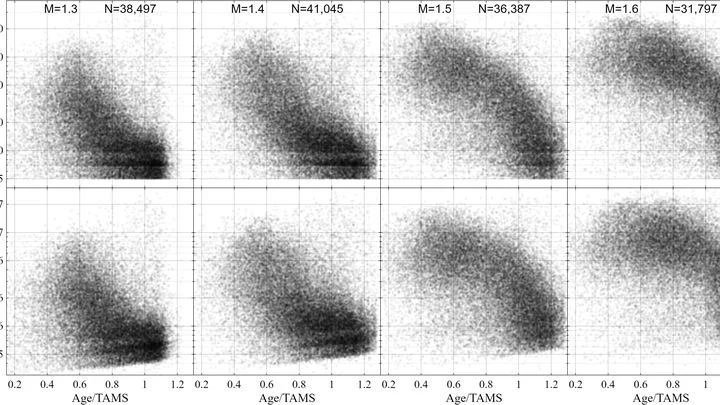
The most massive stars are like overinflated balloons: their envelope stops stretching and instead begins to furiously vent material. At a certain stage, the mass loss becomes so intense that the star stops growing in size. Astronomers see this moment as a kink in the diagram where stars are sorted by luminosity and temperature.
In August 2019, the LIGO and Virgo detectors picked up gravitational waves from the merger of two compact objects in a binary star. One weighed 23 solar masses — a standard black hole. The other came in at 2.5–2.67 M⊙.
In the depths of space, gravity is mastering the art of disguise. For a quarter century, astrophysicists have been trying to decipher the nature of dark energy, which makes the Universe expand at an accelerating rate.
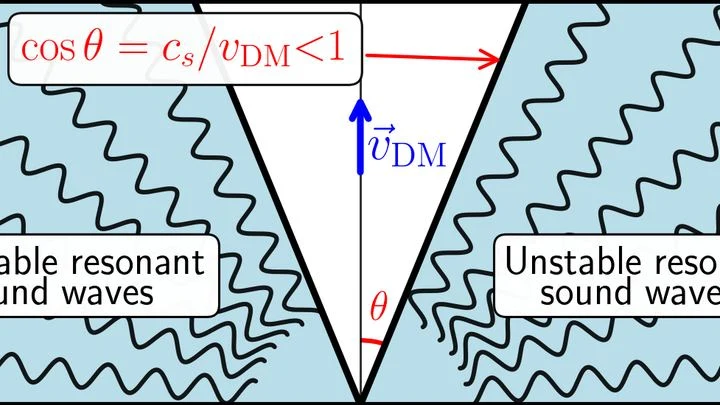
After the Big Bang, dark matter and ordinary matter (mostly hydrogen) went their separate ways in terms of speed. Their gravitational pull acts like a bow gliding across a string: when frequencies match, resonance occurs, and sound waves start to rapidly grow in ordinary matter.
In a large gas cloud where stars are born, the magnetic field lines are roughly aligned in one direction, like the fibers in a piece of felt. But look inside, into the dense clumps that will eventually become stars, and the picture changes: there the lines are twisted every which way, like a ball of yarn after a kitten has played with it.
Previously, astronomers calculated galaxy mass as if they were perfect spheres. But a galaxy is a flat pancake. The new 'Lost and Found' model takes the actual shape into account: it sums up the gravitational pull from all parts of the disk, not just the central bulge. The result is stunning: many galaxies need a third less invisible dark matter than previously thought.
When stars at the edges of galaxies rotate faster than calculations based on visible mass predict, standard cosmology invokes the hypothesis of hidden dark matter — invisible substance that reveals itself only through gravity. A new study offers an alternative that requires no new particles.
Stars on the outskirts of galaxies rotate unexpectedly fast. According to Newton, the farther from the center, the slower the motion should be, like in a round dance, where the outer dancers move more slowly. But in reality, stellar outskirts race along almost as fast as the core, resembling a giant carousel: on it, the outer horses fly faster so as not to fall behind the inner ones.
A galaxy is like a giant merry-go-round: stars and gas whirl around the center, and their speeds reveal how much stuff is on the ride. If we only saw the luminous matter, the outer parts would spin slower than observations show. So there must be invisible mass, dark matter, that holds the galaxy together.
At the center of our Galaxy lies a supermassive black hole, with stars orbiting around it. Their motion resembles a cosmic dance: some race along elongated orbits, others follow nearly circular paths. If invisible dark matter exists near the black hole, it slightly distorts these orbits, like an unseen hand nudging a star off course.
The Gaia space telescope has measured how fast more than a hundred thousand stars spin. It turns out that a star's rotation speed depends on its temperature. For stars cooler than 6500 degrees, the surface moves at 10–20 kilometers per second.
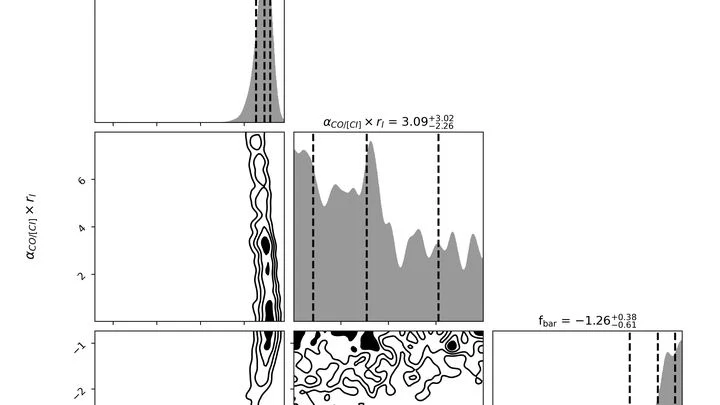
Three distant galaxies spin like giant carousels. Their stars and gas move along spiral arms, and from the speed of this motion you can calculate how much total matter the galaxy contains — visible and invisible.
Astronomers combined two views: radio telescopes revealed cold gas, while the James Webb Space Telescope showed the stars.