The Edge of Time: How an Instant Turns a Quantum into a Frozen Wave express
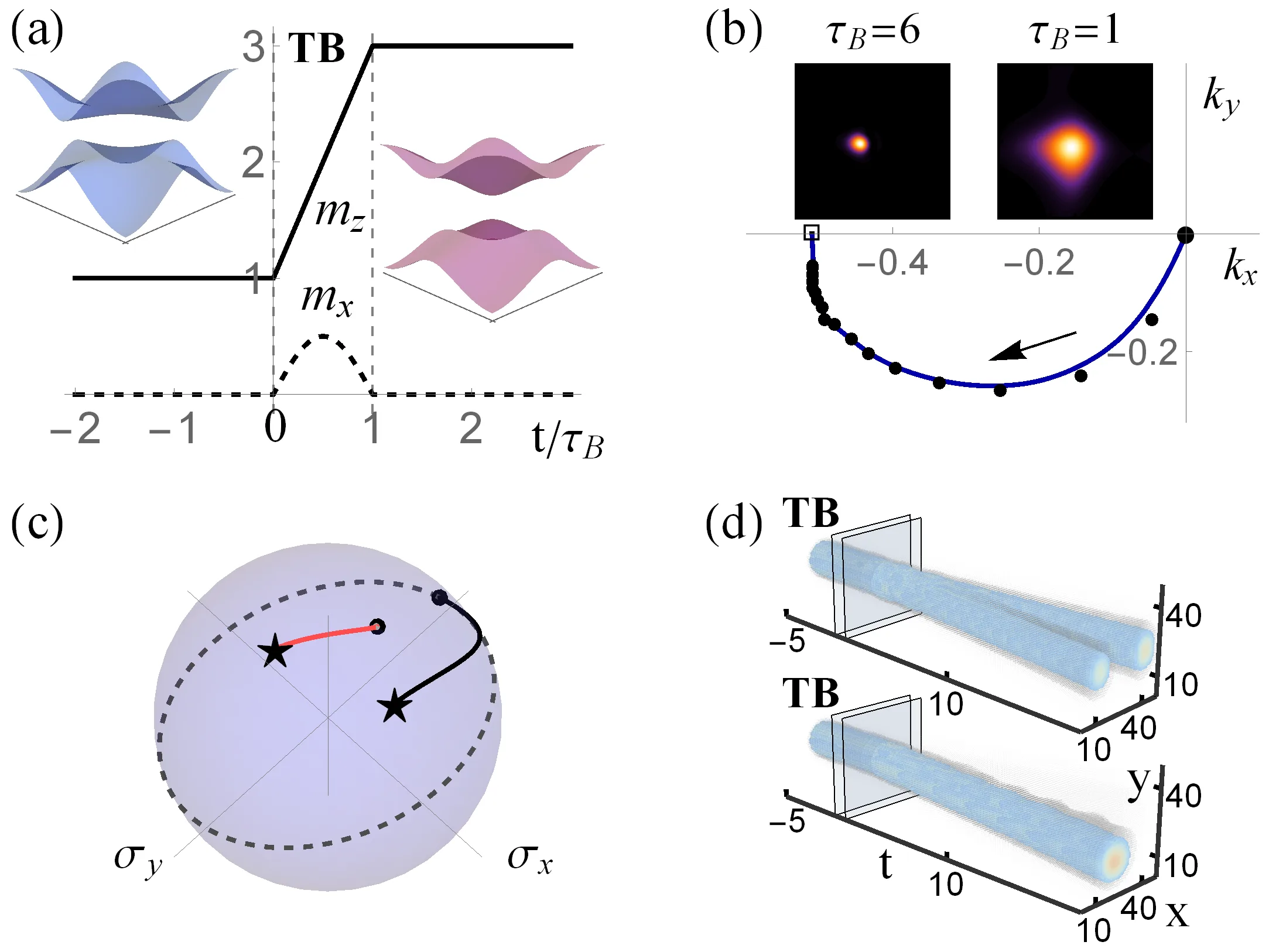
A stone falls into a pond, and ripples spread across the water. They reflect off the shore, overlap, and die out. All this motion unfolds in space. But what if the pond itself changed its depth or density for an instant — not at one point, but everywhere at once? A temporal boundary is exactly such a jump in properties over time, not space. The authors of the work built a mathematical tool that describes the behavior of quantum particles at these boundaries.
Previously, physicists were adept at calculating scattering at spatial interfaces — for example, how light refracts when passing through glass. The main tool there is the scattering matrix, a table of numbers that relates incoming and outgoing waves. The researchers transferred this idea to temporal boundaries. They introduced a temporal scattering matrix and found its special points, poles, which they called topological resonant transmissions. At these points, a particle completely transitions from one energy state to another, and its quantum state freezes. Time for it seems to stop.
The most unexpected finding came when testing stability. In even-dimensional worlds (for example, on a plane) these resonances are robust: they cannot be destroyed by smooth changes or disorder. But in odd-dimensional ones, such as our three-dimensional space, the slightest symmetry breaking can destroy them. This resembles the behavior of a knot in a rope: in some dimensions it unties itself, in others it holds fast.
A temporal boundary can be created in the laboratory by abruptly changing the refractive index of a material with a laser pulse. Light passing through such a medium experiences 'temporal reflection' and changes frequency.
In Kurt Vonnegut's novel 'Slaughterhouse-Five', the protagonist 'unsticks' from time and experiences moments of his life out of order. Topological resonant transmissions are a distant but real physical analog of such freezing.