Simple

Tunnels in Space: How Shadows Give Them Away

Original: "Dynamics and Radiative Signatures of Accretion Flows onto a Kerr-like Wormhole"
arXiv:2605.04631v1 · 2026-05-06 · CC BY · ⏱ 1 min · High Energy General Relativity HEP Theory
Gas falling into a [tag:wormhole]wormhole[/tag] creates a unique shadow and rhythmic glow, unlike a [tag:black_hole]black hole[/tag].
Abstract

Wormholes are hypothetical tunnels in spacetime. Scientists simulated on a computer how magnetized gas falls onto a rotating wormhole. It turned out that its throat (the narrowest part) emits nearly periodic pulses, like a cosmic lighthouse — unlike black holes. This could be the key to detecting wormholes.

Links in the knowledge graph 1

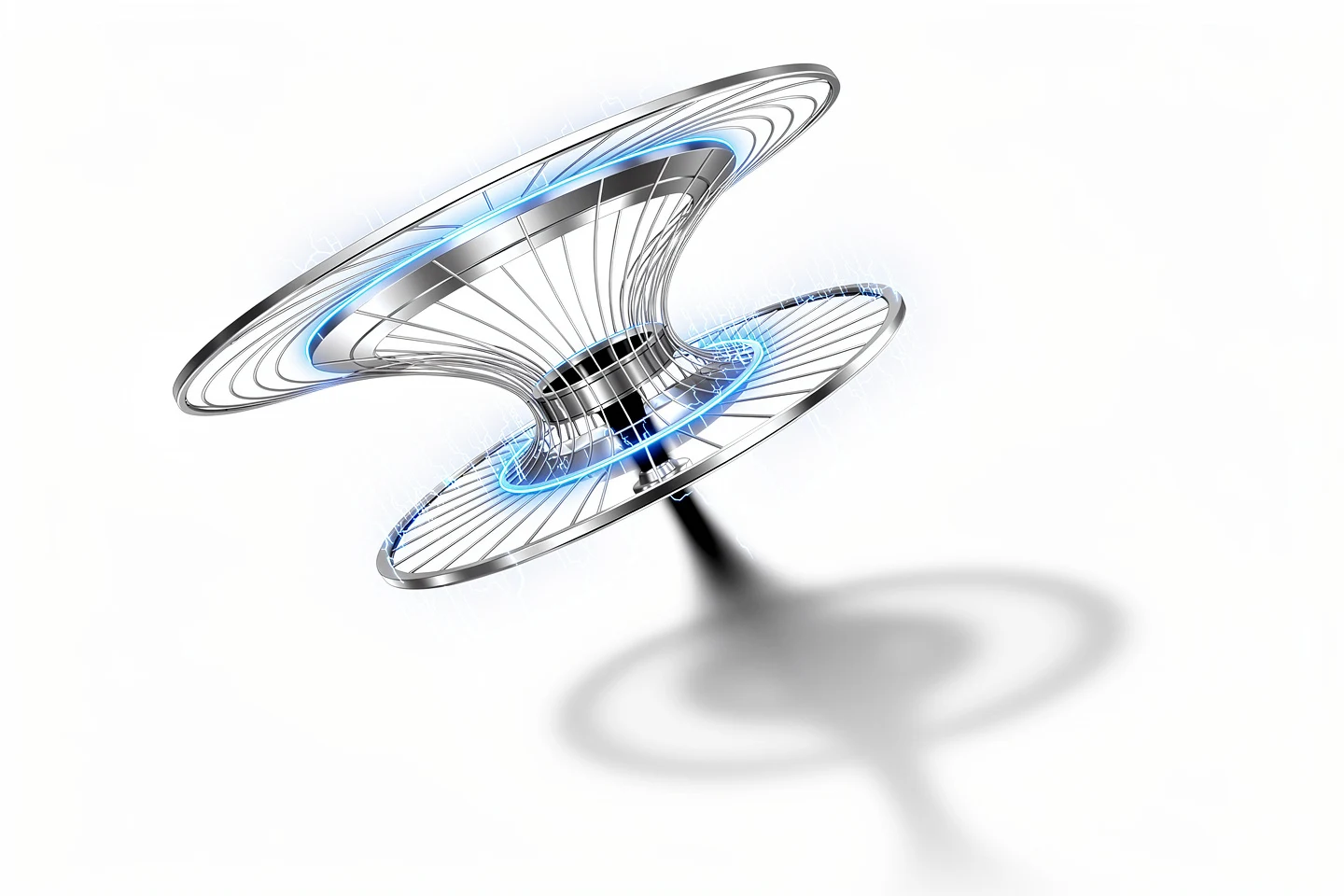
Water going down a kitchen sink drain swirls into a funnel. If the drain leads to another pipe, the flow churns at the narrow point. Gas falling into a wormhole — a tunnel connecting two edges of the Universe — behaves the same way. Computer simulations show: superheated plasma (ultra-hot gas) piles up at the wormhole's 'throat,' forming a shadow with an extra bright spot — as if a ring has a bulge.

The term 'wormhole' was coined by physicist John Archibald Wheeler in 1957. The idea of such tunnels emerged shortly after Einstein formulated the theory of gravity.

The big surprise: this clump of gas makes the wormhole 'blink' — its brightness rhythmically changes every few minutes. Radio telescopes observing the centers of active galaxies can catch this flickering. Even from afar, the curvature of space around the throat reveals itself through the shadow's unique geometry and pulsation — a clear sign that we're looking not at a black hole, but a portal.

🎯 The idea of a wormhole as a bridge between universes first emerged with Ludwig Flamm in 1916, just a year after Einstein published his general theory of relativity. The term itself only appeared in 1957, courtesy of John Wheeler.

🎬 In 'Interstellar,' the wormhole was shown as a sphere; calculations confirm we would notice its shadow and flicker.

ds^2 = -\!\left(1 - \frac{2M}{\sqrt{r^2+\ell^2}}\right) dt^2 + \left(1 - \frac{2M}{\sqrt{r^2+\ell^2}}\right)^{-1} dr^2 + r^2 d\Omega^2
Metric of a static wormhole with throat parameter ℓ. Unlike a black hole, there is no horizon—at r=0, space does not collapse but transitions to the other mouth.
P \approx 2\pi \sqrt{\frac{r^3}{GM}}
Approximate period of orbital motion for plasma at radius r (near the throat). For r on the order of a few gravitational radii, this yields minutes to hours for supermassive objects, matching the quasi-periodic oscillations in the simulations.
Scientists
Stephen HawkingJacob BekensteinAlbert EinsteinFritz ZwickyVera RubinBernhard Riemann
Tags
Wormhole black hole Accretion disk spacetime curvature gravity numerical simulation radio astronomy plasma active galactic nucleus
Laws
Hawking radiationgravitational lensingBekenstein-Hawking entropyEinstein field equationsequivalence principlevirial theorem
Original: arXiv:2605.04631v1 · CC BY · bridge42worlds