Shadows of Wormholes: Accretion, Photon Rings, and Flickering ✛ ✎ ✦
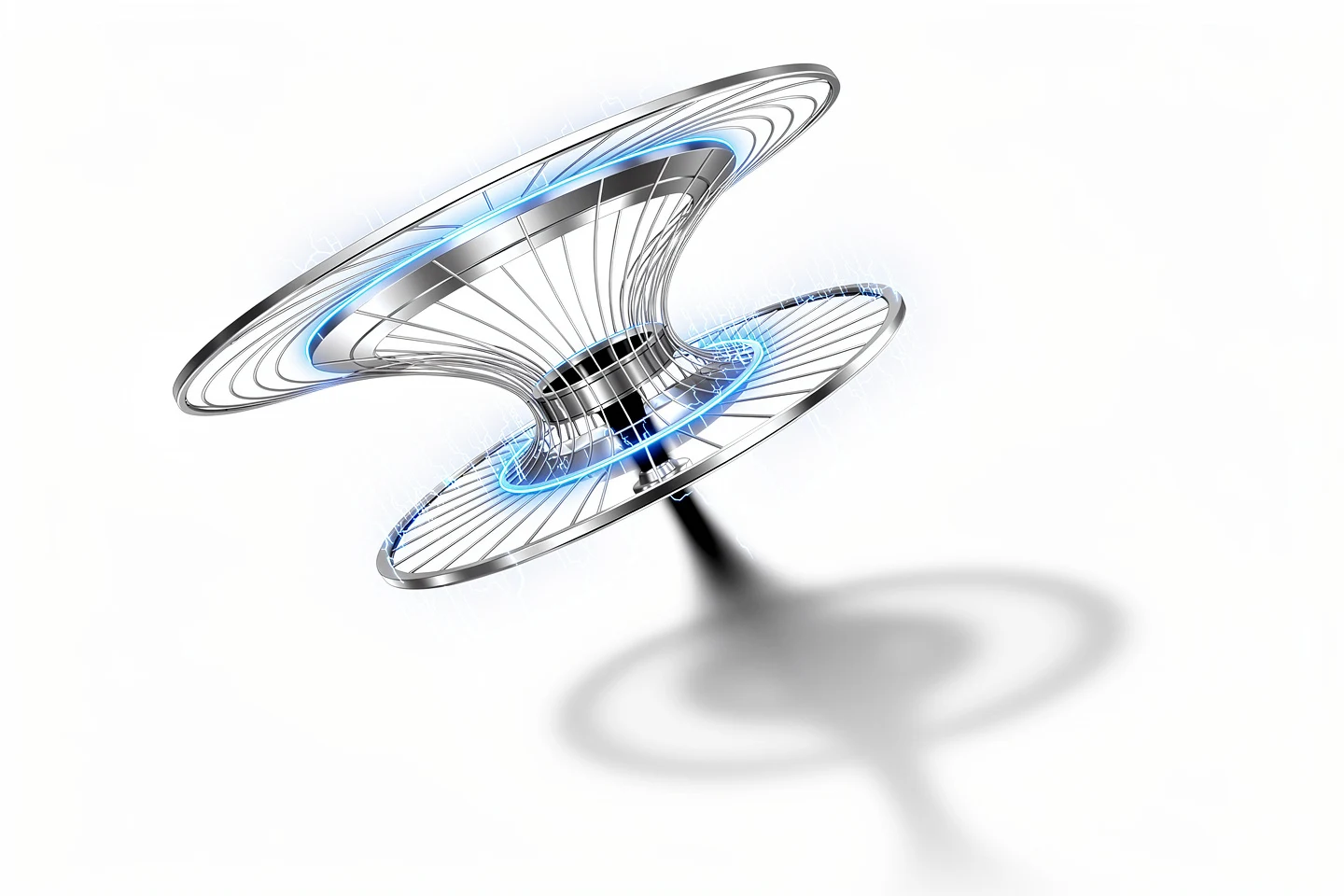
Context
Direct images of the 'shadows' of supermassive compact objects, obtained by the Event Horizon Telescope for M87 and Sagittarius A*, have opened a new era in testing theories of gravity. But what if these objects are not classical Kerr black holes? Alternative solutions to Einstein's equations, such as traversable wormholes, can mimic black holes yet leave observable traces. Studying how accreting plasma behaves in such curved spacetimes is key to deciphering the nature of supermassive central bodies in active galactic nuclei.
Methods
To find out, the scientists performed three-dimensional simulations within the framework of general relativistic magnetohydrodynamics (GRMHD) for the Kerr-like black-bounce metric, which describes a wormhole with a throat parameter ℓ = 2.5 M and spin a from 0 to 0.9. The accretion flow was initialized as a magnetized accretion torus at one mouth, while the opposite mouth was empty. Then, using the RAPTOR code, they carried out radiative transfer and constructed images that can be compared with 230 GHz observations.
Results
The simulations showed that mass accumulates near the wormhole throat due to a saddle point in the effective potential: the matter flow through mouth A (inflow) systematically exceeds the flow through mouth B (outflow). Although the global accretion structure resembles a black hole, spin noticeably influences the magnetization: at high a, the toroidal magnetic field is amplified by frame-dragging – a manifestation of spacetime curvature – which leads to a more extended and strongly magnetized outflow region. In shadow images, the behavior of higher-order photon rings was key. For moderate spin (a=0.3), the critical curve consists solely of the 'Kerr' branch, while for rapid rotation (a=0.9), an additional 'throat' branch appears, distorting the left side of the shadow – this is in good agreement with analytical calculations. Moreover, the light curves reveal quasi-periodic oscillations with a period of about ~100 GM/c³, which are linked to vertical epicyclic motions of plasma in the potential well near the throat. It is worth noting that the term 'wormhole' was coined by John Archibald Wheeler in 1957.
Implications
These results mean that by combining the analysis of fine photon ring structure with timing variability characteristics, astronomers can obtain decisive evidence for or against wormholes. Even if the overall accretion picture resembles a black hole, the throat leaves an 'imprint' in the form of bright matter accumulation at the center and a distinctive shadow geometry, governed by gravity.
Future development
Future studies should include simulations with variable throat parameters and higher resolution using numerical methods, as well as consider the magnetically arrested disk (MAD) regime, where magnetic fields are much stronger. This could alter outflow dynamics and the observable properties of wormholes.
Impact
The work directly impacts the interpretation of data from the Event Horizon Telescope and future submillimeter observations, as well as fundamental physics, as it necessitates the study of exotic plasma and spacetime geometry.
Next steps
Next steps include polarized radiative transfer and comparison with actual EHT observations, as well as searching for similar signatures in other candidates, such as the active nucleus of M87.
Key open problems
The study connects to unsolved problems in quantum gravity and the nature of singularities: wormholes offer an alternative without an event horizon, but they require violation of standard energy conditions by matter, which has not yet been confirmed in particle physics. As Wheeler noted, such objects challenge our understanding of spacetime structure.
The knowledge machine's view
This section is addressed to the author of the paper and their colleagues. Neighbouring works were found by meaning-based search across our archive, not by word overlap. We do not review: we show the field around the work.
What the work does
The study models accretion onto a black-bounce wormhole within the framework of GRMHD, produces images at 230 GHz, and analyzes photon rings and light curves. It shows that for rapid rotation, an additional branch of the critical curve appears, and the emission exhibits quasi-periodic oscillations with a period of ~100 GM/c³.
Where its strength is
The strength lies in combining self-consistent plasma simulations with observational predictions: it identifies specific differences from a black hole (an extra photon ring branch, characteristic oscillations) that can be searched for in data.
Where it could go next
- One could compare the predicted images and light curves with those of alternative exotic objects, such as white holes: there is a paper in the archive on how a white hole appears through a telescope lens, which would allow a comparison of observational signatures of different solutions.based on: A White Hole in the Lens: What the Telescope Will See arXiv:2607.20945
- It would be interesting to test how a dark matter environment affects accretion and emission from a wormhole: nearby there is an analysis of a black hole in a dark matter cocoon, showing how such a cloud alters dynamics and observational manifestations.based on: Black hole in a dark matter cocoon arXiv:2608.05861v1
- It might be useful to compare the shadow shape and photon rings with predictions for black holes in modified gravity theories: the archive contains a paper where the black hole shadow is used as a probe of unknown gravity, which could provide additional context for interpreting the differences.based on: A Black Hole's Shadow as a Mirror of Unknown Gravity arXiv:2606.15727
Worth trying
- Perform similar simulations for a white hole metric and compare shadow shapes and light curves.
- Include a toroidal dark matter cloud in the initial conditions and trace its effect on accretion and emission.
- Compute images for several alternative gravity theories and look for invariant wormhole signatures.
Why this may matter
If observational signatures of wormholes can be clearly distinguished from those of black holes and other exotic objects, this would provide a direct way to test the nature of supermassive compact objects using Event Horizon Telescope data and future observations.
Nearby works in our archive
- Dark Matter Around a Black Hole: A Torus-Shaped Cloudsimilarity 0.68
- The Quiet Phantom Before a Black Hole Ringssimilarity 0.67
- Invisible Conductors of Galactic Diskssimilarity 0.66
- A Charged Black Hole Changes the Lifetime of a Particle Cloudsimilarity 0.66
- Black hole in a dark matter cocoonsimilarity 0.66
- A White Hole in the Lens: What the Telescope Will Seesimilarity 0.66
- A Black Hole's Shadow as a Mirror of Unknown Gravitysimilarity 0.65
The closest work in the archive sits at 0.68 by meaning — the usual level for our corpus.
The idea of a wormhole as a 'bridge' between two universes was first proposed by Ludwig Flamm in 1916, just a year after Einstein published his general theory of relativity. The actual term 'wormhole' came later, in 1957, coined by John Archibald Wheeler.
In the movie 'Interstellar', a wormhole is depicted as a sphere that allows instantaneous travel to another galaxy. Although the film's consultants used real Einstein equations, modern simulations show that the throat of such a wormhole would collect hot plasma, and its shadow could tell us about the geometry of spacetime.
Key numbers
- Throat parameter ℓ: 2.5 M
- Spin a: 0, 0.3, 0.9
- Period of quasi-periodic oscillations: ~100 GM/c³ (≈4 min for Sagittarius A*)
- Mass of Sagittarius A*: 4.14×10⁶ M☉
- Observation frequency: 230 GHz