Simple

Mysterious twist of ancient light: a solution without axions

Original: "CMB Birefringence from Vacuum Interfaces"
· Nemanja Kaloper
The observed twist of ancient light explained by pure geometry — without invoking hypothetical particles.
Abstract

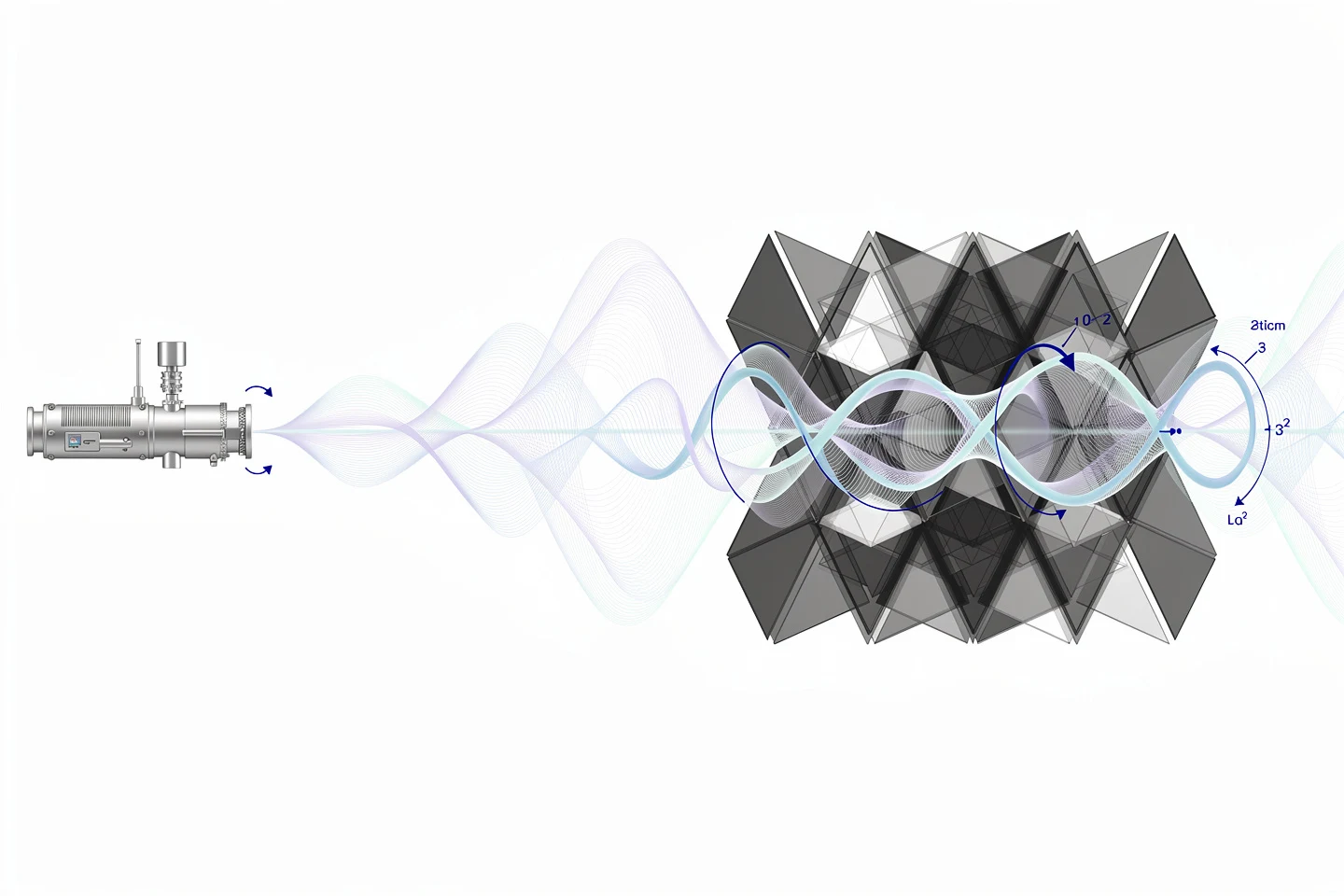
Ancient light from space is slightly twisted. It used to be thought that this was due to ultra-light particles, but new research suggests a different mechanism: the vacuum structure itself can rotate polarization when photons pass through its hidden seams — as if stepping onto an invisible rotating platform. This twist helps feel out the hidden architecture of the Universe.

Links in the knowledge graph 1

The light left over from the Big Bang — the cosmic microwave background — is like a giant ribbon threading through the cosmos. It oscillates in a single plane, but astronomers noticed that this plane is slightly twisted over billions of years. The previous explanation required hypothetical particles axions, going beyond the Standard Model, but they haven't been found. A new approach shows: the twist arises naturally when the ribbon of light crosses invisible boundaries in dark matter. Each crossing gives a tiny rotation — a purely geometric effect, independent of the ribbon's color. Whether radio waves or gamma rays, the twist is the same. This effect is known as a geometric phase and needs no new particles. Such a mechanism allows us to study the hidden structure of the universe. Future polarization measurements of the sky will test the idea, while computer models will link it to the expansion of the universe. As Wheeler foresaw, the geometry of space itself governs light. The works of Maxwell and Lorentz on electromagnetism laid the foundations, and now perhaps string theory will find echoes here.

🎯 The effect that explains this cosmic mystery was discovered back in 1956 for ordinary light in crystals — and now helps us understand the structure of the Universe.

\Delta\vartheta = \frac{\zeta q}{6}
Rotation of the linear polarization plane upon crossing an interface, expressed via the effective coupling constant ζ and the membrane charge q.
\zeta(k) \simeq \frac{\zeta(0)}{1 + k^2/M^2}
Suppression of the interaction at photon momenta k exceeding the cutoff scale M, due to integrating out heavy degrees of freedom.
Scientists
Alan GuthAndrei LindeGeorges LemaîtreJames PeeblesAdam RiessBrian Schmidt
Tags
cosmic microwave background axion polarimetry electromagnetism dark matter expansion of the universe Standard Model Quantum Field string theory numerical simulation
Laws
Friedmann equationsHubble's lawgravitational lensingNoether's theoremPlanck's lawPlanck–Einstein relation
Original: arXiv:2605.11065v1 · CC BY · bridge42worlds