Polarization Rotation of the Cosmic Microwave Background: Geometric Phase at Vacuum Boundaries ✛ ✎ ✦
Context
Searching for the cosmic microwave background with an anomalous rotation of its polarization plane is a key challenge in observational cosmology. Such birefringence would be a ‘smoking gun’ for physics beyond the Standard Model. Conventional explanations rely on ultralight axions with masses m ≲ $10^{-28}$ eV that adiabatically rotate photon polarization via field evolution on scales of cosmic expansion. However, stringent limits on such particles and dependence on cosmological history make this picture problematic. This study shows that the same observational signal can arise not from field dynamics but from the vacuum topology of the dark sector, radically shifting the paradigm.
Methods
The author constructs a low-energy effective theory coupling electromagnetism to an axion-like field and a topological 4-form sector, generalizing Maxwell’s equations. Two regimes are considered: adiabatic (thick axion domain walls) and the axion-decoupling regime, where the walls become vanishingly thin. In the latter case, photon–wall interaction is described by an exact Lippmann–Schwinger equation accounting for reflection and transmission. Symmetry considerations supplement the analysis: the transition between vacua is controlled by a conserved 1-form symmetry, and the Chern–Simons operator’s normalization on the wall is fixed by descent from a five-dimensional topological term. This approach reveals the geometric nature of the phase, independent of the defect’s microscopic thickness, and traces back to pioneering work on polarization by Lorentz.
Results
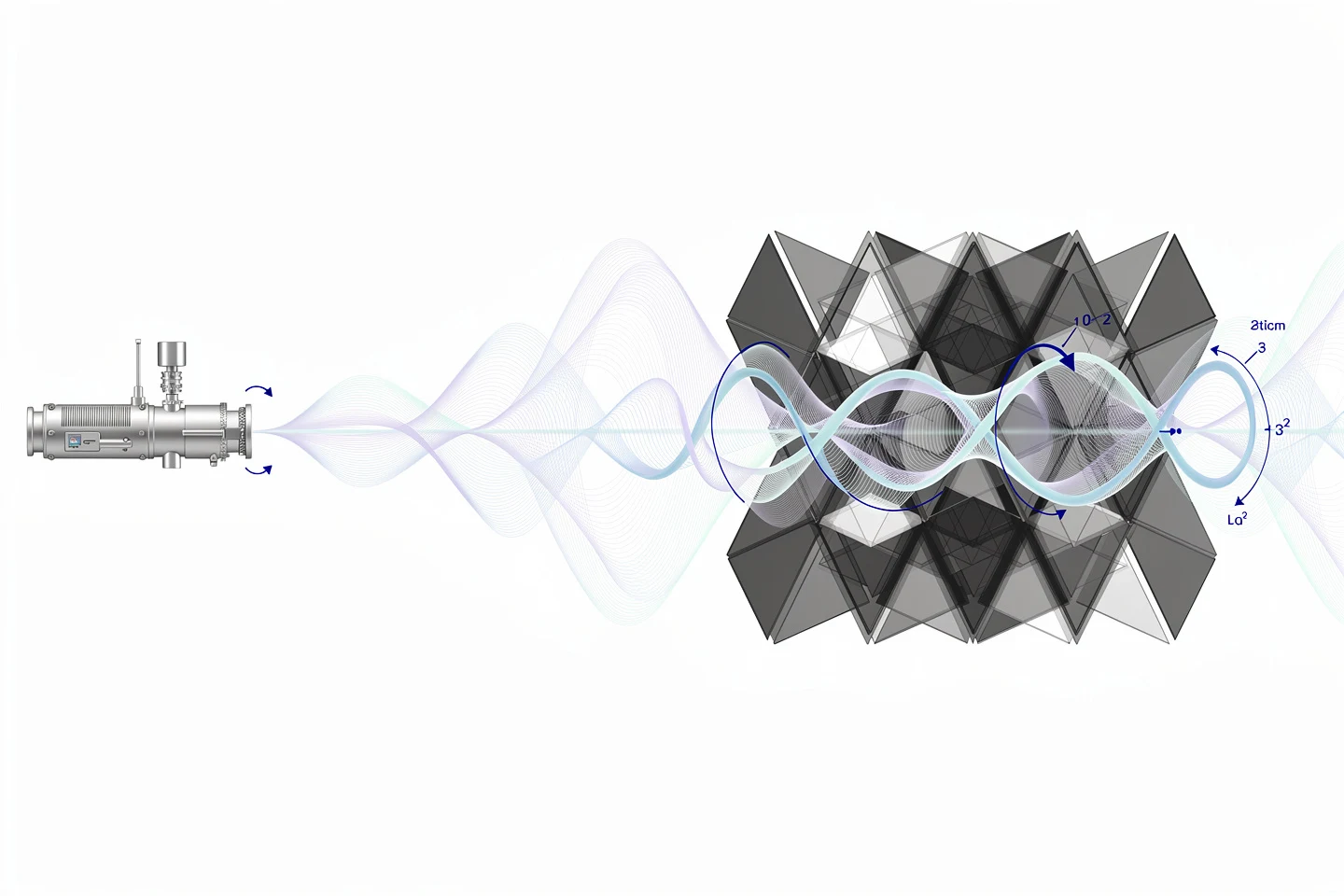
It is found that upon crossing a thin wall, a linearly polarized wave undergoes a discrete rotation of the polarization plane by an angle Δϑ = ζq/6, where ζ is the effective coupling constant and q is the topological charge of the membrane. For typical parameters, ζq/6 ~ a few × $10^{-3}$, matching observational hints. The solution shows that the phase is independent of photon frequency below the cutoff scale M, because the power-law dependence on ω in the Chern–Simons operator and the Green’s function cancels out. At high frequencies (comparable to M), the coupling is suppressed as ζ(k) ~ (1+$k^2$/$M^2$)^{-1}, and the rotation vanishes—the wall becomes transparent. The effect is interpreted as a Pancharatnam geometric phase extracted from the overlap of polarization states on both sides of the defect. In the adiabatic limit, the standard axion result is recovered, but it emerges as a special case of a more general topological mechanism.
Implications
The results shift the focus from searching for ultralight particles to studying the vacuum structure of the Universe. Polarization rotation becomes an indicator of discrete transitions between topologically distinct states of the dark sector, linking observational cosmology with non-perturbative physics. In particular, this opens the possibility of testing higher-form symmetries, which play a central role in modern string theory constructions. As Wheeler emphasized, the topology of ‘inner space’ can have observable consequences, and this work is a step toward their detection.
Future development
Next-generation experiments—CMB-S4, LiteBIRD—will measure polarization sky maps with high precision, enabling tests of the model’s predictions. A key task will be spectral analysis: the frequency-independence of the angle over a broad range will become the ‘calling card’ of this mechanism. There will also be a need for numerical simulations of the formation and evolution of domain wall networks, consistent with cosmological constraints, including the observed expansion rate of the Universe.
Impact
The proposed mechanism will impact the interpretation of CMB polarimetry data, as well as searches for axion-like particles and studies of Faraday rotation in astrophysical sources. It will stimulate the development of theories with topological defects in the dark sector.
Next steps
Immediate next steps include a detailed quantum-mechanical description of sequential crossings of multiple walls and an analysis of dissipative effects. It is also important to investigate whether similar phases can arise in laboratory analog systems, such as metamaterials.
Key open problems
The work addresses the fundamental problem of the composition and symmetries of the dark sector, offering a new criterion for distinguishing models. It also sheds light on the connection between CP violation in the early Universe and observed polarization, and raises the question of whether vacuum topology could influence the evolution of the Universe as a whole.
The knowledge machine's view
This section is addressed to the author of the paper and their colleagues. Neighbouring works were found by meaning-based search across our archive, not by word overlap. We do not review: we show the field around the work.
What the work does
The paper proposes a new mechanism for the polarization rotation of the cosmic microwave background: a geometric phase acquired when a photon crosses topological domain walls in the dark sector. The author constructs an effective theory with a 4-form sector and an axion-like field, solves the Lippmann–Schwinger equation for a thin wall, and shows that the rotation of the polarization plane is discrete and frequency-independent below the cutoff scale. The result is interpreted as a Pancharatnam phase, and in the adiabatic limit the standard axion scenario is recovered.
Where its strength is
The strength of the work lies in shifting the explanation of polarization rotation from the dynamics of ultralight fields to vacuum topology, which removes the dependence on cosmological history and opens a new observational channel for probing the structure of the dark sector.
Where it could go next
- It might be interesting to compare the predictions for the frequency dependence of rotation with observational constraints from CMB polarization surveys.based on: Cosmic Light Changes Polarization arXiv:2608.05296v1
- A related approach connects polarization effects with gravitational lensing; one could explore how topological walls affect correlations between rotation and lensing maps.based on: Light Twists in the Universe's Lens arXiv:2605.16945
- One could also study a similar mechanism near compact objects, where strong fields might amplify the effect and make it observable.based on: A Black Hole in Polarized Glasses arXiv:2607.10658
Worth trying
- Test whether the proposed mechanism predicts a correlation between anomalous rotation and the large-scale structure distribution, which could be searched for in Planck data or future experiments.
- Consider how multiple wall crossings along the line of sight combine into a net rotation, and compare with the observed isotropy of the signal.
- Investigate whether the geometric phase could affect the polarization of radiation from neutron stars or accretion disks, where magnetic fields and dense media might create analogous topological defects.
Why this may matter
If the proposed mechanism is realized, polarization rotation becomes a direct probe of the discrete vacuum structure of the dark sector, potentially providing the first observational evidence of topological transitions in the early Universe and constraining models with multiple vacua.
Nearby works in our archive
- The Universe Puts String Theory to the Testsimilarity 0.71
- Blurred Light from Neutron Stars Reveals Their Spin Ratesimilarity 0.67
- Light Twists in the Universe's Lenssimilarity 0.67
- Cosmic Light Changes Polarizationsimilarity 0.67
- Cosmic Dust Reveals the Anatomy of Magnetic Ripplessimilarity 0.65
- Cosmic Pendulum and Extra Heatsimilarity 0.65
- A Black Hole in Polarized Glassessimilarity 0.64
The archive is crowded around this work: 4 reviews nearby, closest at 0.71. This ground is well walked — and there is plenty to compare against.
The Pancharatnam phase, discovered in 1956 by Indian physicist Sivaramakrishnan Pancharatnam for ordinary optical media, turns out to be key to a cosmological signal. Remarkably, even if the domain walls vanished long before the present era, their imprint on the CMB polarization remains forever.
Key numbers
- rotation angle: ~10-3 rad
- ultralight axion mass (limit): ≲ 10-28 eV
- wall thickness (for mϕ~10^{-4} eV): ~1 mm
- cutoff scale M: determined by the topological susceptibility X^{1/4}
- constant ζq/6: ~10-3