Lunar detector to hear ancient black holes express
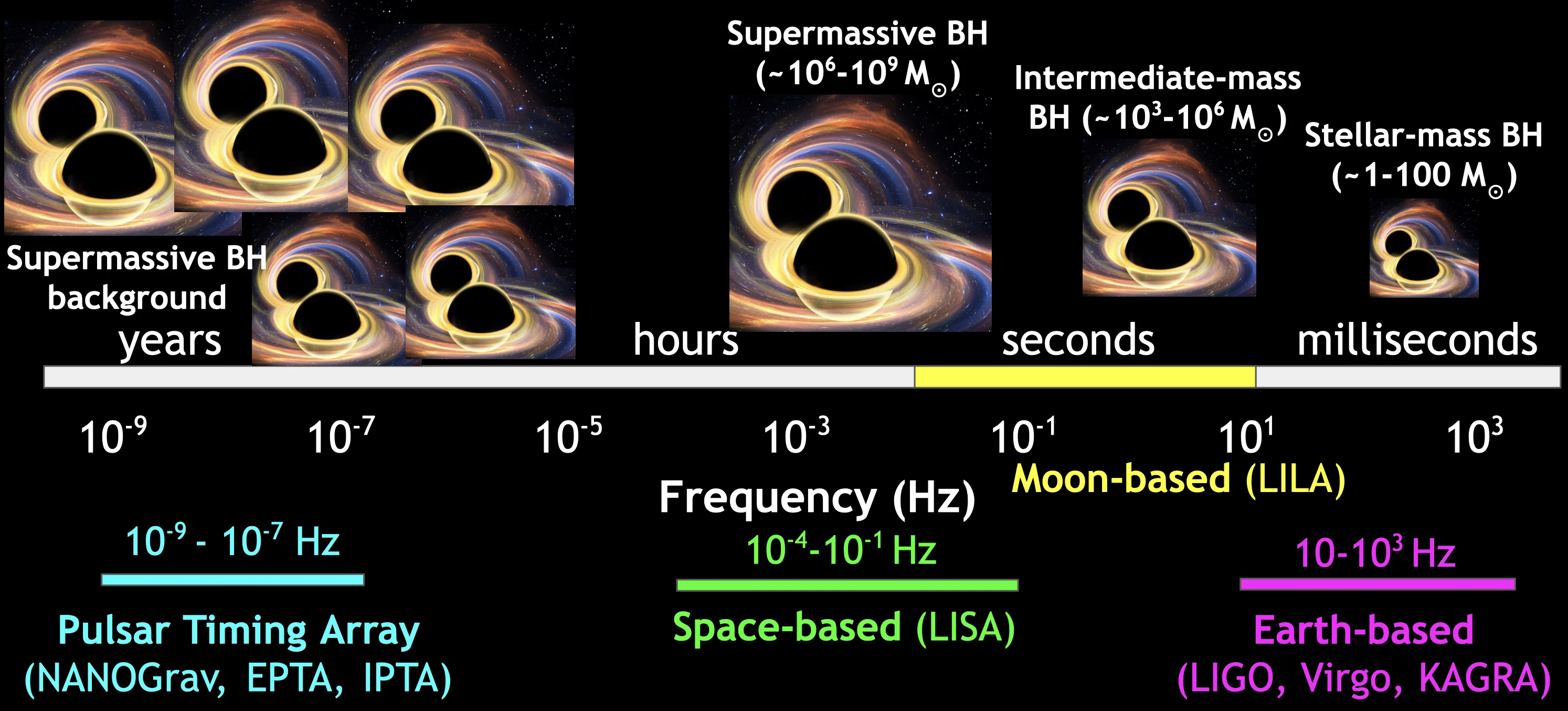
Gravitational waves are ripples in the fabric of space, like circles on water from a thrown stone. On Earth, they are drowned out by traffic, tides, and earthquakes, like a storm beating on a lake, making it impossible to notice faint splashes. The LILA project moves the detector to the Moon, where windless silence reigns. There, even the weakest wave from merging black holes will show up clearly.
The instrument targets intermediate-mass black holes — objects from hundreds to millions of suns, which scientists have yet to see. Their collisions will tell how galaxies grew after the Big Bang. LILA will sense the hum of an upcoming merger months before the finale and send a signal to telescopes around the world. For the first time, the birth of a supermassive black hole will be seen in full detail: from the trembling of space to flashes of light and a shower of particles.
Original abstract
as written by the authors arXiv:2605.11283v1
The Laser Interferometer Lunar Antenna (LILA) is a proposed gravitational-wave project aiming to take full advantage of the Moon's environment to access the deci-Hz band and detect intermediate-mass black hole (IMBH) binaries of mass $$\sim 10^2-10^6 \, M_{\odot}$$ (arXiv:2508.11631). With an observational period of 4 years, LILA can extend its IMBH detection horizon to the very early Universe, directly probing the first population of massive black holes ($$z \sim 20-30$$). LILA could also detect intermediate-mass-ratio inspiral systems with a total mass of $$\sim 10^4 - 10^6 \, M_{\odot}$$ and a mass ratio of $$\sim 10^{-4} - 10^{-2}$$. LILA can discover IMBH binaries months to years before merger with measurable eccentricity residuals retained from their formation, providing crucial early warning for multi-messenger and multi-band follow-up. The high SNR ($$\gtrsim 100$$) events detectable with LILA would enable strong-field tests of gravity. With these capabilities, LILA will provide important insights into the formation and evolution of massive black holes, as well as the astrophysical environments and evolutionary pathways of black hole binaries. LILA will also complement current LIGO/Virgo/KAGRA detections of pair-instability mass gap events, hierarchical merger candidates, and light IMBH mergers, while expanding the upper envelope of discovered black holes with stellar origin to masses of $$\gtrsim 250 \, M_{\odot}$$.
Lunar dust is sharp as glass and scratches mirrors, so engineers designed protective electrostatic shields and even mini cleaning robots.
Sci-fi authors like Arthur C. Clarke long sent observatories to the Moon. LILA fulfills that dream, but captures not light, but the trembling of space itself.