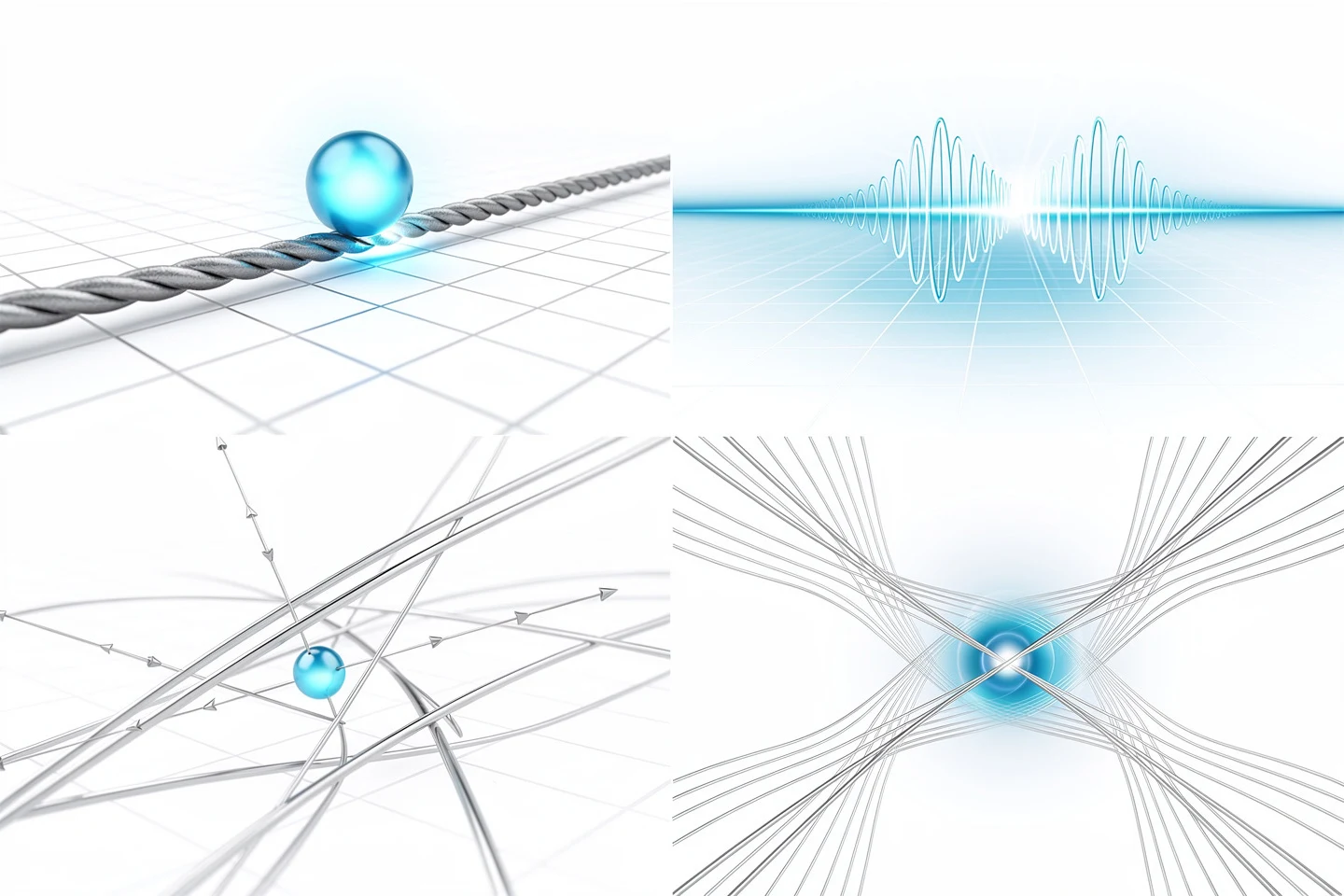
Simple

Do Charged Bodies Fall Faster?

Original: "Toward Charge-Dependent Tests of the Equivalence Principle: A Phenomenological Parameter and an Unexplored Frontier"
· Renato Vieira dos Santos
For the first time, the possible link between electric charge and gravity has been assessed: it turned out to be imperceptibly tiny.
Abstract

Scientists proposed a way to check whether electric charge and gravity might be linked more tightly than we think — as if electrified objects fell a little differently. It turns out this connection is almost unexplored, which means a surprise could be waiting. What if gravity has a hidden electric face?

Links in the knowledge graph 1

Gravity is like a plumb line: Galileo and Einstein showed that all bodies fall equally — the principle of equivalence in gravity. But tests always removed charge — as a possible interference. Physicists have now checked whether charge itself changes the "plumb line". Even with a huge charge — a coulomb per kilogram — the acceleration of falling changes by only 0.02%. This is like the plumb line's thread deviating by a hair's breadth over a meter. Instruments don't notice.

Why is this important? Many theories, from dark matter to strings (Witten) and quantum field theory, predict a tiny connection. Even in curved spacetime, κ might show up. Now charge becomes a probe: in atomic interferometers, deviations will be sought, testing dark energy, dark photons, and the fall of antimatter.

🎯 Under the current limit, even if a one-kilogram weight carried a charge like from a rubbed comb, the difference in weight would not exceed that of a speck of dust.

\kappa = \frac{\Delta a / g}{\Delta (q/m)}
κ is a thermometer for gravity's electromagnetic sensitivity: it measures how much a difference in specific charges makes accelerations differ.
\kappa_{\mathrm{EMD}} \approx 2.0 \times 10^{-14} \alpha^2 \ \mathrm{kg\,C^{-1}}
In the dilaton model, κ is expressed through the coupling constant α; the minuscule coefficient exposes the chasm between the negligible geometric contribution and a potential signal of new physics.
Scientists
Alan GuthAndrei LindeGeorges LemaîtreJames PeeblesAlbert EinsteinFritz Zwicky
Tags
gravity electromagnetism Standard Model string theory Quantum Field spacetime curvature antimatter dark energy dark matter dark photon quantum optics
Laws
Friedmann equationsgravitational lensingNoether's theoremPlanck–Einstein relationequivalence principlespin–statistics theorem
Original: arXiv:2605.12246v2 · CC BY 4.0 · bridge42worlds