Gravitational Waves from Cosmic Cracks Could Help Find Dark Matter ✛ ✦
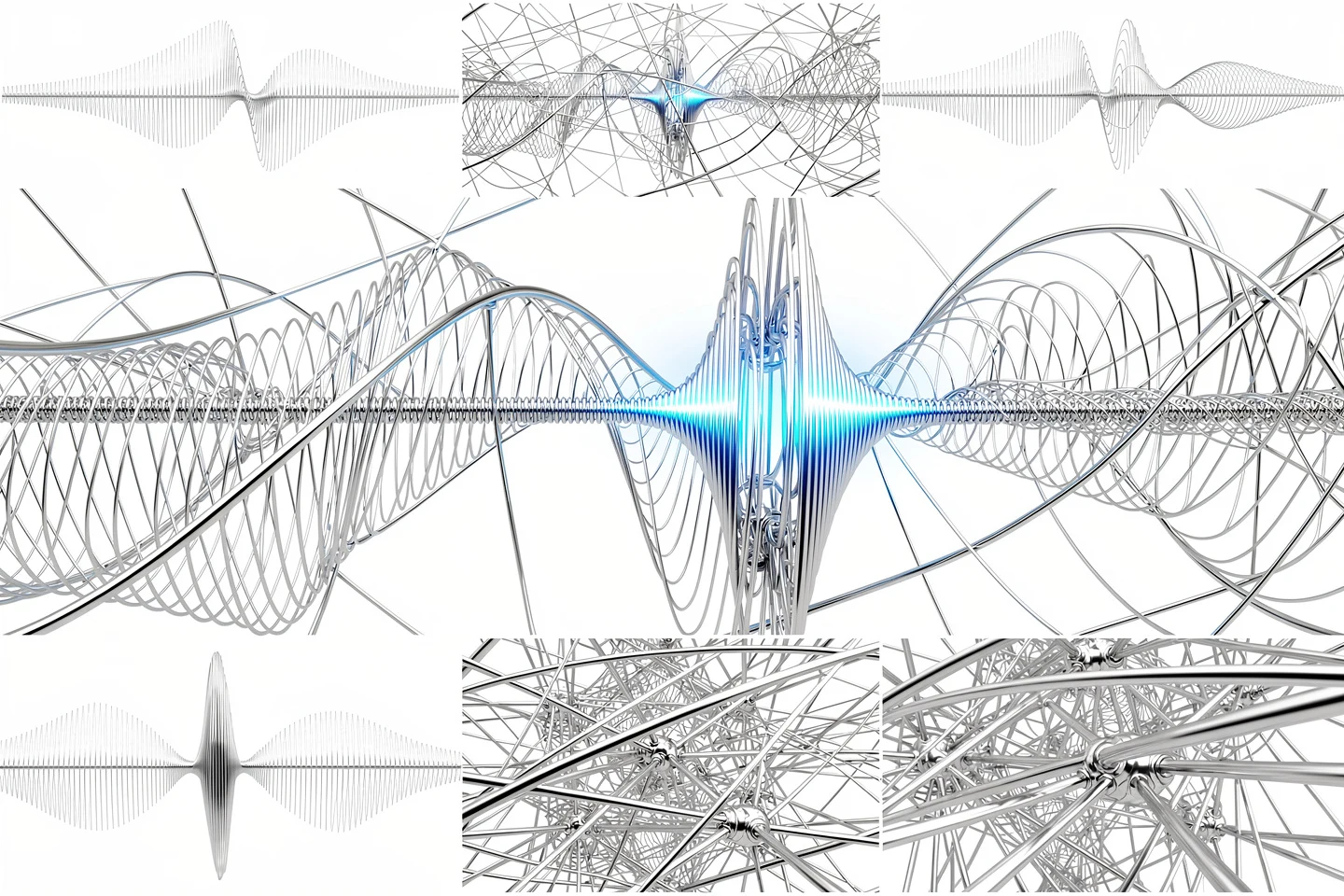
A windowpane cracks: it trembles, producing a sound: first a hum, then a dip into silence, and again a hum. Similar 'cracks' — cosmic strings — emerged in the first fractions of a second after the Big Bang, when the Universe was expanding rapidly. These threads are thinner than an atom yet heavier than stars. Their trembling spreads as gravitational waves through curved spacetime. Without dark matter, discovered by Vera Rubin, galaxies would fly apart. The LIGO detectors (created by Rainer Weiss) catch these ripples.
The new theory claims: the waves from strings have a special pattern — a flat plateau, a sharp dip, then plateau again. The dip arises when the string changes its nature, as if a crack in the glass suddenly became metallic and rings differently. But the main surprise is that this dip works as a thermometer. It precisely indicates the temperature at which the quark soup 'boiled' — the primordial particle mix from which protons and neutrons were born. Unlike the cosmic microwave background, which paints a picture of the Universe 380,000 years later, gravitational waves from strings carry news from the very first moments. Future space antennas, like LISA, catching this trace, will prove: dark matter is axions born together with the cracks, and will unveil the mystery of mass.
The gravitational dip serves as a cosmic thermometer: it shows the temperature at which the primordial quark soup boiled in the first moments after the Big Bang.