Gravitational Waves from Strings Reveal the Secrets of the Axion and Flavors ✛ ✦
Context
The Standard Model of particle physics, despite its successes, leaves two fundamental puzzles unanswered. The strong CP problem—the negligibly small CP violation parameter in quantum chromodynamics—requires fine-tuning. The Peccei–Quinn mechanism turns this parameter into a dynamical field, the axion, but the axion's quality suffers from Planck-scale corrections. Simultaneously, the hierarchy of quark and lepton masses and mixings—the flavor puzzle—hints at a hidden symmetry. Vera Rubin convincingly showed that dark matter dominates galaxies, and the axion remains one of the best candidates. This work weaves these threads together: a U(1)F gauge flavor symmetry protects the axion from quantum gravity effects, and the cosmic strings born when it breaks become sources of gravitational waves with a unique spectral structure.
Methods
The authors construct a model extending the standard DFSZ axion scheme with a flavon field X and a U(1)F gauge symmetry. The fermion mass hierarchy is generated via the Froggatt–Nielsen mechanism: Yukawa couplings are suppressed by powers of a small parameter ε~0.22. Spontaneous breaking of U(1)F forms a network of two types of cosmic strings—'axionic' (S field) and 'flavonic' (X field). Their evolution in the expanding Universe is traced from Planckian scales down to the QCD epoch. Gravitational-wave emission is computed by summing contributions from oscillating string loops; for axionic strings, axion emission dominates, but after the QCD phase transition, flavonic strings reorganize into purely gauge strings and start radiating gravitational waves efficiently. Key parameters: the flavor scale ΛFN~$10^{12}$ GeV, the vacuum expectation value ratio r=vS/vX, and the axion decay constant fa.
Results
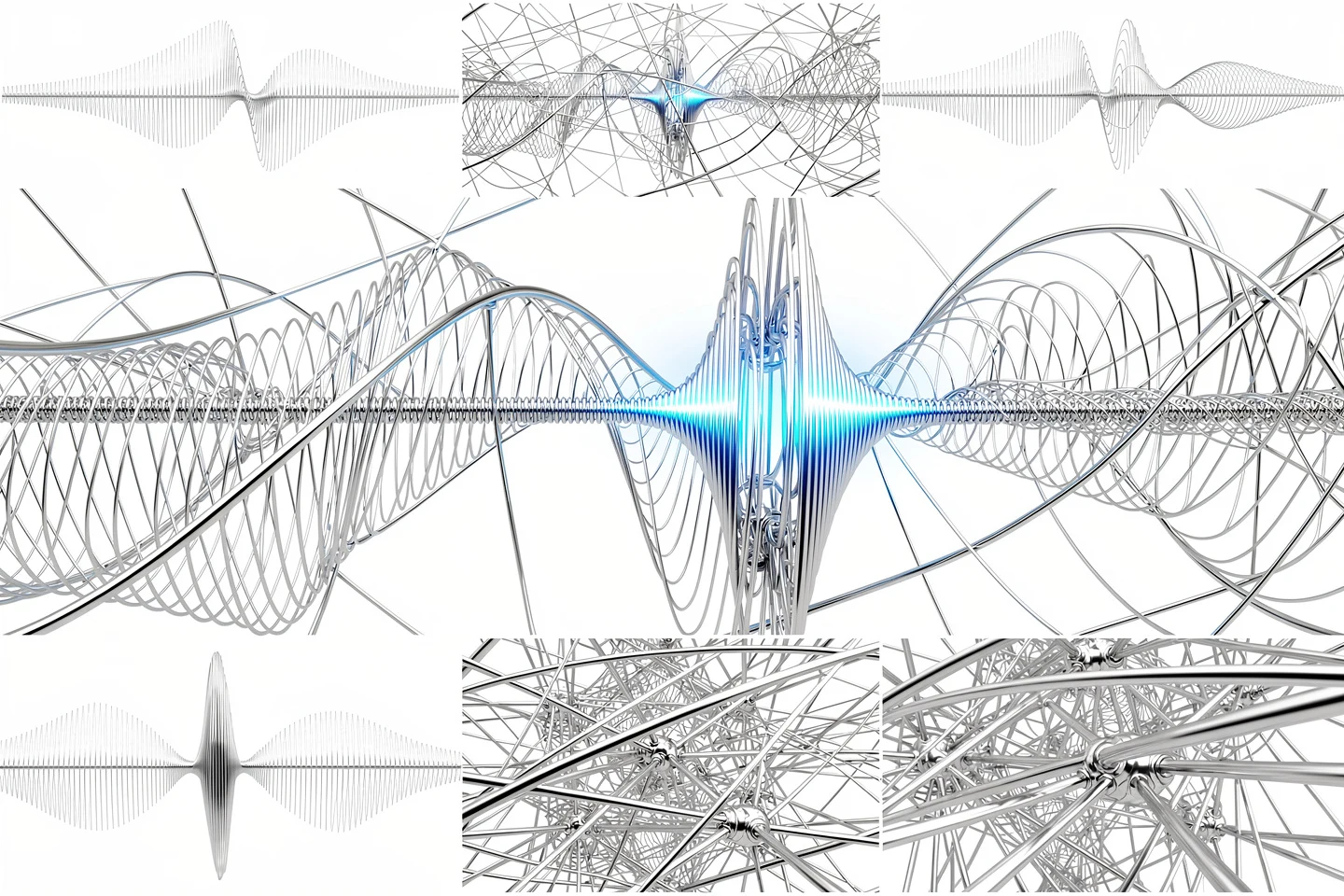
The gravitational-wave spectrum exhibits a characteristic 'plateau–dip' in the millihertz frequency range. The plateau arises from radiation by purely gauge string loops, while the dip results from the abrupt transition from global to gauge strings at the QCD epoch. The cutoff frequency fcut≈10^(−3) Hz is directly related to the flavor scale ΛFN. For axion dark matter with fa~1.26×$10^{10}$−$10^{11}$ GeV (the relic density window), the amplitude ΩGWh^2 reaches 10^(−11)−10^(−9), falling within the sensitivity band of future detectors LISA, BBO, DECIGO. For certain r, the axion becomes neutronphobic (Can=0) or electrophobic (Cae=0), relaxing astrophysical bounds and narrowing the parameter space. Combined analysis with NA62 data on rare K-meson decays highlights a preferred band ΛFN~$10^{12}$ GeV, where solutions to all five puzzles intersect.
Implications
The proposed mechanism links for the first time five fundamental problems into one coherent picture: neutrino masses, baryon asymmetry (leptogenesis), the flavor hierarchy, the strong CP problem, and dark matter. The characteristic plateau–dip structure in the gravitational-wave spectrum becomes a smoking-gun signature of a high-quality flavored axion. Detecting such a signal would not only confirm the gauge origin of flavors but also rule out many alternative axion models, providing a crucial test for quantum gravity.
Future development
The subject will advance along two fronts. On one hand, precision measurement of the frequency and shape of the gravitational-wave dip with LISA, DECIGO, and ground-based facilities (ET, CE) will allow extraction of the flavor scale and ratio r, turning GW astronomy into a spectroscope of high-energy physics. On the other, improved limits on rare K→πa decays from HIKE experiments will narrow the allowed ΛFN range, while direct axion detection (e.g., ADMX) could complete the chain of evidence.
Impact
The results will deeply impact gravitational-wave astronomy, particle physics, and cosmology, as they tie the origin of dark matter to the dynamics of the early Universe. The methods for analyzing string networks will be applicable to a broad class of models beyond the Standard Model.
Next steps
Numerical simulations of the reorganization of string-wall networks at the QCD epoch taking axion emission into account are needed. In parallel, targeted searches for a correlated signal in NA62 data and preparations for HIKE are necessary.
Key open problems
The model simultaneously addresses: the strong CP problem (axion), the flavor hierarchy (FN mechanism), dark matter (axion), neutrino masses (type I seesaw), and baryon asymmetry (resonant leptogenesis). Cosmic strings and gravitational waves become the experimental bridge between these challenges.
The knowledge machine's view
This section is addressed to the author of the paper and their colleagues. Neighbouring works were found by meaning-based search across our archive, not by word overlap. We do not review: we show the field around the work.
What the work does
The authors build a model where the flavor gauge symmetry U(1)F protects the axion from Planck-scale corrections, and cosmic strings from its breaking produce gravitational waves with a characteristic 'plateau–dip' spectrum. They tie together five puzzles: neutrino masses, baryon asymmetry, flavor hierarchy, the strong CP problem, and dark matter, and show that the signal falls within the sensitivity range of future detectors.
Where its strength is
Combining the axion and flavor in a single model with a prediction of a unique spectral structure in gravitational waves is a concrete, testable bridge between high-energy physics and cosmology.
Where it could go next
- One could investigate how the gravitational atoms of axions, considered in a companion work, affect the evolution of strings and the gravitational wave spectrum in this model.based on: Gravitational atoms of axions sing in black hole pairs arXiv:2606.28161
- An analysis of quantum-gravity corrections to the axion potential lies nearby; it might clarify how well the gauge symmetry actually solves the axion quality problem in the presence of other operators.based on: Quantum Gravity vs. Axions: How Fine-Tuned Is the Universe? arXiv:2606.14098
- The idea of a resonance between dark and ordinary matter from a companion paper could offer an additional channel to test this model through cosmological observations.based on: The Universe Sings: Resonance of Dark and Ordinary Matter arXiv:2604.22665
Worth trying
- Check whether the 'plateau–dip' shape persists when accounting for the interaction of strings with gravitational atoms of axions.
- Assess how quantum-gravity operators, suppressed by the flavor scale, modify predictions for the axion's mixing with other light fields.
- Search for a possible resonant signal in the matter power spectrum associated with axion dark matter in this model.
Why this may matter
If the proposed signal is detected, it would connect laboratory measurements of rare decays with cosmological observations, turning the axion into a window into both flavor physics and dark matter.
Nearby works in our archive
- Gravitational atoms of axions sing in black hole pairssimilarity 0.65
- Dark matter sings in magnetic fieldssimilarity 0.65
- Quantum Gravity vs. Axions: How Fine-Tuned Is the Universe?similarity 0.64
- A Levitating Dust Grain Hunts Invisible Mattersimilarity 0.64
- Dark Matter Speaks in Gamma-Ray Lightsimilarity 0.64
- The Universe Sings: Resonance of Dark and Ordinary Mattersimilarity 0.63
The closest work in the archive sits at 0.65 by meaning — the usual level for our corpus.
Original abstract
as written by the authors arXiv:2606.05320v1
Axions, arising from an anomalous global Peccei-Quinn symmetry $$U(1)_{\text{PQ}}$$, offer a compelling solution to the strong CP problem but are vulnerable to Planck-suppressed operators. Gauged abelian flavor symmetries $$U(1)_F$$, invoked to explain the flavor hierarchies via the Froggatt-Nielsen mechanism, can naturally shield the axion from such effects, yielding an accidental high-quality flavored axion with unit domain wall number. Such constructions predict two complementary signatures: (i) flavor-changing neutral currents from $$K\to\pi a$$ decays, typically associated with high flavor scales $$\Lambda_{\text{FN}}\gtrsim f_a$$, and (ii) stochastic Gravitational Waves (GWs) sourced by the evolution and decay of gauged flavonic and axionic cosmic-string networks. In addition, global axionic strings can efficiently radiate axions, potentially accounting for the observed dark matter relic abundance. We show that the resulting characteristic plateau--valley structure in the GW spectrum provides a distinctive and powerful probe of high-quality flavored axion dark matter models, complementary to low-energy flavor experiments.
Within the model, an axionic string can decay into several unit strings that annihilate, avoiding catastrophic domain wall domination. And the characteristic dip in the gravitational-wave spectrum serves as a 'cosmic thermometer,' pinning down the temperature of the QCD phase transition.
Key numbers
- Flavor scale Λ_FN: ~1012 GeV
- Axion decay constant fa: 1.26×10¹⁰ – 1.26×10¹¹ GeV
- GW spectrum dip frequency: ~mHz (matches LISA's peak sensitivity)
- GW signal amplitude Ω_GW h^2: 10^−11 – 10^−9
- Vacuum expectation value ratio r: 0.6 (benchmark giving best fit to experiment)