Plateau and Dip: The Music of Cosmic Strings ✛ ✦
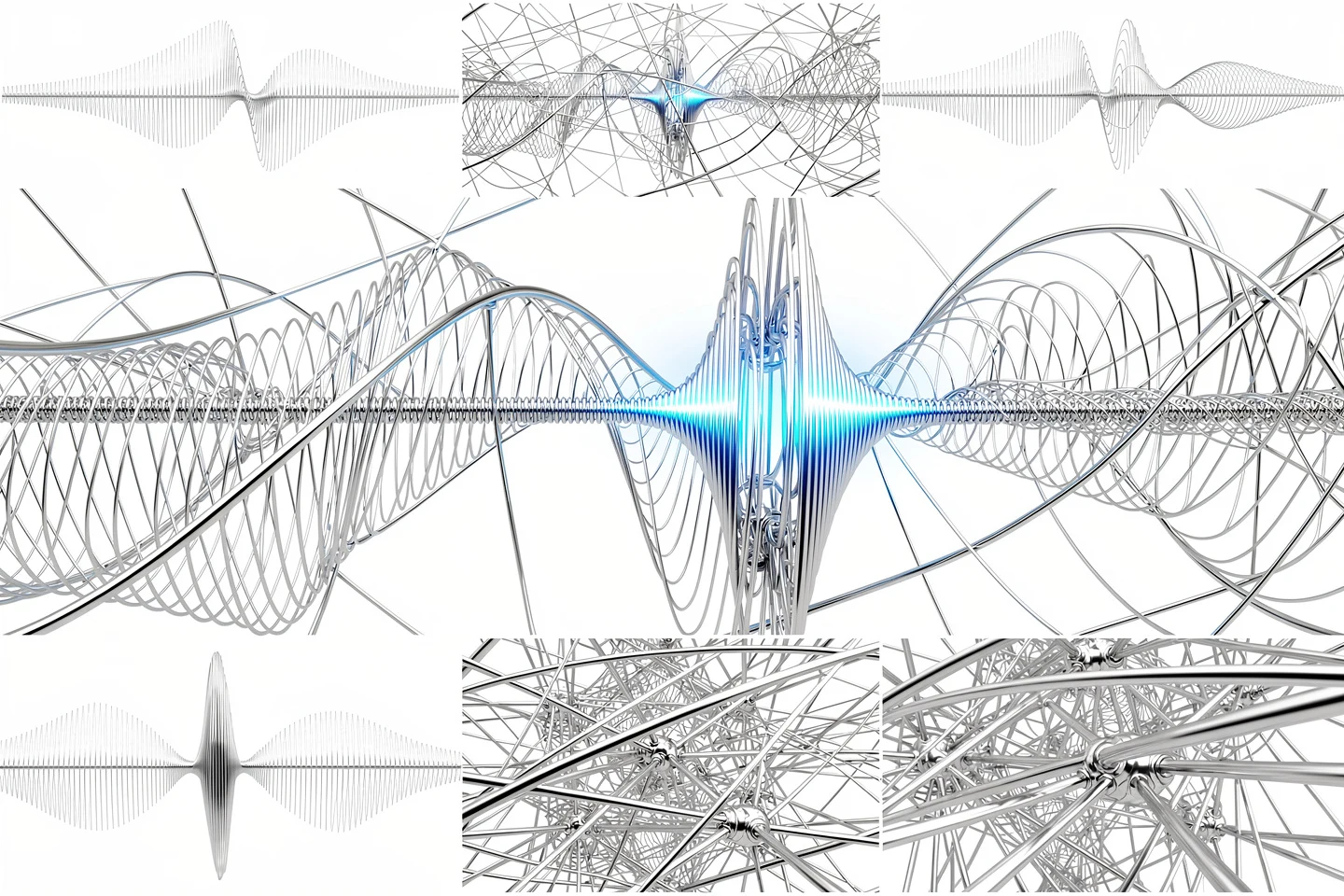
The Universe doesn't just expand — it resonates. After the Big Bang, stretched strings remained in its fabric — thin as a proton, yet heavy as a mountain range. Their oscillations give birth to gravitational waves, and in this radiation, like in a musical score, the history of fundamental symmetries is encoded.
Two puzzles keep theorists restless. Why is the strong interaction so symmetric that CP violation in it remains elusive? And where does the ladder of quark and lepton masses come from — from the light electron to the massive top quark? Flavor physics offers an elegant solution: a U(1)F gauge symmetry that spontaneously breaks at high energies. The Froggatt–Nielsen mechanism explains the hierarchy by masses being suppressed by powers of a small parameter ε ~ 0.22. And the flavon field, like a guardian, protects the axion from quantum-gravity distortions, turning it into an ideal candidate for dark matter. Vera Rubin already showed that without dark matter galaxies would fly apart, and the axion is the best bet so far.
As the Universe cools, the flavor symmetry breaks, and space is filled with a network of two kinds of strings: axionic and flavonic. At first, axion strings mainly radiate axions, while flavonic strings are almost inaudible. But at the QCD transition epoch, when the temperature drops to about 100 MeV, the picture changes abruptly. Flavonic strings, having lost their connection to the axion, become purely gauge and begin to sing: their gravitational waves burst forth with maximum power.
The spectrum of these waves carries a clear signature. It consists of an almost flat plateau in the millihertz region, followed by a dip, and then a new rise. The cutoff frequency fcut ≈ 8.67×10⁻³ Hz (TQCD/GeV) (10−11/Gμ0(vX))1/2 points to the very moment when the strings find their voice. This equation is a cosmic chronometer: knowing the dip frequency, we measure the QCD transition temperature and the string tension, hence the scale of new physics. NA62 experiments are already narrowing the allowed region, and if the future LISA detector — heir to the ideas of Rainer Weiss and other pioneers of LIGO — detects such a signal, we will for the first time touch the gauge nature of flavor.
Catching such a 'gravitational melody' means solving five problems at once: the fermion hierarchy, the strong CP problem, the nature of dark matter, neutrino masses, and baryon asymmetry. It would not be just a discovery, but a unification of particle physics and gravity into a single symphony. And then the expansion of the Universe, once set by the Big Bang, will sound for us in the notes of gravitational waves, weaving together quantum fields, spacetime curvature, and even echoes of the cosmic microwave background.
An axion string can decay into several unit strings, which annihilate, avoiding the dominance of domain walls. The characteristic dip in the spectrum is not just a 'cosmic thermometer,' but an imprint of the exact moment when the Universe became transparent to axions; it fixes the temperature of the QCD transition with an accuracy unattainable by any terrestrial experiment.