How a Black Hole Tears Apart Invisible Planets ✛ ✦
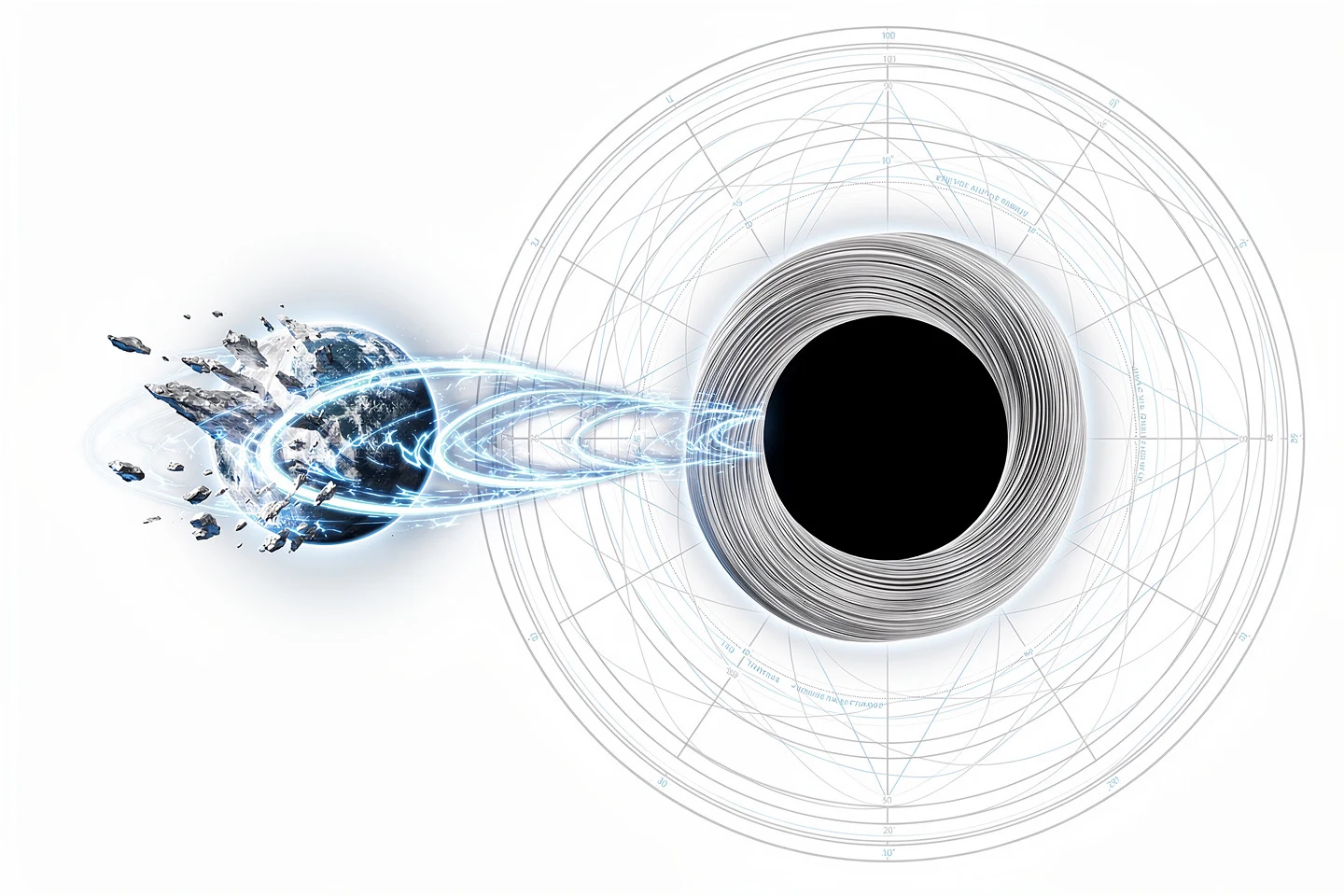
At the centers of galaxies lurk supermassive black holes, surrounded by disks of gas and dust. Within these disks, planets are born — blanets, cousins to familiar exoplanets. If such a planet ventures too close, the hole's gravity begins to stretch it like cosmic taffy. Tidal forces pull the planet into a long thread until it snaps, flaring farewell in ultraviolet.
Blanets are denser than stars, so they withstand stronger gravitational pull and break apart closer to the hole. Their flares last hours or days — and by analyzing them with spectroscopy, astronomers can gauge the hole's spin (spacetime curvature) and count invisible worlds.
The most unexpected twist: sometimes the hole only strips away the planet's outer layers. The surviving core escapes on an orbit and can return, triggering a repeat flare — a cosmic boomerang. These events leave a trace in gravitational waves, picked up by instruments like LIGO and James Webb. The insights of Schwarzschild, Schmidt (who discovered quasars), and Thorne help us hunt for these silent cataclysms.
A hole with the mass of 10 billion suns still tears a planet apart before swallowing it whole — that's why we can spot the flare.
In Interstellar, a planet is shown near a black hole; real blanets born in accretion disks are much colder, but the idea itself is no longer science fiction.