The Rapids of a Black Hole: The Birth and Death of Blanets ✛ ✦
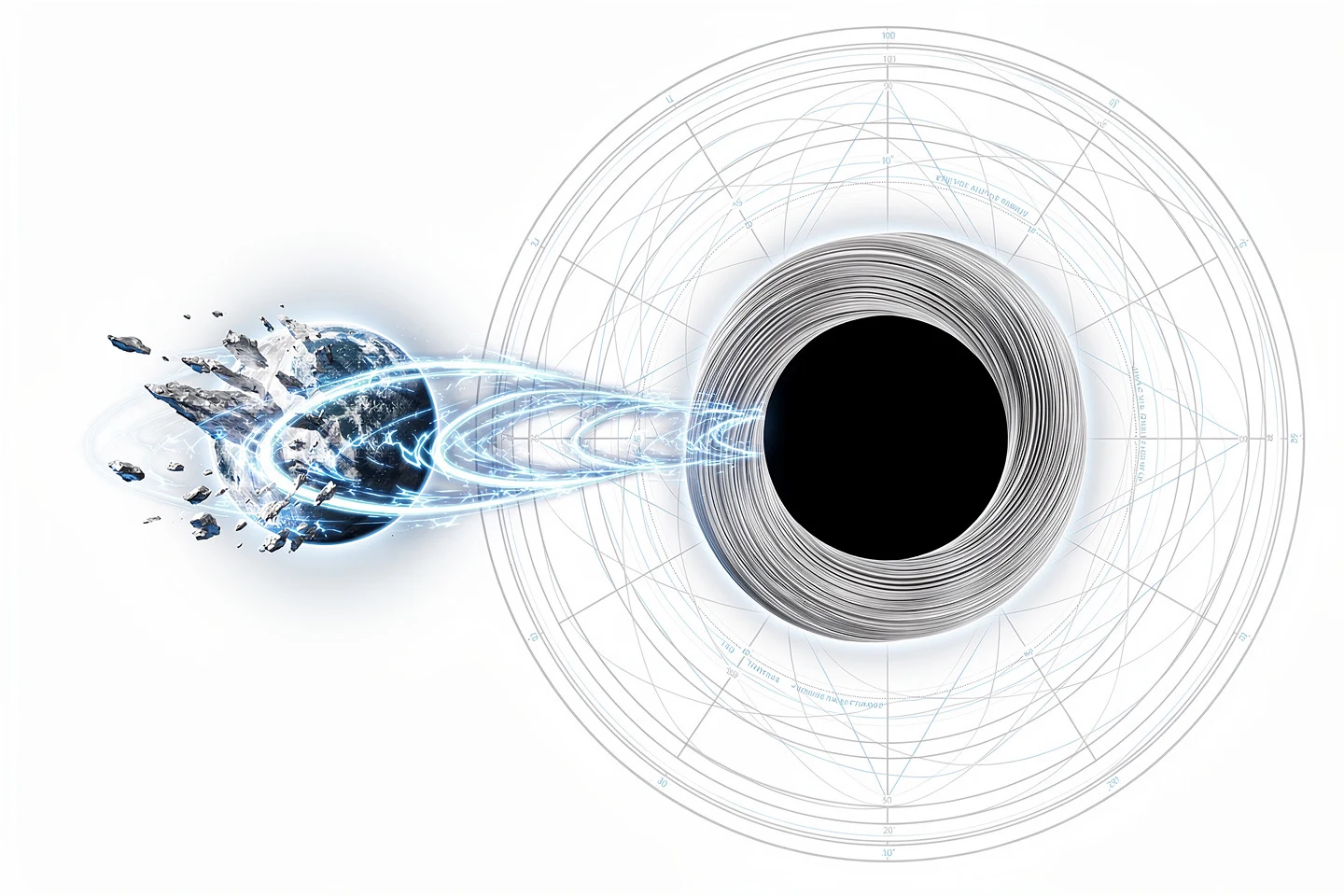
In the accretion disks that gird the nuclei of active galaxies (quasars, discovered by Maarten Schmidt way back in the 1960s) a river of incandescent gas and dust churns. In its backwaters, where turbulent flows subside, against all odds, planets are born. Not ordinary ones, but exotic ones — blanets, with masses comparable to Earth or reaching thousands of Earth masses. They are distinguished by incredible density: like river pebbles, polished by the current, but compressed a thousand times more. This entire river is merely an obedient stream, subject to the gravity of the supermassive black hole.
But the calm is deceptive. Losing angular momentum, blanets drift inexorably toward the center, like branches sucked into a whirlpool. Here, tidal forces (the same that raise ocean waves on Earth, but amplified by the abyss of curved spacetime) tear worlds apart. Schwarzschild outlined the point of no return for a static hole, while Thorne and colleagues showed how spin twists space itself, turning the calm river into spiral chaos with no escape.
When a blanet crosses the fatal line of the tidal radius, its fate is sealed. Its rocky interior crumbles, and the debris is stretched into a sparkling plume, like a string of pearls snapped by an invisible hand. The flare lasts from hours to weeks, heating up to 70,000 degrees: tens of times hotter than the surface of the Sun. For comparison: the destruction of a star drags on for months; a blanet dies in hours — nature is in a hurry to end the story. Its fading follows a power law $t^{-5/3}$—like an echo melting into the abyss. The relentless formula $r_t$ = $R_p$ (2M / $M_p$)^{1/3} dictates: the more massive the hole and the denser the planet, the closer the predator lets its prey come before the final lunge. Blanets, compressed to incredible density, manage to avoid direct plunge into the horizon for holes up to 10 billion solar masses, and it is precisely such monsters that rule the centers of great galaxies.
But this is not just theory. It is a new class of transients for sky surveys. The light hunters, the James Webb Space Telescope and the Vera Rubin Observatory, are poised to catch the ultraviolet and optical screams of dying worlds. Spectroscopy of the flares will allow probing hidden planetary material in galactic nuclei, independently measuring black hole spins, and catching the whisper of low-frequency gravitational waves. Future detectors, an upgraded LIGO or the LISA space antenna, may capture the trembling of space from colliding debris.
Thus, each blanet death is not just a flare, but a key to fundamental puzzles: how worlds are born under extreme conditions, what the true geometry of spacetime is, and where the matter plunging into the abyss goes. A black hole is a devourer of the past, but also a generous giver of knowledge about the Universe.
The flare from a blanet's destruction lasts a few days, but in that time it releases energy comparable to a billion solar flares, or to hundreds of years of a star's entire luminous output.
In Interstellar, the heroes explore planets near the supermassive black hole Gargantua. Blanets are the scientific version of such worlds: they are born directly in the fiery disk, not captured, and although much colder than the movie ones, their resilience near the horizon is astounding.