Tidal Disruption of Blanets in Kerr Spacetime: From Test Particles to Planetary-Mass Bodies ✛ ✦
Context
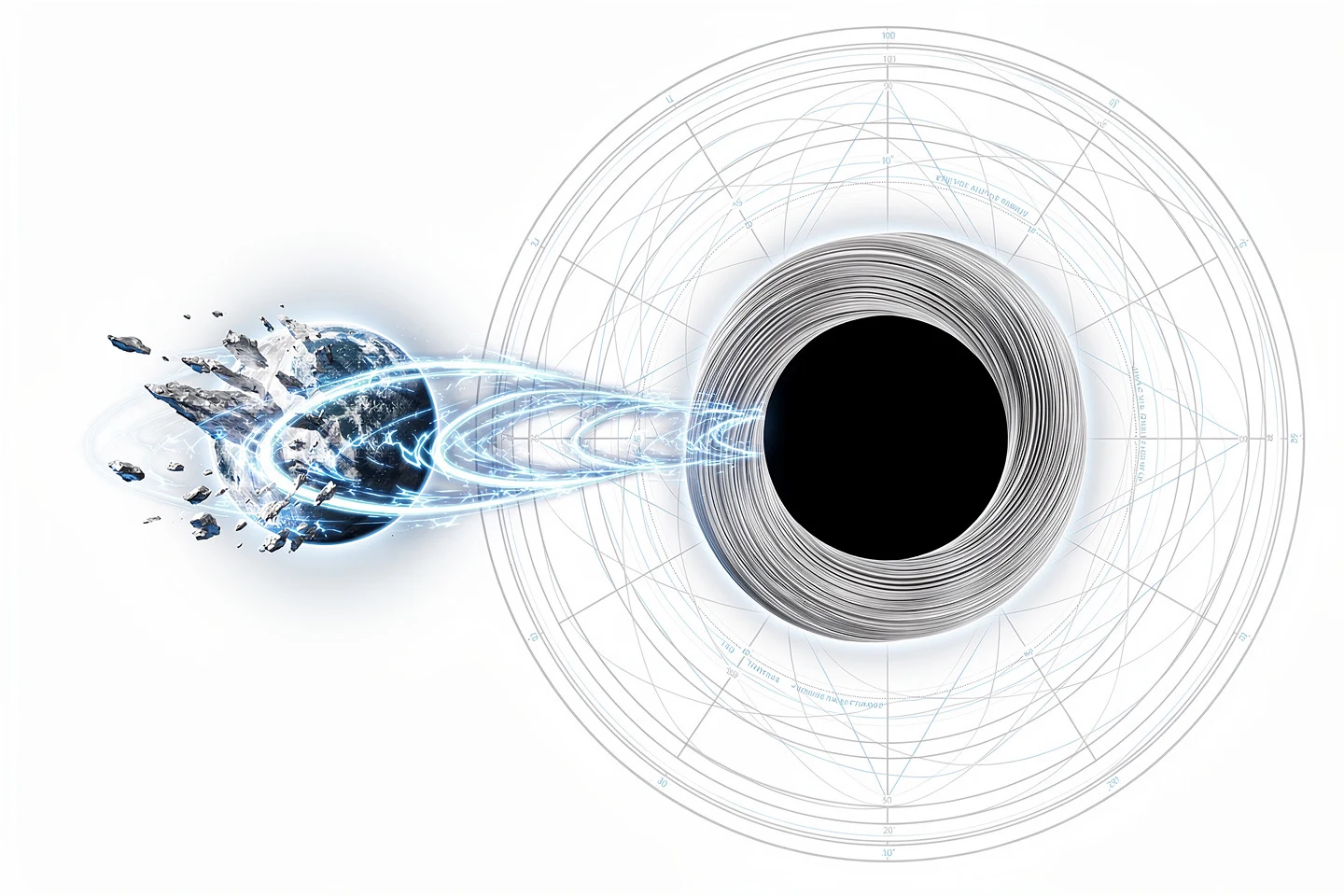
In active galactic nuclei (quasars), first identified by Maarten Schmidt, gas-dust disks around supermassive black holes may serve as cradles for forming planet-like bodies—blanets. These exotic planets were predicted based on dust-coagulation mechanisms free of radial-drift barriers. Yet their fate upon losing angular momentum and potential observable signatures remained poorly studied. Understanding the tidal disruption of blanets is key to finding new classes of transients in galactic centers and to probing the makeup and dynamics of accretion disks.
Methods
The authors applied the Schwarzschild and Kerr formalisms to compute orbits with finite-size corrections. Using the geodesic deviation equation and the tidal tensor in the ZAMO frame, they derived exact disruption criteria, disruption radii, and the Hills mass for blanets with masses 20–3000 M⊕. First-order spin relativistic corrections were included, and orbital stability was analyzed: Lense–Thirring precession, disk migration, and Kozai–Lidov resonance. The debris dynamics after disruption were studied in detail, leading to a universal accretion rate.
Results
The tidal radius for blanets is about 60 times smaller than for a star at the same black hole mass, but thanks to their compactness, blanets avoid falling into the horizon even for supermassive black holes up to ~$10^{10}$ M⊙ (the Hills mass for blanets is ~5×$10^9$ M⊙). The characteristic peak fallback time ranges from hours to a day, and the accretion rate is orders of magnitude below Eddington, resulting in optical and ultraviolet flares. The brightness decay follows $t^{-5/3}$, typical also for stellar tidal disruptions. The black hole's spin (Kerr effects) weakly alters the disruption radius at parsec distances, but becomes significant when a blanet migrates deeper into the disk. Partial disruptions leave surviving cores, generating repeating flares.
Implications
The results introduce a new class of sources for spectroscopic and time-domain sky surveys. Blanet tidal disruption events will probe the population of hidden planetary material in galactic nuclei and independently estimate black hole spins through flare-duration statistics and the ratio of prograde/retrograde disruptions. Detecting such events will confirm planet-formation theory in extreme environments and refine accretion-disk models.
Future development
Future work requires modeling disruption of differentiated blanets with iron cores, accounting for super-Eddington accretion, and computing precise optical light curves with black hole spin corrections. Upcoming facilities like James Webb and the Vera Rubin Observatory will enable systematic searches for such transients, while next-generation gravitational-wave detectors could register signals from the inspiral of debris.
Impact
This work impacts stellar tidal disruption astrophysics, accretion disk physics, and gravitational-wave astronomy.
Next steps
Next steps include numerical simulations of blanet disruption with realistic equations of state and building population models to estimate event rates in upcoming all-sky surveys.
Key open problems
This study links unsolved problems of planet formation in extreme conditions, the nature of active galactic nucleus variability, and the search for low-frequency gravitational waves with LIGO and future space antennas like LISA.
The knowledge machine's view
This section is addressed to the author of the paper and their colleagues. Neighbouring works were found by meaning-based search across our archive, not by word overlap. We do not review: we show the field around the work.
What the work does
The authors examined the tidal disruption of bl planets (planet-like bodies in the disks of active galactic nuclei) in the Kerr metric, derived disruption criteria accounting for finite sizes and black hole spin, analyzed the dynamics of debris, and obtained observational characteristics of the flares: duration, decay law t^{-5/3}, optical-ultraviolet range.
Where its strength is
The work unifies relativistic dynamics, tidal physics, and observational consequences for a new class of transients, paving the way for using bl planet disruptions as probes of the population of bodies in galactic nuclei and black hole spins.
Where it could go next
- It might be interesting to compare the predicted bl planet flares with X-ray transients arising from stellar disruptions in disks — our archive has a review of a mechanism where a compact object passing through a disk produces a flare with a characteristic light curve; common features could help distinguish bl planet events among other transients.based on: The Arrow Piercing the Disk: Recipe for an X-ray Flare arXiv:2607.05508v1
- Since bl planets are dense bodies and their disruption is modeled as a tidal breakup, a related paper concerns primordial black holes that, passing through stars, cause local heating and flares; although the scales differ, the approach to calculating energy release and observable signatures could be transferred to bl planets in disks.based on: Dark Matter's Invisible Sparks: Tiny Black Holes as Stellar Detonators arXiv:2606.07505v2
- To assess the contribution of bl planet disruptions to background radiation or population studies, a review examining the impact of primordial black holes on cosmological evolution and event rates could be useful; similar methods for estimating event frequencies in a given volume can be adapted to bl planets in galactic nuclei.based on: Cosmic Hot Tap: How Primordial Black Holes Rewrite the Speed of the Universe arXiv:2607.18528v1
Worth trying
- Test whether bl planet disruptions can be distinguished from stellar disruptions by the shape of the X-ray light curve, using models from the paper on flares caused by passage through a disk.
- Estimate the rate of bl planet disruption events in the local Universe, following the approach used for calculating event rates for primordial black holes.
- Consider the possibility of detecting gravitational waves from bl planet disruptions with future detectors, relying on methods for analyzing signals from extreme black hole events.
Why this may matter
If bl planet disruptions are detected, it would be the first observational confirmation of planets existing in the extreme conditions of accretion disks and would provide a new tool for measuring the spins of supermassive black holes.
Nearby works in our archive
- Cosmic Hot Tap: How Primordial Black Holes Rewrite the Speed of the Universesimilarity 0.63
- How Black Holes Spit Out Energysimilarity 0.62
- The Arrow Piercing the Disk: Recipe for an X-ray Flaresimilarity 0.62
- Stellar Droplets from Quark Soupsimilarity 0.61
- Dark Stars: Cradle of Giant Black Holessimilarity 0.61
- Black hole in a dark matter cocoonsimilarity 0.60
- Dark Matter's Invisible Sparks: Tiny Black Holes as Stellar Detonatorssimilarity 0.60
The closest work in the archive sits at 0.63 by meaning — the usual level for our corpus.
Original abstract
as written by the authors arXiv:2606.06884v1
Blanets are planetary-mass bodies ($$20$$--$$3000\,\Me$$) that may orbit supermassive black holes (SMBHs) in the circumnuclear disks of active galactic nuclei (AGN). We examine tidal disruption events produced by blanet--SMBH encounters, from the test-particle limit to massive planetary bodies in Kerr spacetime. Using the geodesic deviation equation and the Kerr tidal tensor, we derive disruption criteria, tidal radii, and Hills masses for planetary-mass objects, and show that blanet TDEs can remain observable for SMBHs up to $$\sim10^{10}\,\Msun$$, well above the stellar Hills mass of $$\sim10^8\,\Msun$$. The fallback rate retains the usual $$t^{-5/3}$$ form, but the peak timescales are shorter -- from hours to months -- with lower peak accretion rates and multi-wavelength signatures that differ from those of stellar TDEs. We also examine orbital stability, including Keplerian precession, Lense--Thirring nodal precession, migration in the circumnuclear disk, and the Kozai--Lidov resonance, and identify the region where blanets can survive before disruption. We derive relativistic corrections to the tidal radius, spin-dependent disruption thresholds, and the effect of Kerr spin on the disruption geometry. We also discuss gravitational-wave emission from blanet debris EMRIs and the prospects for LISA detection, which may help in interpreting unusual TDE-like transients in AGN environments.
Blanets might be the most numerous planets in the Universe: the disk of a single active nucleus may harbor thousands, yet we haven't spotted one due to their faintness and transient flares.
In the movie Interstellar, the crew explores a planet orbiting the supermassive black hole Gargantua; the blanet concept gives such worlds a scientific footing, though real blanets are much colder and form differently.
Key numbers
- tidal radius: ∼4.2×1010 cm for a 100 M⊕ blanet near a 107 M⊙ black hole
- r_t / r_s ratio: ∼1100 for a 100 M⊕ blanet near a 107 M⊙ black hole
- peak flare duration: from several hours to several weeks
- accretion disk temperature: ∼7×10⁴ K
- characteristic gravitational-wave frequency: ∼4×10⁻⁵ Hz