Spectral fitting is a data analysis technique used in astrophysics to interpret the observed electromagnetic spectrum of an astronomical object, such as a black hole, galaxy, or supernova. The observed spectrum — from X-rays to gamma rays or from radio to optical — is compared to theoretical models that predict the emission based on physical processes like thermal radiation, synchrotron emission, or inverse Compton scattering. By adjusting model parameters, researchers can infer properties like temperature, density, magnetic field strength, and the geometry of the emitting region.
History
Spectral fitting has been a cornerstone of X-ray astronomy since the 1970s, with the development of spectral analysis software like XSPEC, which remains widely used today.
How it works
The process involves constructing a model spectrum that includes contributions from various emission mechanisms, each with its own functional form. The model is convolved with the instrument's response function and then compared to the observed data using statistical methods like chi-squared minimization or Bayesian inference. The best-fit parameters are found by exploring the parameter space, often with Markov Chain Monte Carlo methods, to account for uncertainties and degeneracies.
In practice
It is used to determine the mass and spin of black holes from X-ray spectra, to measure the temperature and composition of galaxy clusters, and to identify the physical conditions in gamma-ray bursts.
Fun fact
The same spectral fitting techniques are used to analyze data from laboratory plasmas, such as those in fusion experiments, to diagnose temperature and density.
An artist makes a quick charcoal sketch, and the face in the portrait is already recognizable. Astrophysicists face a similar challenge: the spectrum of a star is its individual portrait, revealing temperature, composition, and gravity.
An ultra-sensitive microphone listens not to sound, but to the trembling of space itself. That's how gravitational wave detectors work — LIGO, Virgo, KAGRA.
After a merger, the newborn black hole emits a fading tremble — gravitational waves, similar to a ringing bell. By analyzing the overtones of this signal, spectroscopy can determine its mass and spin rate.
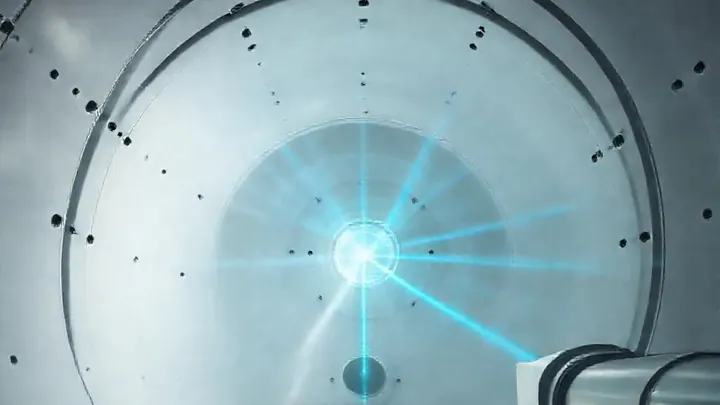
An X-ray beam is a stream of tiny packets of energy, photons. Ordinary detectors count them but don't distinguish shades: two photons with close energies look the same to them. The new device works like a sensitive thermometer: it catches each photon and measures how much it warms a thin film. From the warming, you can tell exactly how much energy the photon brought.
When an X-ray burst erupts on a neutron star, its atmosphere heats up to millions of degrees. The light we catch with telescopes passes through this dense layer of gas, and gets dramatically altered along the way. The spectrum no longer looks like that of an ideal radiator: some colors get amplified, others dim.
For years, an X-ray telescope in orbit recorded how binary systems shine, where an ordinary star orbits a black hole or a neutron star. Matter from the companion falls onto the compact object, heats up to millions of degrees, and emits X-rays.
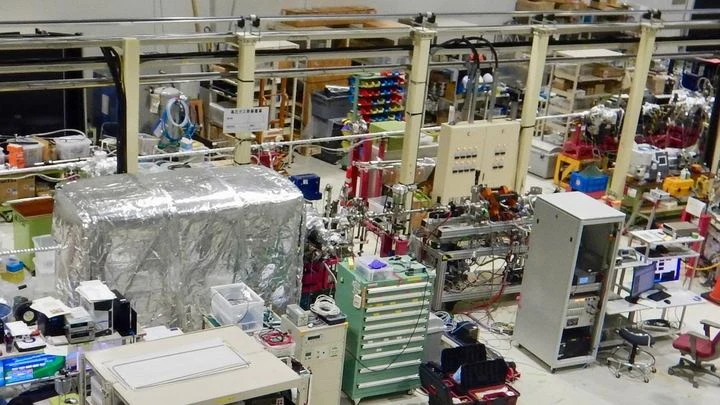
An X-ray telescope captures light from hot gas around stars, but that light arrives 'blurred'—like a voice over a bad phone line. To make out the words, you need a dictionary of the exact frequencies at which atoms glow. Such a dictionary is written not only with calculations but also with direct experiments.
Astronomers read the history of galaxies by their portraits. Previously, they used either lengthy analysis of light by colors or quick filtered snapshots, losing the details of shape.
A gravitational-wave detector catches not only the roar of mergers but also the quiet splash when a star or gas cloud dives into a supermassive black hole. Such a dive, like a stone falling into a well, generates waves at all frequencies at once—and in that spectrum lies encoded the nature of the well itself.