Magnetic Ropes on the Sun: A New View from the Chromosphere express
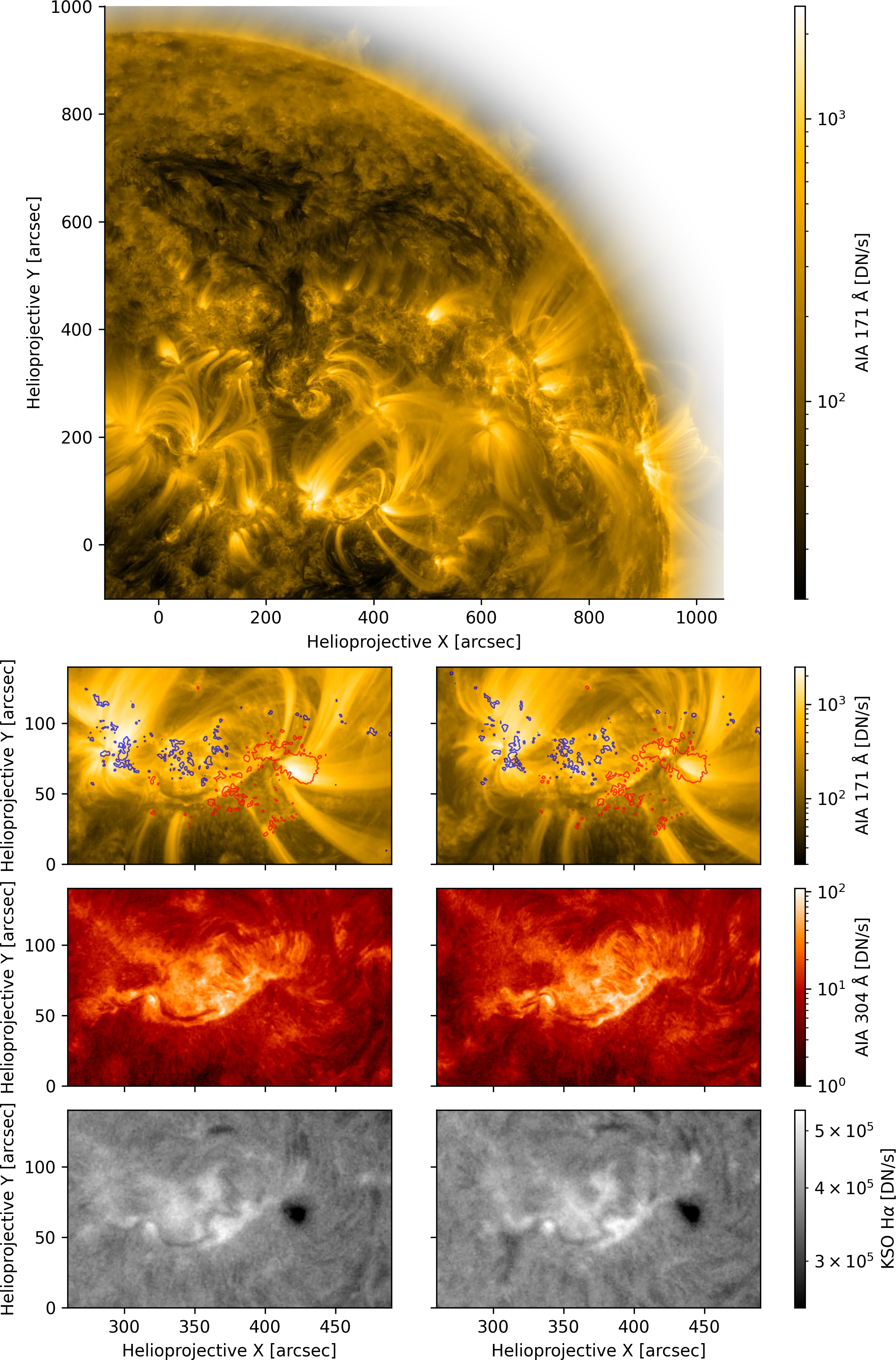
A sunspot cools, and above it a dark filament, a prominence, hangs for weeks. Inside it, like a compressed spring, hides the magnetic field. It can be laid out in neat arches, or it can be twisted into a tight rope. This difference determines when and how it will blow: a rope is more unstable and ready to fly at the slightest nudge. For a long time, astronomers debated what exactly sits in the prominence channel hours before a flare, because ordinary images of the Sun's lower layer, the photosphere, did not give a clear answer.
A group of physicists from Sweden and other countries added a second floor. They took data from the chromosphere — the layer that lies just above the photosphere and glows pinkish during eclipses. Measuring chromospheric magnetic fields is difficult: the signal is weak, and the spectral lines (the rainbow bands used to infer the field) are blurred and sit at different heights. The new method automatically selects the correct height for each point and resolves the 180-degree ambiguity — when the field could point one way or the exact opposite, and it's unclear which.
They tested it on computer simulations where the true magnetic structure is known in advance. It turned out that using only the photosphere, you can make a mistake and take a rope for a simple arch. But when chromospheric measurements were included, the three-dimensional portrait of the field was reconstructed almost without distortion. Then they applied the method to real observations of an active region with a prominence, obtained at the Swedish Solar Telescope — an instrument with a one-meter mirror on the island of Palma. The reconstructed field clearly showed: inside the channel sits a twisted magnetic rope. The spring was cocked long before the jerk.
Now, with a reliable way to peek under the "lid" of a prominence, physicists can spot earlier where energy for a flare is building up. And that means better predicting those solar storms that sometimes hit satellites and power grids on Earth. The spring inside the dark filament is no longer a mystery.
The temperature at the base of the chromosphere is about 4000 degrees, and at its upper boundary it's already 25,000. For comparison: a tungsten filament in a light bulb heats up to 2500 degrees.