The Laser That Decided to Throw a Tantrum express
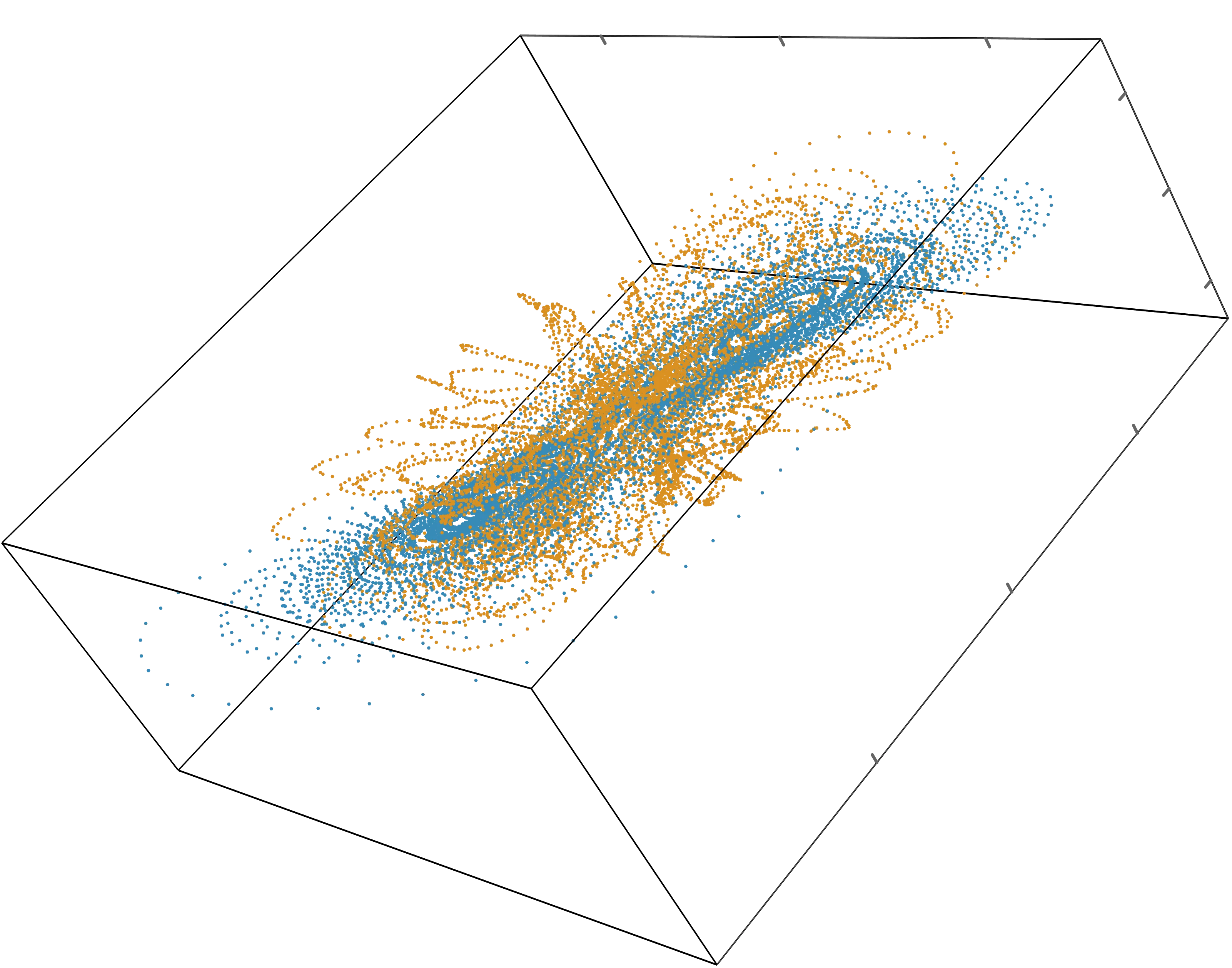
A string sounds perfectly pure until a draft touches it. That's roughly how a superradiant laser works: a beam of atoms, pre-charged with energy, flies through a room made of two mirrors — an optical resonator (a trap where light bounces back and forth). The atoms collectively release their stored light, producing a beam with an extremely stable frequency — good enough for atomic clocks. But the authors of a new study found that this idyll doesn't last forever.
If the lifetime of light in the resonator is made much shorter than the lifetime of the excited atoms, the laser tips into chaos. The beam's intensity stops being steady and starts to dance — flaring up and dying down like a candle flame in the wind. The researchers derived a clear condition for this instability: it arises when photons leave the resonator faster than the atoms manage to 'settle down.' In this regime, the laser resembles a pot of boiling water: heating from below (atoms), cooling from above (light losses)—and the Bénard convection cells, familiar from turbulence physics, appear here too.
But there's good news too: if there are many atoms, the laser enters a regime of regular self-pulsing — rhythmic flashes, like a heartbeat. For practitioners, this offers a double benefit: you can either avoid the dangerous zone and maintain perfect stability for optical clocks, or deliberately drive the laser into chaos and turn it into a laboratory for studying turbulence. Here, unlike in a fluid, every photon is accounted for, and you can see what slips away in a turbulent flow of water. And the string we started with keeps sounding — only now its music can be both gentle and wild, depending on how hard the draft blows.
Original abstract
as written by the authors arXiv:2606.21675
We investigate the intensity stability of the superradiant laser. Our study focuses on the architecture where a continuous beam of atoms in an electronically excited state crosses the mode of a high-finesse Fabry-Perot cavity, which has been proposed as a new architecture of an active optical clock. We show that such superradiant laser can become unstable and develop chaotic behavior. We derive an analytical criterion for this instability and find that it may only occur when the lifetime of photons in the cavity is significantly shorter than the lifetime of atoms. This criterion allows for refining the necessary parameters to run a superradiant laser as a frequency reference in the optical domain. In particular, we point-out the consequences of the instability on intensity fluctuations and laser linewidth. On the other hand, we also point out that the superradiant laser, when in the unstable regime, can become an interesting playground for studying chaos. At the mean-field level, there is a direct mapping to the B\'enard instability associated with fluid turbulence; however quantum fluctuations associated with photon out-coupling and atom re-filling substantially modify the expected behaviors. Finally, we point-out the existence of a regular self-pulsing regime at large atom numbers.
In a superradiant laser, atoms don't just emit light individually; they act together, like an orchestra without a conductor, where every instrument comes in exactly on the beat.
In Peter Watts's novel Blindsight, chaos in alien neural networks produces something akin to self-pulsation — only instead of atoms, there are nodes of consciousness.