Stellar Archaeology: The Age of the Universe from the Oldest Stars ✛ ✦
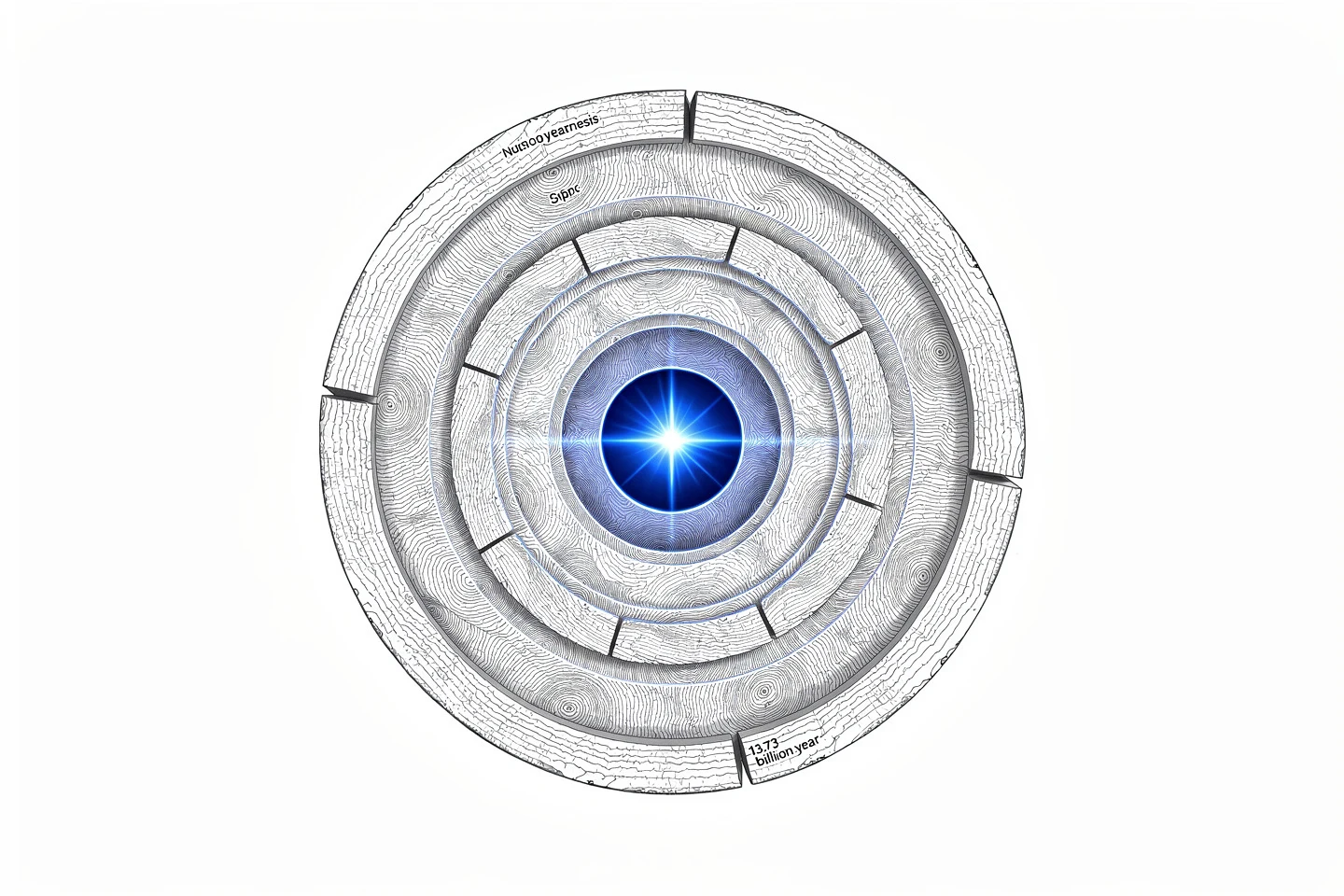
Astronomers debate the age of the universe as passionately as 19th-century geologists argued over the age of the Earth. Direct measurements give contradictory numbers: Edwin Hubble's law and the cosmic microwave background paint different cosmic chronologies. In search of truth, researchers turned to 'galactic archaeology' — the study of the oldest stellar populations. Our Milky Way appears as a giant fossil metropolis: each star is a petrified fragment of history, and its chemical composition is a geological layer. The poorer the star in metals, the older it is; it's like reading a city's age by the inscriptions on its stones.
A new study combined the power of LAMOST spectroscopy and Gaia astrometry, sifting through 247,000 stars. Rigorous selection based on metallicity and α-element abundance left 155,600 candidates — true galactic centenarians. Applying MCMC reconstruction to their age distribution, scientists pinpointed the moment where real stars give way to measurement noise. This sharp edge indicated the maximum possible age: 13.73 (+0.18/–0.15) billion years.
Adding about 0.2 billion years — the time from the Big Bang to the birth of the first long-lived stars (an idea dating back to Georges Lemaître) — we get a universe age of 13.93 billion years. An amazing match with the standard ΛCDM model prediction, calibrated by the CMB. But trendy 'early' solutions to the Hubble tension predicted a universe only 12.91 ± 0.18 billion years old — a full billion years younger. Our result rules them out with over 3σ confidence. The oldest stars proved too old for theories that speed up expansion in the early epoch.
This work not only strengthens the case for standard cosmology but also forces a rethink of the interpretation of redshifts in the nearby universe. Perhaps the key to the Hubble tension lies not in exotic pre-recombination physics, but in subtle systematic errors — for instance, in local voids distorting the motions of galaxies. Further progress will require refined stellar models and cosmographic parameters that don't demand a revision of general relativity. The Milky Way is not just our home, but also the oldest chronicler, its tablets etched with chemical letters. It will keep tossing up riddles about the first moments of the Big Bang for a long time to come.
The oldest star in the sample, Gaia DR3 3656896440426302592, is 13.73 billion years old — just 0.2 billion years younger than the universe itself. With a typical error of 7.5%, its true age could be as high as 14 billion years! Imagine: the light from a star that is a peer of the cosmos traveled to us for 13.7 billion years.