Black Holes Sing in Two Frequencies: A Connection Found ✛
In the first moments after the Big Bang, primordial black holes could have formed in ultra-dense clumps. Today, they are considered one of the main contenders for dark matter — the invisible substance that binds galaxies together.
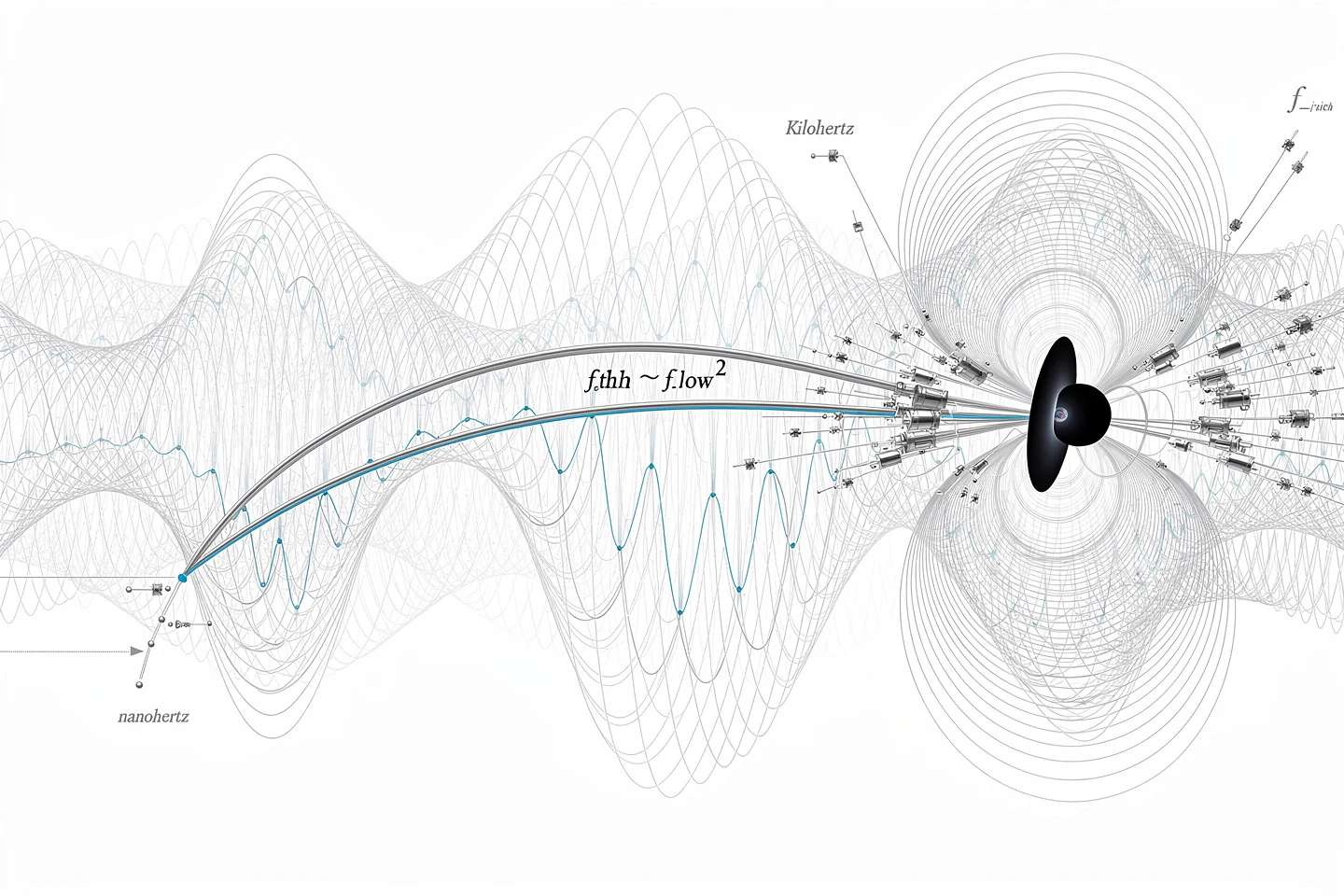
Imagine a distant thunderstorm: first, you hear a low rumble, then a sharp crack of lightning nearby. Though the sounds differ, they stem from the same flash. It's similar with holes: their birth creates a low-frequency hum, which today we try to capture using pulsars — cosmic "lighthouses" sending out strictly periodic signals. And when two holes spiral together and merge, they produce a high-frequency "chirp," detectable by ground-based instruments. The study's authors realized that the hum frequency and chirp frequency are linked by a simple rule: knowing one lets you predict the other. The calculations even had to account for the speed of light and time dilation due to cosmic expansion, as well as the influence of mysterious dark energy that accelerates the Universe. This discovery bridges two different methods of catching gravitational waves and promises new insights into the nature of things. The first hints of such ideas appeared with Stephen Hawking, and detectors like the one built with the participation of Rainer Weiss are already poised to listen to this cosmic symphony.
A hum at one nanohertz (one oscillation every 30 years) matches a black hole merger at 34 kilohertz — ultrasound far beyond human hearing.