Gravitational Waves from Primordial Black Holes: Linking Low and High Frequencies ✛
Context
Studying the early Universe and the nature of dark matter is a key goal of modern cosmology. Primordial black holes (PBHs), possibly formed right after the Big Bang from the collapse of overdense regions, are dark matter candidates. Their formation requires rare but strong curvature fluctuations, which inevitably produce a background of second-order gravitational waves — so-called scalar-induced gravitational waves (SIGWs). When PBHs then form binaries and merge, they emit another, much higher-frequency gravitational signal. Detecting such events with detectors like LIGO and future instruments would open a new window into inflation physics and the composition of dark matter. The key idea of the new work is to show that these two signal types share a common origin and can be tightly linked through the PBH mass. Stephen Hawking laid the foundations of our understanding of such objects.
Methods
The analysis is based on an amplified primordial curvature spectrum with a narrow peak, corresponding to an almost monochromatic PBH mass function. The amplitude of this peak is constrained by current PBH abundance data. Using the Press-Schechter formalism with nonlinear corrections, the authors computed the variance of density contrasts and, consequently, the SIGW amplitude for two collapse scenarios: spherical and ellipsoidal. The SIGW spectrum is derived from the tensor power spectrum at second order in perturbation theory, evolved to the present day, accounting for changes in relativistic degrees of freedom, finite speed of light, and time dilation due to cosmological expansion. For the merger signal, a merger rate model with suppression was used, along with an approximation of the full binary radiation spectrum. The key step is matching the SIGW peak scale to the innermost stable circular orbit (ISCO) frequency for an equal-mass PBH binary. This gives an analytical link between the SIGW frequency and the characteristic merger frequency. Detectors like those built with contributions from Rainer Weiss can pick up such signals.
Results
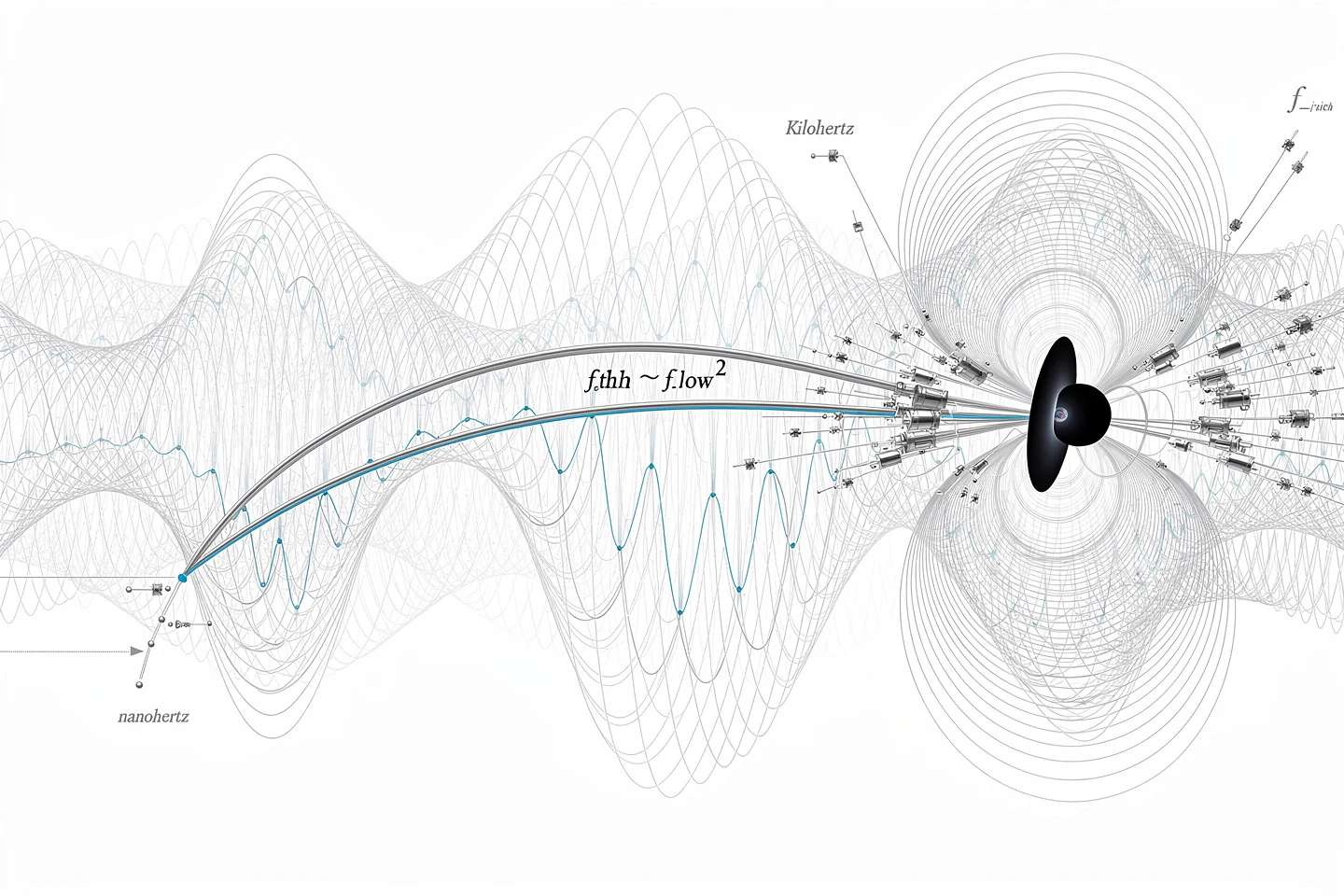
The main result is a direct correspondence between the peak SIGW frequency ($f_{SIGW}$) and the merger ISCO frequency ($f_{ISCO}$): $f_{ISCO}$ ≈ 3.4×$10^{20}$ Hz ($f_{SIGW}$/Hz)^2. This means that a nanohertz SIGW signal, detectable by, for example, pulsar timing arrays (PTAs), translates into a kilohertz merger signal accessible to LIGO-class detectors. Moreover, it is numerically shown that the peak of the total merger spectrum, $f_{peak}$, always satisfies an almost universal relation $f_{peak}$ = 1.79 $f_{ISCO}$, independent of PBH masses. This allows using $f_{ISCO}$ as a reliable estimate of the peak frequency. The authors also, for the first time, compared predictions for the SIGW background between spherical and ellipsoidal collapse: due to a higher collapse threshold in the latter, the SIGW amplitude is significantly higher — over an order of magnitude for some frequencies. For instance, for PBHs with masses around $10^{-2}$ solar masses, the signal in the ellipsoidal scenario reaches a peak amplitude of $h^2$ $Ω_{GW}$ ~ $10^{-9}$, which could be accessible to the future DECIGO detector. Dark energy in the form of a cosmological constant was also accounted for in the background evolution calculations.
Implications
The established connection is of fundamental importance for multi-messenger gravitational-wave astronomy. It proves that detectors operating in vastly different frequency bands — from nanohertz (PTA) to kilohertz (LIGO, ET) — can probe the same primordial perturbation amplification process. This opens the possibility of indirectly constraining the high-frequency PBH merger background, currently inaccessible to direct measurements, through observations of the low-frequency SIGW background. Furthermore, comparison of spherical and ellipsoidal models shows that uncertainty in collapse dynamics strongly affects amplitude predictions, which is crucial for interpreting future detections.
Future development
The proposed unified approach lays the groundwork for further development. In the future, it can be generalized to extended (non-monochromatic) PBH mass functions and broader primordial curvature power spectra, making the model more realistic. It is also important to include a more accurate description of merger rate suppression due to interactions in clusters and the early Universe. With data from next-generation detectors like the Einstein Telescope and Cosmic Explorer, joint analysis of both gravitational-wave channels will become possible, greatly tightening constraints on inflation parameters and dark matter composition.
Impact
The work will impact early-Universe physics, black hole astrophysics, gravitational-wave astronomy, and cosmology. It bridges fields such as the search for a background of nanohertz gravitational waves using pulsars and the detection of individual black hole mergers by ground-based interferometers.
Next steps
Immediate next steps include testing the obtained relation f_peak = 1.79 f_ISCO for a broader class of binaries, including unequal-mass systems. It is also necessary to investigate how the connection between f_SIGW and f_ISCO depends on the choice of window function when smoothing perturbations.
Key open problems
The work directly addresses unsolved problems in physics: the nature of dark matter and the origin of the primordial perturbations that led to structure formation in the Universe. The link between the two types of gravitational waves could be key to understanding the inflationary stage of the Big Bang and the mechanism of black hole generation in the early Universe.
The knowledge machine's view
This section is addressed to the author of the paper and their colleagues. Neighbouring works were found by meaning-based search across our archive, not by word overlap. We do not review: we show the field around the work.
What the work does
The authors linked scalar-induced gravitational waves from the formation of primordial black holes to gravitational waves from their mergers, obtaining an analytical relation between the peak frequency of SIGWs and the ISCO frequency of the merger, as well as a universal factor of 1.79 for the peak of the merger spectrum.
Where its strength is
A direct quantitative connection is established between signals in the nanohertz and kilohertz ranges, allowing observations in one range to predict the signal in the other.
Where it could go next
- It might be interesting to compare the obtained relation with the analysis of the joint contribution of astrophysical and cosmological backgrounds in the work on signal separation, to assess how the presence of PBHs affects the interpretation of detector data.based on: Two Signals in the Universe's Noise arXiv:2608.00281v1
- A nearby review considers gravitational waves from PBHs in a broader context, including possible formation mechanisms and observational signatures; additional constraints or ideas for testing the proposed relation might be found there.based on: Chord from the Abyss: Gravitational Waves of Primordial Black Holes arXiv:2607.01818
- In the archive, there is a work on gravitational atoms of axions around black holes, which investigates the environmental influence on the merger signal; using such an approach could refine the expected spectrum from PBH binaries.based on: Gravitational atoms of axions sing in black hole pairs arXiv:2606.28161
Worth trying
- Test the robustness of the relation f_peak = 1.79 f_ISCO for a broader class of PBH mass functions, not just for a nearly monochromatic spectrum.
- Assess how uncertainties in merger rates and environmental suppression affect predictions for specific detectors.
- Consider using PTA data to constrain the parameters of the curvature spectrum peak through its connection to the expected merger signal.
Why this may matter
If the link between low- and high-frequency gravitational waves is confirmed, it will provide a powerful tool for testing the hypothesis that primordial black holes constitute dark matter and will allow existing and planned observations to mutually enhance constraints.
Nearby works in our archive
- Chord from the Abyss: Gravitational Waves of Primordial Black Holessimilarity 0.72
- Black Hole Collisions: A Hum That Echoes Across the Universesimilarity 0.71
- Black Holes Are Born When the Universe Bouncessimilarity 0.70
- Cosmic Strings: Echoes of the Universe's Birthsimilarity 0.70
- Magnetic Ripples from the Dawn of Timesimilarity 0.69
- Gravitational atoms of axions sing in black hole pairssimilarity 0.69
- Two Signals in the Universe's Noisesimilarity 0.68
The archive is crowded around this work: 9 reviews nearby, closest at 0.72. This ground is well walked — and there is plenty to compare against.
Original abstract
as written by the authors arXiv:2607.01818v1
Formation of primordial black holes (PBHs) requires a significant enhancement of curvature perturbations. This enhancement generates a twofold gravitational wave (GW) signature: a \emph{low-frequency} stochastic background of scalar-induced GWs (SIGWs) and a distinct \emph{high-frequency} signal from subsequent PBH binary mergers. Assuming a monochromatic PBH mass function, we use PBH abundance constraints on the primordial curvature power spectrum to evaluate the stochastic SIGW background. We also compute the stochastic GW background from mergers of the corresponding PBH binaries, incorporating merger-rate suppression effects to obtain realistic estimates. Furthermore, we derive a model-independent correspondence between the characteristic frequencies of these two signals. This unified framework links these otherwise distinct GW channels, enabling the same primordial fluctuations to be probed across widely separated frequency bands.
For example, a signal at a frequency typical of pulsar observations — just one nanohertz (one oscillation every 30 years!) — corresponds to a primordial black hole merger that occurred at about 34 kilohertz, thousands of times higher than audible sound. Indeed, the Universe sounds in different octaves!
Key numbers
- fISCO / fSIGW: fISCO ≈ 3.4×10²⁰ Hz (fSIGW/Hz)^2
- fpeak / fISCO: 1.79
- ISCO frequency for a 1 M⊙ PBH: 2200 Hz
- PBH mass range: 10-16 to 100 M⊙
- peak SIGW amplitude (ellipsoidal collapse): h^2 Ω_GW ~ 10-9 for MPBH = 10-2 M⊙