Cosmic Symphony: How the Bass and Whistle of Primordial Black Holes Sound in Unison ✛
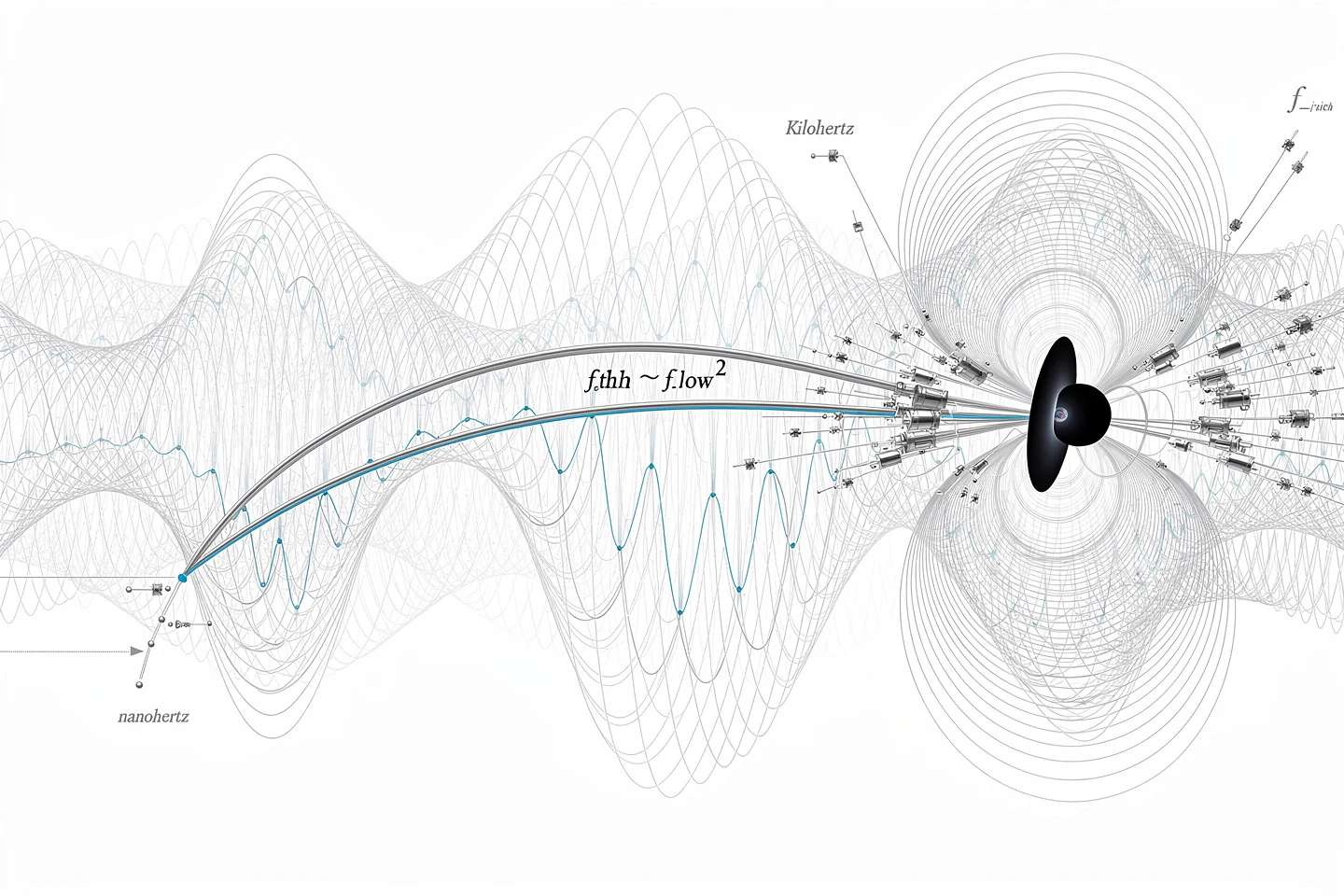
The mystery of dark matter has puzzled physicists for nearly a century. Among the candidates for its role are primordial black holes (PBHs), born in the fiery embrace of the first moment after the Big Bang. The idea itself, voiced by Stephen Hawking, has grown flesh from calculations: for enough such holes to form and today explain the hidden mass, the infant Universe must have contained gigantic overdensities — peaks in spacetime curvature. In a new study, astrophysicists have proved that these primordial spikes leave a dual gravitational autograph: a low-frequency hum lasting eons, and a high-frequency ring from the mergers of binary black holes, and both signals are linked by an unbreakable thread.
It’s like an orchestra playing the same theme in two extreme registers. The double basses of pulsar timing carry their slow part: one oscillation stretches thirty years. And somewhere on another stage, the piccolo flute of ground-based interferometers, like those built with the involvement of Rainer Weiss, trills at tens of thousands of hertz. Previously, these voices were considered independent, but the work shows: the peak frequency of the basses unequivocally sets the pitch of the whistle.
The central discovery is an almost magical formula, the “tuning fork” of the entire piece. The peak frequency of the scalar-induced gravitational wave background $f_{SIGW}$ (typical nanohertz range) and the frequency of the innermost stable circular orbit (ISCO) before the merger of a hole of the same mass are related as $f_{ISCO}$ ≈ 3.4×$10^{20}$ Hz ($f_{SIGW}$/Hz)^2. In other words, if we “hear” a wave rippling the pulsar sea at one nanohertz, then the paired merger of the same black holes strikes a spark at around 34 kilohertz — almost twenty orders of magnitude higher.
Moreover, the collapse of overdensities could have proceeded differently: if the dense clumps took not a spherical but an ellipsoidal shape, the threshold for hole formation turns out higher, and the perturbations must be even stronger. This sharply boosts the amplitude of the background hum — calculations yield an enhancement of more than an order of magnitude for masses around a hundredth of a solar mass. Thus, the gravitational wave signature encodes not only the mass but also the drama of birth.
This connection turns detectors of different profiles into a single instrument. Ground-based interferometers, heirs to the ideas of Rainer Weiss, operate in kilohertz, networks like PTA listen in nanohertz, and the future space-based DECIGO will fill the gaps. Now, by measuring the low-frequency background, one can predict which high-frequency signal to expect, and vice versa. We gain stereoscopic vision into the world of primordial perturbations, where clues to inflation, the nature of dark matter, and even the behavior of dark energy, which influences expansion through time dilation on cosmological scales, are hidden. The relationship itself is as inexorable as the speed of light: it is written into the structure of Einstein’s equations.
Someday, a joint analysis of these channels will allow not just constraining models, but directly recreating the sound of the early Universe. And perhaps primordial black holes will cease to be a hypothesis and become what holds galaxies from flying apart.
Imagine: to record a single full oscillation of a nanohertz wave, you need to observe for nearly 30 years, and in that time, the LIGO detector could register a million cycles of the high-frequency signal from the same source.