The Kick of a Dying Star: Where Lonely Planets Come From ✛
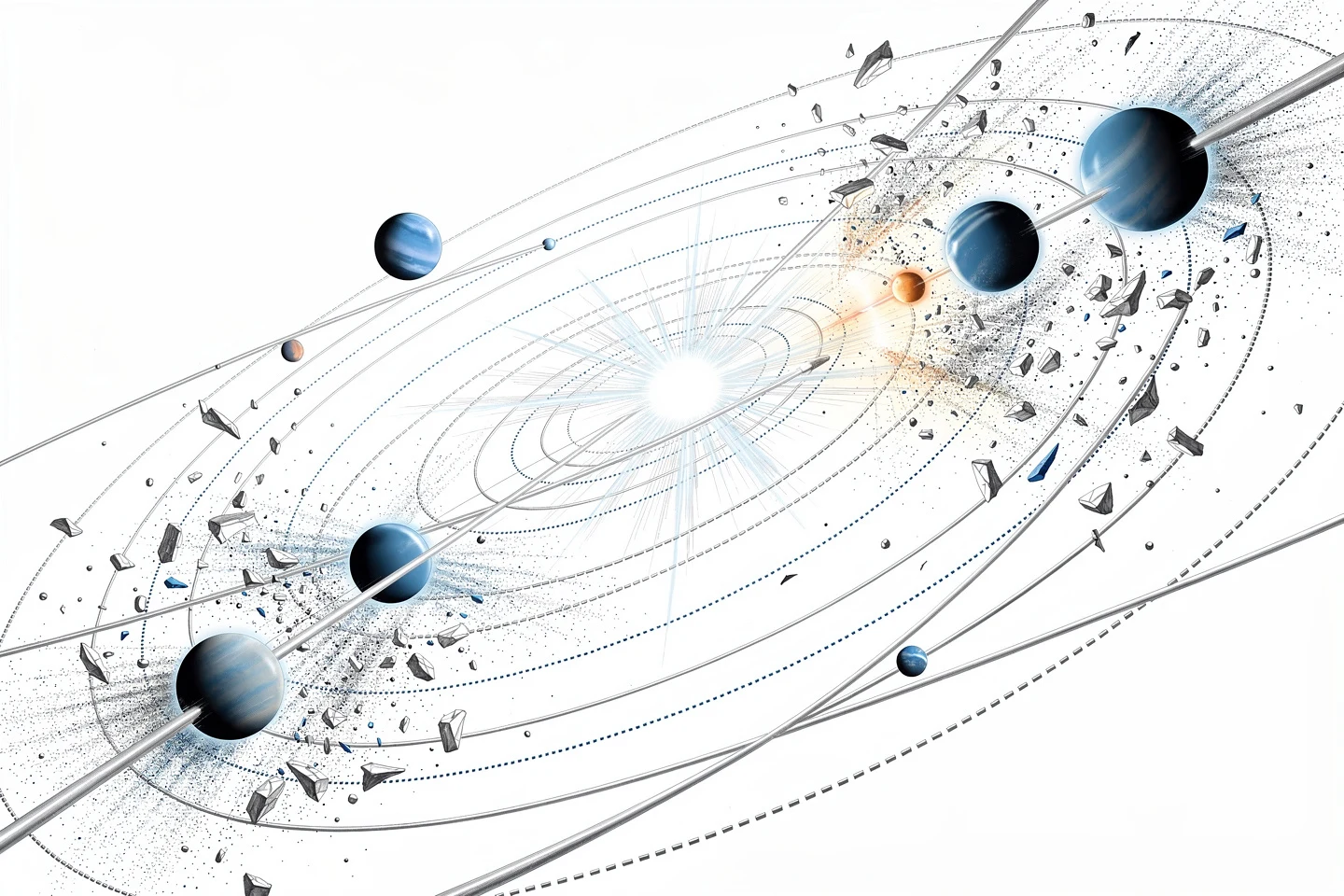
When a star like our Sun ages, it swells into a red giant and then shrinks into a white dwarf — a tiny but very dense star. At that moment, it loses some of its mass and receives a small kick, like the recoil from a gun. The average kick speed is about 0.75 kilometers per second — faster than a bullet, but very little by cosmic standards. Yet even such a weak push is enough to jostle planetary orbits. It's like billiards: after the cue ball strikes, the balls scatter in all directions. So the gentle kick of a dying star can disrupt an orderly planetary system, flinging some planets into open space.
Most known exoplanets have been discovered by the transit method — when a planet passes in front of the star and slightly dims it. This method was used by the Kepler telescope, launched under the leadership of William Borucki. It found thousands of worlds, but mostly ones close to their stars. Distant planets are hard to see this way. But free-floating planets, on the contrary, are searched for via gravitational microlensing — when such a planet-lens magnifies the light of a distant star. This allows even dark objects to be detected.
What's especially important is that ejected planets stay warm. When the star was a red giant, it intensely heated its planets. After the ejection, they cool down slowly. A Jupiter-like world could maintain a temperature above 400°C for millions of years. That means it could be spotted by infrared telescopes — for example, James Webb or in archival images from Hubble. Scientists can even determine the planet's composition using spectroscopy — splitting light into colors, like a rainbow. In our Galaxy, such warm wanderers born from white dwarf kicks could account for a few percent of the total free-floating planets. That's a small but important contribution that will help us better understand the fate of planets and find new worlds.
If the Sun became a white dwarf today, Jupiter would heat up to 700 degrees and glow in infrared longer than humanity has lived on Earth.