The contribution of white dwarf kicks to the population of free-floating planets ✛
Context
Free-floating planets — exoplanets without parent stars — are a numerous but still not fully understood class of objects. Most proposed formation mechanisms, such as direct collapse or ejection in young systems, operate at early evolutionary stages. However, little attention has been paid to the role of late stellar evolution. Observations of gravitational microlensing have already identified many FFP candidates, and the upcoming Galactic survey by Roman will significantly increase their numbers. Modern detection methods for exoplanets, like the transit method (e.g., the Kepler mission led by William Borucki and TESS), are strongly biased toward short-period orbits, whereas FFPs are mostly discovered through microlensing.
Methods
To assess the impact of white dwarf kicks, the empirical kick velocity distribution derived for exoplanetary systems from Gaia observations was used (peak at about 0.75 km/s), and the kick was assumed to occur instantaneously at the end of the asymptotic giant branch (AGB) phase. Based on an analytical derivation of the fraction of directly disrupted orbits and the Petrovich (2015) stability criterion, the probability of instability in known multi-planet systems was estimated. Calculations were supplemented by n-body numerical simulations with the REBOUND code for 53 systems from the NASA exoplanet archive, whose host stars are massive enough to become white dwarfs within the age of the universe. The modeling was limited to 5 million years after the kick.
Results
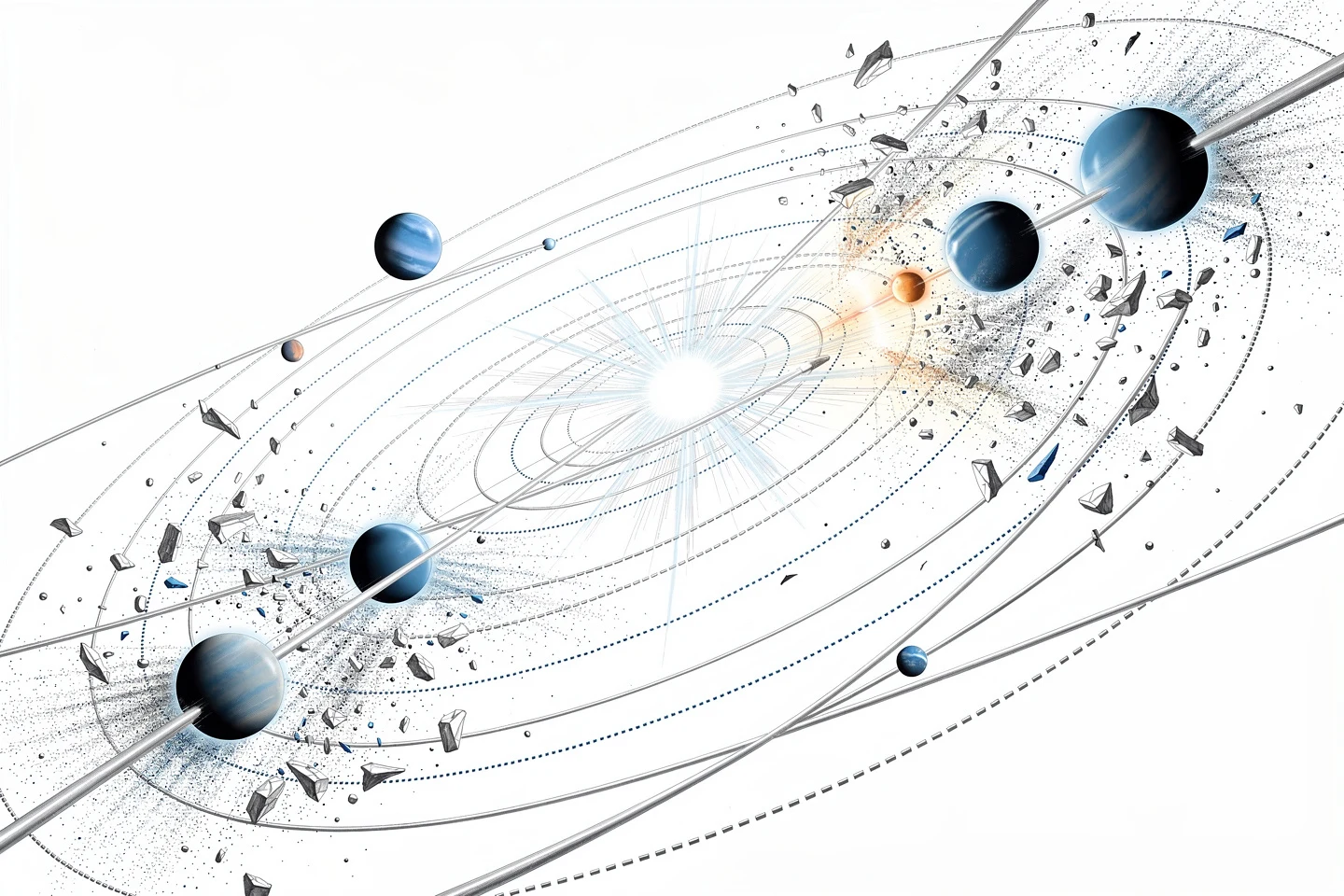
Direct release of planets by kicks affects only about 1.3% of the known exoplanet population, which is expected due to observational bias toward close-in orbits. However, in 41% of multi-planet systems, according to the stability criterion, the kick leads to orbit crossing or violation of stability conditions; numerical simulations show ejections in 47% of cases within 5 million years. As an example, in the outer Solar System, the Uranus–Neptune pair exhibits a 50% probability of instability after a similar kick. Such events produce FFPs with characteristic velocities of about 0.75 km/s, which remain within a projected distance of no more than 5 pc from the former star for ~8 million years in half of the cases. Moreover, during the AGB phase, planets were subjected to intense heating: for a Jupiter-like planet, the temperature could reach 700 K. After ejection, such a giant cools according to a power law, staying above 400 K for many millions of years. The total contribution of the white dwarf kick channel to the overall FFP population of the Galaxy is estimated at a few percent, which is significant for the statistics of future surveys.
Implications
The existence of warm, slowly receding FFPs in the vicinity of young white dwarfs opens a new observational window. These objects can be distinguished from other FFPs by their infrared excess and spatial correlation with white dwarfs. This changes approaches to searching for and classifying exoplanets, and underscores the importance of accounting for late stellar evolution in models of planetary system dynamics. Data from future telescopes like James Webb and Hubble (via archival observations) could be used to test these predictions.
Future development
The upcoming survey of the Galaxy by Roman using microlensing will greatly expand the sample of FFPs, and identifying the subpopulation from white dwarf kicks will become possible when combined with infrared observations, for instance, with spectroscopic instruments on future telescopes. Development of planetary cooling models and accounting for the diversity of their internal structures will allow more accurate estimates of the visibility timescales for such warm FFPs. As the Galaxy ages, the fraction of this channel will increase, affecting the mass function of FFPs.
Impact
The results will impact observational exoplanetology, stellar astrophysics (especially the dynamics of open clusters and stellar streams), and the planning of search strategies for microlensing-oriented missions.
Next steps
Full-scale n-body simulations with longer evolutions and realistic orbital distributions are needed, along with a targeted infrared survey of a few dozen young white dwarfs to search for excess thermal signatures at distances up to 10 pc.
Key open problems
This work connects the unresolved questions of free-floating planet origins with the physics of mass loss and kicks during white dwarf formation. The exact kick mechanism, its dependence on initial stellar mass, and the influence of mutual inclinations on the long-term stability of multi-planet systems remain open.
The knowledge machine's view
This section is addressed to the author of the paper and their colleagues. Neighbouring works were found by meaning-based search across our archive, not by word overlap. We do not review: we show the field around the work.
What the work does
The authors assessed the contribution of white dwarf kicks to the population of free-floating planets using the empirical kick velocity distribution from Gaia and the Petrovich stability criterion, along with numerical simulations of 53 known systems. They showed that although direct liberation affects only ~1.3% of exoplanets, in ~41% of multi-planet systems the kick triggers instability, and in ~47% of cases ejections occur within 5 million years. The ejected planets can remain hot and detectable for millions of years, and their contribution to the overall FFP population is estimated at a few percent.
Where its strength is
The strength of the work lies in combining analytical estimates with numerical simulations for specific observed systems, allowing quantitative predictions for future surveys such as Roman.
Where it could go next
- It might be interesting to compare your late-ejection scenario with the early-ejection mechanisms in young stellar clusters discussed in a neighboring paper, to refine the relative contribution of different channels.based on: Cosmic Billiards: How Planets Become Wanderers arXiv:2601.09835v2
- A nearby paper examines the influence of dark matter on the dynamics of distant planets; perhaps its approach to accounting for external perturbations could be useful for modeling the long-term evolution of ejected planets.based on: Dark Matter Sways Distant Planets arXiv:2606.14827
- There is an analysis in the archive about orbital misalignment in planetary systems; it would be interesting to check how a white dwarf kick affects mutual inclinations and whether this could enhance instability.based on: Born Misaligned: Why Planets Don't Dance to Their Star's Tune arXiv:2508.06488
Worth trying
- Test how the fraction of unstable systems changes when accounting for a finite kick duration rather than an instantaneous impulse.
- Estimate the observable manifestations of hot FFPs in the infrared for future missions such as Roman.
- Expand the sample of systems for simulation to include systems with wider orbits, which may be more sensitive to kicks.
Why this may matter
Understanding the contribution of late stellar evolution to the free-floating planet population is important for interpreting microlensing data and planning future surveys, as well as for a complete picture of the fate of planetary systems.
Nearby works in our archive
- Cosmic Billiards: How Planets Become Wandererssimilarity 0.68
- A Star Sneezes and Drifts Awaysimilarity 0.66
- Planetary Budget Doesn't Add Upsimilarity 0.64
- Black Holes Are Born When the Universe Bouncessimilarity 0.61
- Dark Matter Sways Distant Planetssimilarity 0.60
- Born Misaligned: Why Planets Don't Dance to Their Star's Tunesimilarity 0.60
The closest work in the archive sits at 0.68 by meaning — the usual level for our corpus.
Original abstract
as written by the authors arXiv:2607.02653v1
Free-Floating Planets (FFPs) are a distinct class of exoplanets that do not orbit stars but are nevertheless found to be very common. A variety of formation mechanisms have been proposed as their origin, such as "star-like" direct collapse from gas and dust clouds or ejection from young planetary systems via dynamical instabilities. Here, another possible formation scenario is explored that would instead apply for old planetary systems, in the form of White Dwarf (WD) formation kicks. Observations over recent years have shown that WDs experience a mild recoil kick during their formation from Asymptotic Giant Branch (AGB) stars. Here we show that, while WD formation kicks directly unbind only $$\sim1\%$$ of the known planet and exoplanet population, they drive dynamical instabilities in $$\gtrsim40\%$$ of known long-period multi-planet systems, likely leading to planet ejection and FFP generation in roughly half of all such systems. We also show that FFPs generated via WD kicks will additionally have undergone significant and long-lasting heating via their host stars' enhanced AGB luminosities. Given the low ejection velocities due to the weakness of the WD kicks, such warmed FFPs can thus be associated with their former host stars for several Myr after formation. Therefore, WD formation kicks contribute a distinct, observationally identifiable FFP sub-population comprising a few percent of the Galaxy's FFPs, relevant for the results of the upcoming {\it Roman} Galactic Exoplanet Survey.
If the Sun turned into a white dwarf right now, Jupiter would heat up to 700 K — hotter than the surface of Venus — and would stay warm longer than human civilization has existed.
Key numbers
- Kick velocity: 0.75 km/s
- Fraction of unstable multi-planet systems: 41–47%
- Time within projected 5 pc of host (half the sample): 8 million years
- Temperature of Jupiter during the Sun's AGB phase: 700 K
- Estimated contribution to the overall FFP population: a few percent