Cosmic Kick: Warm Orphans Born from Stellar Death ✛
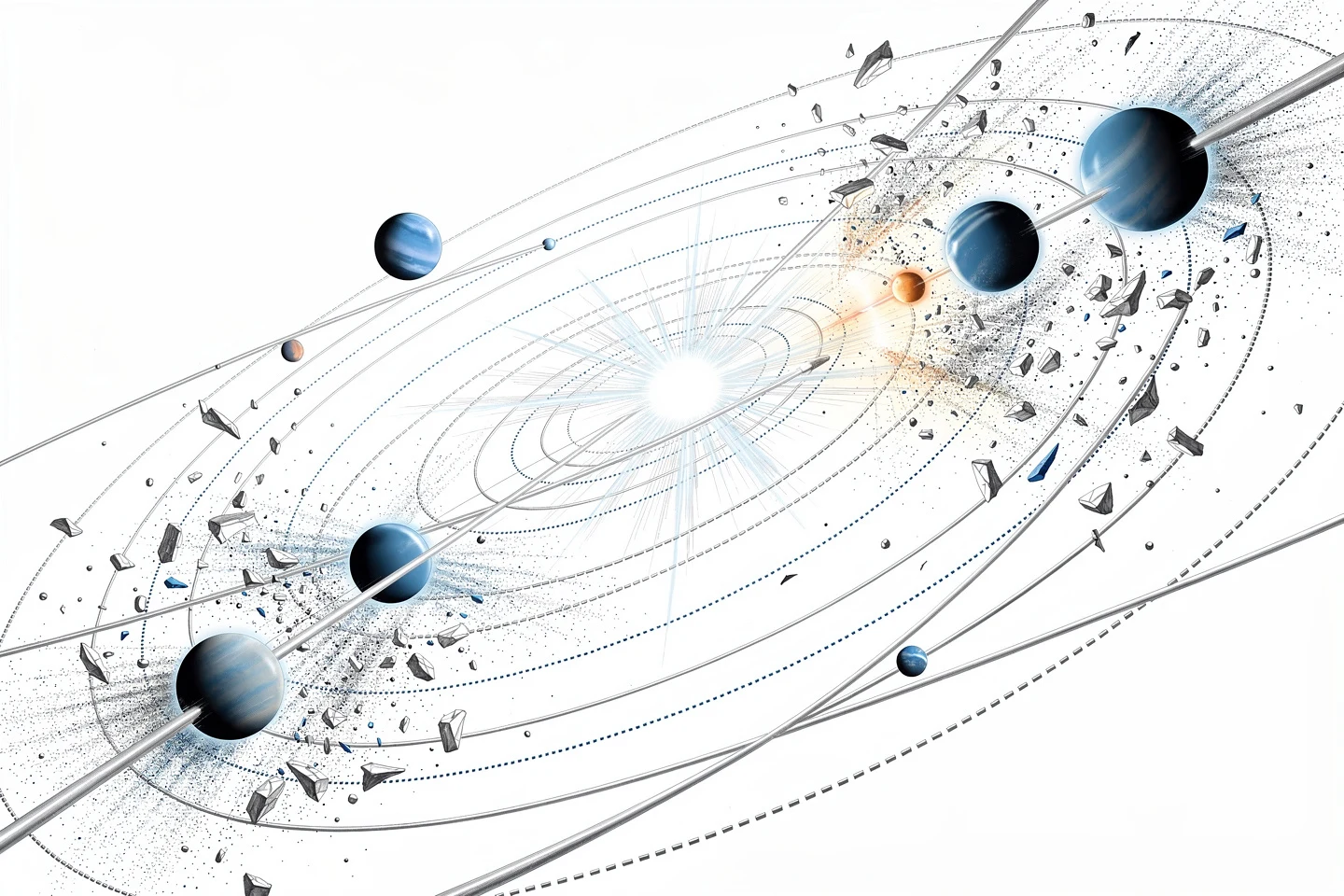
Like an exquisite clockwork mechanism, a multi-planet system responds sensitively to the slightest nudge. And when the star at the heart of this mechanism dies, shedding its envelope and turning into a white dwarf, even a modest kick at a speed of 0.75 km/s can trigger a cascade of events, flinging entire worlds into interstellar emptiness. That’s exactly the scenario recently described by astrophysicists, offering a new channel to replenish the population of free-floating planets (FFP) in our Galaxy.
[caption]After the kick, up to half of multi-planet systems become unstable. In the outer Solar System, the Uranus–Neptune pair has a 50 percent chance of disruption during a similar event.[/caption]
The kick that arises during a white dwarf’s birth, caused by asymmetric mass loss on the asymptotic giant branch, directly unbinds the orbits of only 1.3% of known exoplanets — a consequence of observational bias: the transit method of missions like Kepler (led by William Borucki) and TESS catches planets that are tucked in close to their stars. But in systems with multiple worlds, even a weak jolt triggers gravitational instability: orbits cross, and planets collide or get ejected. Numerical simulations of 53 real systems show that within 5 million years of evolution, ejection occurs in 47% of cases. Thus the stellar clockwork falls apart, scattering its gears — the planets.
Even before their exile, these worlds bathe in the infrared glow of the dying star. For a Jupiter-like planet, temperatures may reach 700 K, hotter than the surface of Venus. After ejection, it cools following a power law, staying above 400 K longer than human civilization has existed. Such warm wanderers are ideal targets for microlensing, especially combined with infrared observations from James Webb and archival data from Hubble. They drift slowly away from their former parent star, and half are still visible within 5 parsecs after 8 million years.
[caption]An ejected Jupiter cools for millions of years, remaining warm — hotter than the surface of Mercury, despite the absolute cold of space.[/caption]
The upcoming survey of the Galaxy by the Roman telescope will uncover thousands of new FFPs specifically through microlensing, and isolating the subpopulation born from white dwarf kicks will become possible by targeted searches for thermal excess. This shifts the approach to classifying solitary worlds and links planetary system dynamics with the final stages of stellar evolution. As the Galaxy ages, the share of this channel will only grow, replenishing the interstellar medium with former moons and giants. Future spectroscopic instruments will help distinguish them by chemical composition and temperature, turning cosmic orphans into full-fledged objects of demographic research.
If the Sun turned into a white dwarf right now, Jupiter would heat up to 700 K, hotter than the surface of Venus, and would stay warm longer than human civilization has existed.