Black Hole with a Quark Secret express
At the centers of many galaxies lurk supermassive black holes. One of them, Sagittarius A* at the heart of the Milky Way, has become a testing ground for a new idea. The authors of the work took Einsteinian gravity and added an unusual electromagnetic field to it. This field is designed to mimic confinement — the phenomenon that locks quarks inside protons and prevents them from flying apart. This gave rise to a metric with a logarithmic correction governed by the parameter ζ. It alters both the event horizon and the vicinity of the singularity.
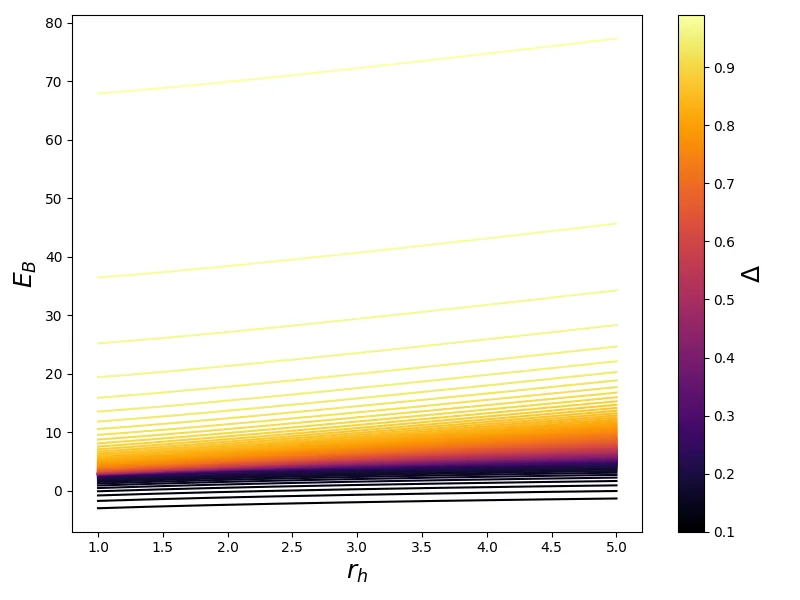
Using the tunneling method for Dirac fermions, physicists computed the Hawking temperature. It turned out that the ζ-terms tame the runaway temperature growth for small holes and hint at the existence of a remnant — a stable clump that does not evaporate completely. Then quantum-gravitational fluctuations, accounted for via Barrow entropy with deformation parameter Δ, came into play. In the extended phase space, they calculated a whole bouquet of thermodynamic quantities: internal energy, free energy, pressure, heat capacity, isothermal compressibility, and the Joule-Thomson coefficient. The heat capacity indicated stability zones depending on Δ, while the compressibility remained negative everywhere. This means the black hole behaves not like a gas but like a rigid, mechanically unyielding body.
The biggest surprise came from geometry. Four different quantities (the peak of the Hawking temperature, the divergence of heat capacity, the Joule-Thomson inversion, and the zero of radial tidal force) converged at the same radius r⋆. It is determined by a simple condition: the second derivative of the function A(r) equals zero. Meanwhile, the extremal horizon and the zero of angular tidal force coincided through the first derivative at the horizon. This reduces the entire analysis of critical points to two scalar equations. Tidal accelerations that would tear an astronaut apart overlapped with the thermodynamic curves. By overlaying Event Horizon Telescope data for Sagittarius A*, the authors obtained the constraint ζ ≲ 0.7 for charge Q/M = 0.5. The window for new physics remains ajar, and the confinement term promises noticeable corrections to the deflection of geodesics, the trajectories of test particles.
The compressibility of this black hole is negative — if you could squeeze it, it would expand in response, like a stubborn spring.
The idea of a stable black hole remnant echoes the 'quantum seeds' from Greg Egan's novel Schild's Ladder, where microscopic black holes become building blocks of new physics.