Black hole swapped wind for jet ✛ ✎
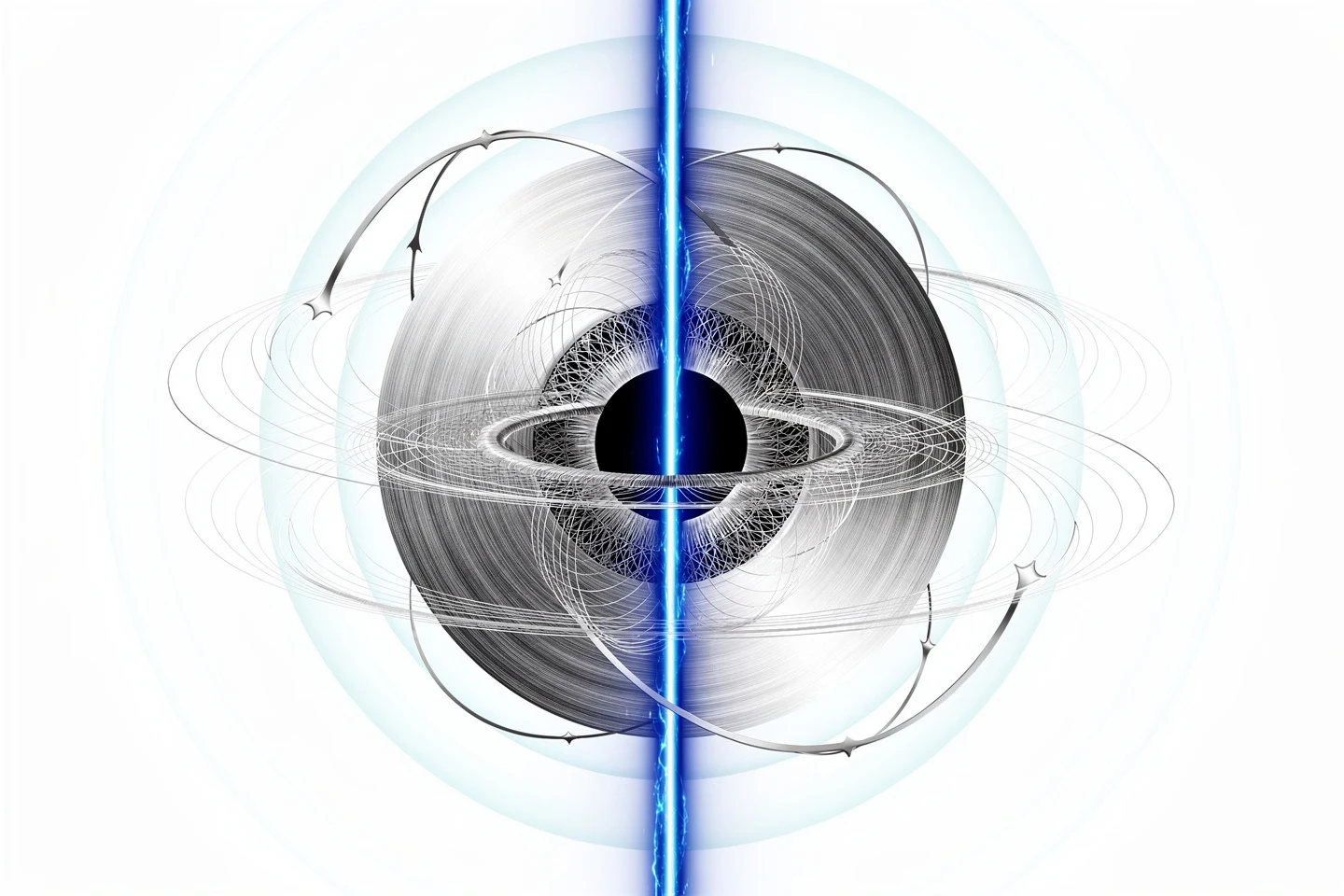
At the center of almost every galaxy lurks a black hole — a cosmic vacuum cleaner of incredible power. Its boundary — the event horizon — was first described by Karl Schwarzschild. Usually, a hole calmly surrounds itself with a swirl of gas, but sometimes it wakes up and begins to greedily consume matter. Part of it heats up to millions of degrees and is ejected away — either as a chaotic wind in all directions, or as a narrow jet, like a laser beam.
Imagine a bathtub with a drain. When there's a lot of water, it splashes and sprays — that's the 'wind'. But as the water level drops, a neat whirlpool forms, going straight down the drain — that's the 'jet'.
This switch happened in galaxy 1ES 1927+654. X-ray telescopes — unlike the good old Hubble, which catches ordinary light — peered into the very inferno. They saw clear lines appear in the radiation, like fingerprints of chemical elements. Thanks to spectroscopy, scientists identified these as glowing hydrogen and oxygen. The wind died down, and instead the outflow stretched into a speedy jet, accelerating to nearly the speed of light.
Previously, astronomers didn't know how winds and jets were connected. Now it's clear: they are two stages of one process. Such switches have influenced the entire history of the Universe after the Big Bang and still govern galaxy growth and the distribution of mysterious dark matter, discovered by Vera Rubin. Stephen Hawking suggested that black holes are changeable — and this work confirms his insights.
The jet accelerated to 20% the speed of light — that's about 60,000 kilometers per second. At that speed, you could circle the Earth in a second and a half.