The Pulse of a Black Hole: Birth of a Jet in X-ray Echo ✛ ✎
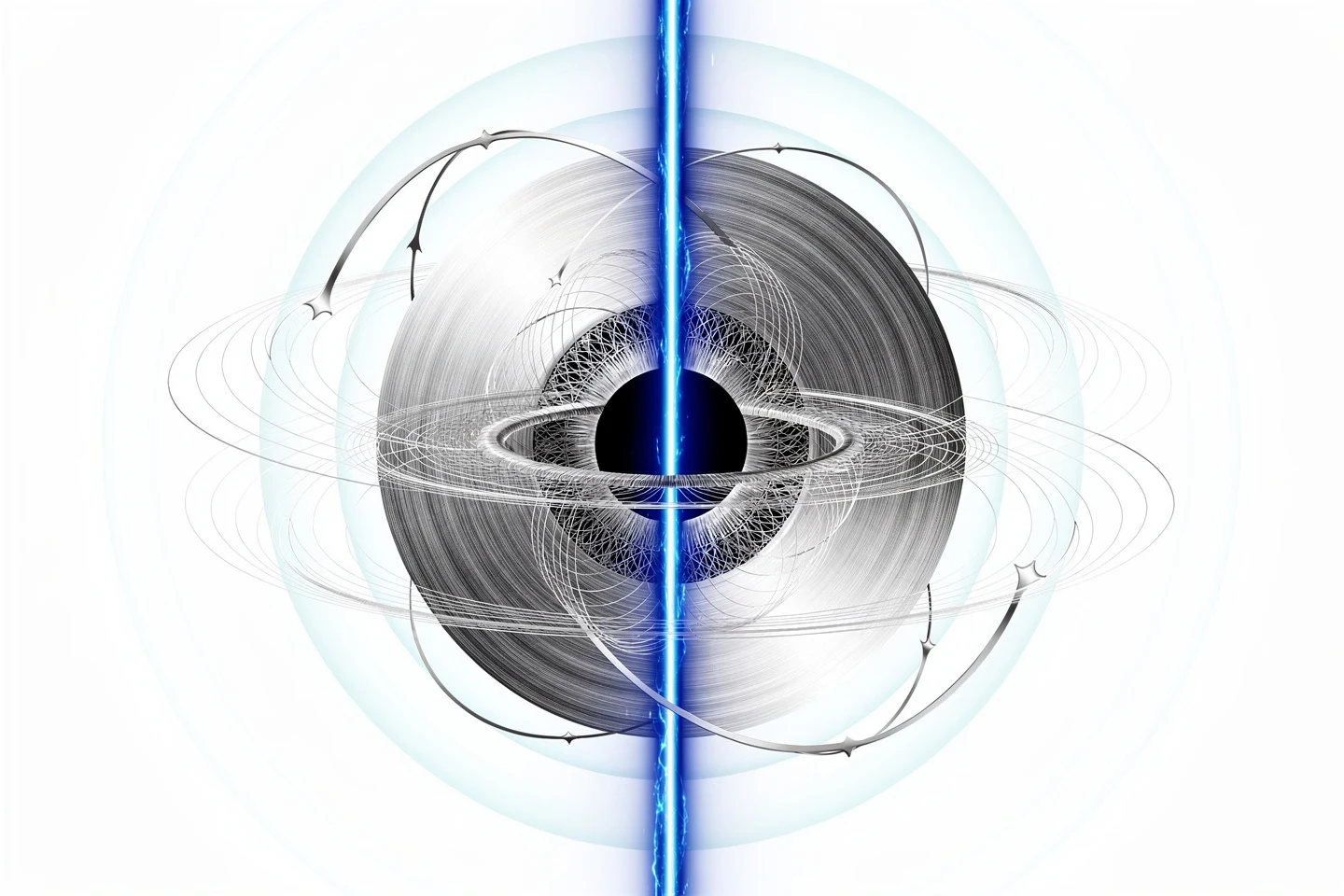
For years, silence reigned in the heart of galaxy 1ES 1927+654: the accreting gas merely whispered in X-rays, leaking slow winds. But in 2022–2025, the picture changed dramatically. Spectra taken by XMM-Newton and Swift lit up with emission lines — a narrow peak at 0.56 keV, likely from OVII oxygen, a broader feature near 1 keV, and a powerful iron band in the 6–7 keV region. It was as if the black hole found its voice, and its song is the X-ray echo of a jet's birth.
This transformation is like a vast cosmic heart at work. While the accretion rate hovered at 0.3 of the Eddington limit — which is simply the ratio of bolometric luminosity to the critical luminosity, λEdd = Lbol / LEdd — the black hole built up energy. Then, like a shockwave, the jet erupted: radio emission at 5 GHz skyrocketed 60-fold, and soft X-rays 10-fold. The black hole's pulse — quasi-periodic oscillations (QPOs) — quickened from 0.9 to 2.5 mHz. This rhythm is beaten out by plasma clumps at the very base of the jet. And while Hubble sees only the outer optical glimmers, X-ray spectroscopy reveals the deep mechanisms.
Concurrent with the jet's birth, the ionized absorber vanished — the warm absorber of hydrogen that had previously muffled the soft emission. In its place, emission peaks blazed: a narrow OVII line and a broad band from the inner disk. And crucially — for the first time in this object — a broad (σ ≈ 800 eV) Fe K iron line appeared, reflected from gas whirling at a breakneck pace near the event horizon. This picture obeys the metric of Karl Schwarzschild — his solution describes a non-rotating black hole, although here the hole likely spins, accelerating the jet to 0.2 speed of light.
The shift from winds to a jet is no mere change of scenery. It reinforces Stephen Hawking’s insights into black hole thermodynamics: the accretion flow can alter its configuration, and soft X-rays are born right at the jet base, not in the distant disk. In the future, missions like XRISM and NuSTAR will probe the gas kinematics right at the horizon, and X-ray polarization will unveil the magnetic fields orchestrating this cosmic symphony. Cracking the mystery of jet launching is no longer a far-future pursuit — it is being written right now, step by step, in the X-ray echoes of galaxies.
The frequency of quasi-periodic oscillations (QPOs) in the emission of black hole 1ES 1927+654 rose from 0.9 to 2.5 mHz as the jet was born — as if a cosmic heart was quickening its beat.