A Black Hole in an Invisible Cocoon express
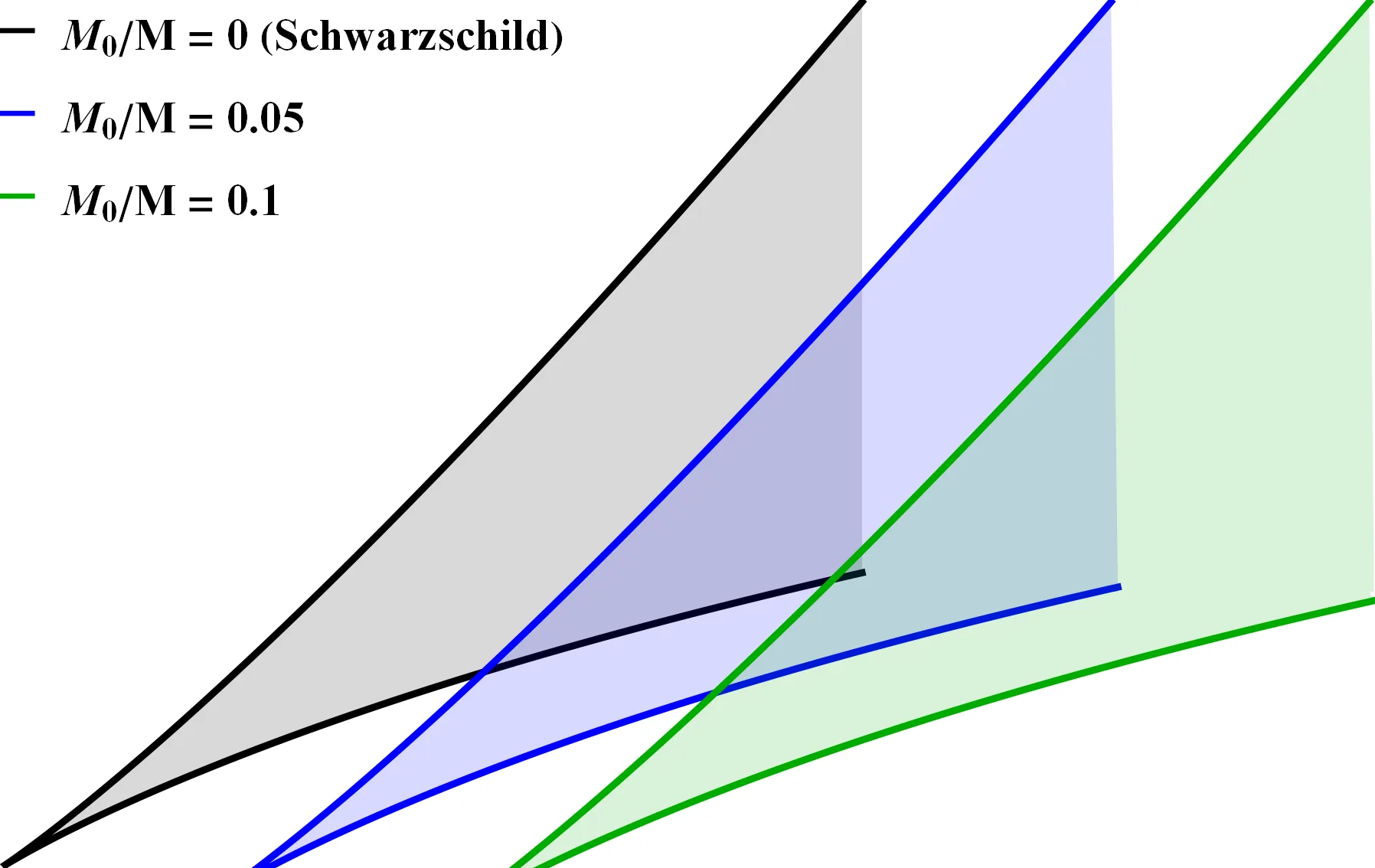
At the center of a galaxy sits a supermassive black hole, surrounded by a vast, tenuous cloud of dark matter. It doesn't shine or heat, but its gravity warps space and changes the rules of the game for everything orbiting nearby.
The authors built a model where a black hole is embedded in such a cloud, called a halo, and observed how orbits change. It turns out that as the cloud's size grows, the most important circular orbits first shrink and then expand again. It's like a seesaw: sometimes the pull is stronger, sometimes weaker. Meanwhile, angular momentum always decreases, as if the cloud saps particles of their "reserve range."
But there's more. When a small compact object (like a stellar-mass black hole) spirals into such a black hole, it emits gravitational waves. Simulations showed that changing the cloud's size noticeably shifts the phase of the waves — the signal is delayed. But changing only the cloud's total mass barely affects the signal, unless the mass becomes comparable to that of the black hole itself. It's like listening to an echo in the mountains: the shape of the valley matters more than the density of the air.
So, future detectors like the space-based observatory LISA could not only catch the "sound" of falling objects but also discern how diffuse or dense the invisible halo around a black hole is. And that's a direct path to mapping dark matter in the very hearts of galaxies.
Original abstract
as written by the authors arXiv:2607.24144
We study a Schwarzschild-like black hole embedded in an exponential-sphere (ESM) dark matter halo, characterized by a halo mass $$M_0$$ and a scale radius $$r_0$$. We first show that the halo's effect on the marginally bound orbit (MBO) and innermost stable circular orbit (ISCO) is richer than a simple shift: the characteristic radii and energies vary non-monotonically with $$r_0$$, dipping below their Schwarzschild values before recovering, while the angular momenta decrease monotonically; as a function of $$M_0$$, the response can even reverse sign depending on how extended the halo is, with only the ISCO energy remaining monotonic throughout. We classify periodic orbits by the rational frequency ratio $$q=\omega_\phi/\omega_r-1=w+v/z$$ and find that $$r_0$$ and $$M_0$$ leave clearly distinguishable imprints on the orbit spectrum. Using the numerical kludge framework, we compute the corresponding extreme-mass-ratio-inspiral (EMRI) waveforms and show that varying $$r_0$$ produces a strong, monotonic effect enlarging the orbits, lengthening the radial period, and introducing a clear dephasing while comparable variations in $$M_0$$ leave the signal nearly unchanged unless $$M_0$$ becomes a sizable fraction of the black hole mass. Together, these results indicate that EMRI waveforms can, in principle, disentangle the total mass of a dark matter halo from its spatial extent, offering a strong-field probe of the dark matter distribution around supermassive black holes.
Dark matter makes up about five times more of the universe than ordinary matter, the stuff stars, planets, and we are made of.
In the novel "Roadside Picnic," invisible "voids" altered the laws of physics — here, a dark halo alters orbits and waves, but without mysticism.