The Milky Way Speaks the Language of Neutrinos express

Original: "High-energy neutrino emission from the Milky Way"
· R. Abbasi, M. Ackermann, J. Adams, J. A. Aguilar, M. Ahlers, J. M. Alameddine, S. Ali, N. M. Amin, K. Andeen, C. Argüelles, S. Athanasiadou, S. N. Axani, R. Babu, X. Bai, A. Balagopal V., S. W. Barwick, V. Basu, R. Bay, J. J. Beatty, J. Becker Tjus, P. Behrens, J. Beise, C. Bellenghi, S. Benkel, S. BenZvi, D. Berley, E. Bernardini, D. Z. Besson, E. Blaufuss, L. Bloom, S. Blot, F. Bontempo, J. Y. Book Motzkin, C. Boscolo Meneguolo, S. Böser, O. Botner, J. Böttcher, J. Braun, B. Brinson, Z. Brisson-Tsavoussis, L. Brusa, R. T. Burley, D. Butterfield, K. Carloni, J. Carpio, N. Chau, Y. C. Chen, Z. Chen, D. Chirkin, S. Choi, A. Chubarov, B. A. Clark, G. H. Collin, D. A. Coloma Borja, A. Connolly, J. M. Conrad, D. F. Cowen, C. De Clercq, J. J. DeLaunay, D. Delgado, T. Delmeulle, S. Deng, P. Desiati, K. D. de Vries, G. de Wasseige, T. DeYoung, J. C. D'\iaz-Vélez, S. DiKerby, T. Ding, M. Dittmer, A. Domi, L. Draper, L. Dueser, D. Durnford, K. Dutta, M. A. DuVernois, T. Ehrhardt, L. Eidenschink, A. Eimer, C. Eldridge, P. Eller, E. Ellinger, D. Elsässer, R. Engel, H. Erpenbeck, W. Esmail, S. Eulig, J. Evans, P. A. Evenson, K. L. Fan, K. Fang, K. Farrag, A. Fattorini, A. R. Fazely, A. Fedynitch, N. Feigl, C. Finley, D. Fox, A. Franckowiak, S. Fukami, P. Fürst, J. Gallagher, E. Ganster, A. Garcia, M. Garcia, E. Genton, L. Gerhardt, A. Ghadimi, C. Glaser, T. Glüsenkamp, J. G. Gonzalez, S. Goswami, A. Granados, D. Grant, S. J. Gray, S. Griffin, S. Griswold, K. M. Groth, D. Guevel, C. Günther, P. Gutjahr, C. Ha, A. Hallgren, L. Halve, F. Halzen, L. Hamacher, M. Handt, K. Hanson, J. Hardin, A. A. Harnisch, P. Hatch, A. Haungs, J. Häu\ssler, K. Helbing, J. Hellrung, B. Henke, L. Hennig, F. Henningsen, L. Heuermann, R. Hewett, N. Heyer, S. Hickford, A. Hidvegi, C. Hill, G. C. Hill, R. Hmaid, K. D. Hoffman, A. Hollnagel, D. Hooper, S. Hori, K. Hoshina, M. Hostert, W. Hou, M. Hrywniak, T. Huber, K. Hultqvist, K. Hymon, A. Ishihara, W. Iwakiri, M. Jacquart, S. Jain, O. Janik, M. Jansson, M. Jin, N. Kamp, D. Kang, W. Kang, A. Kappes, L. Kardum, T. Karg, A. Karle, A. Katil, M. Kauer, J. L. Kelley, M. Khanal, A. Khatee Zathul, A. Kheirandish, T. Kim, H. Kimku, F. Kirchner, J. Kiryluk, C. Klein, S. R. Klein, Y. Kobayashi, S. Koch, A. Kochocki, R. Koirala, H. Kolanoski, T. Kontrimas, L. Köpke, C. Kopper, D. J. Koskinen, P. Koundal, M. Kowalski, T. Kozynets, A. Kravka, N. Krieger, T. Krishnan, K. Kruiswijk, E. Krupczak, E. Kun, N. Kurahashi, C. Lagunas Gualda, L. Lallement Arnaud, M. J. Larson, F. Lauber, J. P. Lazar, K. Leonard DeHolton, A. Leszczyńska, C. Li, J. Liao, C. Lin, Q. R. Liu, Y. T. Liu, M. Liubarska, C. Love, L. Lu, F. Lucarelli, W. Luszczak, Y. Lyu, M. Macdonald, E. Magnus, Y. Makino, E. Manao, S. Mancina, A. Mand, I. C. Mariş, S. Marka, Z. Marka, L. Marten, I. Martinez-Soler, R. Maruyama, J. Mauro, F. Mayhew, F. McNally, K. Meagher, A. Medina, M. Meier, Y. Merckx, L. Merten, S. Minji, J. Mitchell, L. Molchany, S. Mondal, T. Montaruli, R. W. Moore, Y. Morii, A. Mosbrugger, D. Mousadi, E. Moyaux, T. Mukherjee, M. Nakos, U. Naumann, R. Neshat, L. Neste, M. Neumann, H. Niederhausen, M. U. Nisa, K. Noda, A. Noell, A. Novikov, A. Obertacke, V. O'Dell, A. Olivas, R. Orsoe, J. Osborn, E. O'Sullivan, B. Owens, V. Palusova, H. Pandya, A. Parenti, C. Parisel, N. Park, V. Parrish, E. N. Paudel, L. Paul, C. Pérez de los Heros, T. Pernice, T. C. Petersen, J. Peterson, S. Pick, M. Plum, A. Pontén, V. Poojyam, B. Pries, R. Procter-Murphy, G. T. Przybylski, L. Pyras, C. Raab, J. Rack-Helleis, N. Rad, M. Ravn, K. Rawlins, Z. Rechav, A. Rehman, I. Reistroffer, E. Resconi, C. D. Rho, W. Rhode, L. Ricca, B. Riedel, A. Rifaie, E. J. Roberts, S. Rodan, M. Rongen, A. Rosted, C. Rott, T. Ruhe, L. Ruohan, D. Ryckbosch, J. Saffer, D. Salazar-Gallegos, P. Sampathkumar, A. Sandrock, G. Sanger-Johnson, M. Santander, S. Sarkar, P. Savina, M. Scarnera, M. Schaufel, H. Schieler, S. Schindler, L. Schlickmann, B. Schlüter, F. Schlüter, N. Schmeisser, T. Schmidt, F. Schmitt, A. Scholz, F. G. Schröder, S. Schwirn, S. Sclafani, D. Seckel, L. Seen, M. Seikh, S. Seunarine, P. A. Sevle Myhr, R. Shah, S. Shah, S. Shefali, N. Shimizu, B. Skrzypek, R. Snihur, J. Soedingrekso, D. Soldin, P. Soldin, G. Sommani, D. Song, C. Spannfellner, G. M. Spiczak, C. Spiering, J. Stachurska, M. Stamatikos, T. Stanev, T. Stezelberger, T. Stürwald, T. Stuttard, G. W. Sullivan, I. Taboada, S. Ter-Antonyan, A. Terliuk, A. Thakuri, M. Thiesmeyer, W. G. Thompson, J. Thwaites, W. Tian, S. Tilav, K. Tollefson, J. A. Torres, S. Toscano, D. Tosi, K. Upshaw, A. Vaidyanathan, N. Valtonen-Mattila, J. Valverde, J. Vandenbroucke, T. Van Eeden, N. van Eijndhoven, L. Van Rootselaar, J. van Santen, J. Vara, F. Varsi, M. Velazquez, M. Venugopal, M. Vereecken, S. Vergara Carrasco, S. Verpoest, D. Veske, A. Vijai, J. Villarreal, C. Walck, A. Wang, E. H. S. Warrick, C. Weaver, A. Weindl, P. Weigel, J. Weldert, A. Y. Wen, C. Wendt, J. Werthebach, M. Weyrauch, N. Whitehorn, C. H. Wiebusch, D. R. Williams, L. Witthaus, J. Woodward, G. Wrede, X. W. Xu, J. P. Yanez, Y. Yao, E. Yildizci, S. Yoshida, F. Yu, S. Yu, T. Yuan, S. Yun-Cárcamo, A. Zander Jurowitzki, A. Zegarelli, S. Zhang, Z. Zhang, P. Zhelnin, P. Zilberman, C. Zilleruelo Cañas
arXiv:2607.25966 · 2026-07-28 · CC BY 4.0 · 2 min
The IceCube observatory in Antarctica has for the first time confirmed that our galaxy emits high-energy neutrinos.

📄 Showing the "Simple" version — "Advanced" is not ready yet. Add it to favorites to help prioritize it.

Deep beneath the ice of the South Pole, nearly two and a half kilometers down, an unusual telescope is at work. It is not pointed at the sky but through the Earth. Its quarry: neutrinos, nearly elusive particles that pass through planets and stars without interacting with anything. But occasionally a neutrino does collide with an ice molecule, producing a brief flash of light that thousands of sensitive sensors detect.

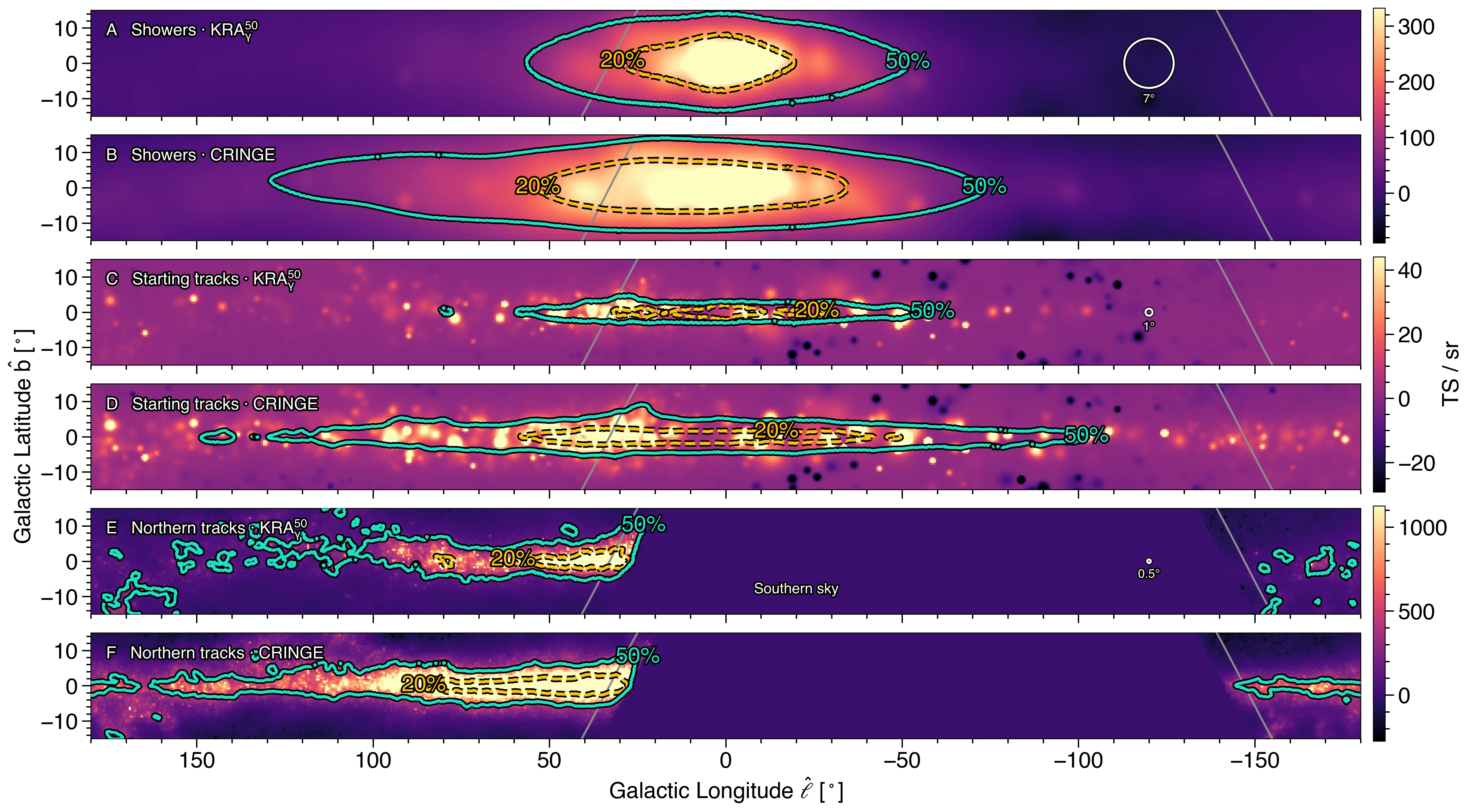
These light signals accumulated over twelve years. Scientists from the IceCube collaboration analyzed the signal shapes from all three neutrino types and improved ice models. And now the plane of the Milky Way, especially its central region, has emerged as a powerful source of high-energy neutrinos. The statistical significance of the signal is 5.7 sigma, meaning chance is virtually ruled out. From the inner part of the galaxy, 217 events with energies above 5 teraelectronvolts were detected, compared to an expected background of only 154.

Unlike light, neutrinos are not absorbed by dust and gas. They bring news from the densest and most turbulent corners of the cosmos.

Previously, astronomers relied on light and other forms of radiation, but these often get stuck in cosmic dust. Neutrinos, however, are ideal messengers. They tell us where natural particle accelerators hide, accelerating protons to energies beyond even the Large Hadron Collider. Now that the neutrino map of the galaxy is emerging, we can study how these particles travel through magnetic fields and where exactly they are born.

An energy of 5 TeV is comparable to the energy of a flying mosquito, but compressed into a single elementary particle.

This discovery opens an era of galactic multimessenger astronomy, where light, gravitational waves, and neutrinos combine into a unified picture. Antarctic ice has become a window into the heart of the Milky Way.

Original abstract

as written by the authors arXiv:2607.25966

The Milky Way hosts astrophysical objects that accelerate cosmic rays to energies beyond the reach of terrestrial particle accelerators. It remains a longstanding goal to locate the sites of these powerful Galactic engines and understand how cosmic rays propagate through the Galaxy, leading to the production of high-energy neutrinos. In this paper, we combine event morphologies characteristic of all three neutrino flavours and apply recent improvements in ice modelling, calibration and reconstruction to 12 years of IceCube data. With a predefined, global analysis we establish high-energy neutrino emission from the Galactic plane at 5.7 $$\sigma$$ significance. A further study shows that the inner region of the Galaxy is a prominent neutrino source, with 217 shower events with visible energy above 5 TeV compared with an expected background of 154.4 $$\pm$$ 4.1. These results herald a new era of Galactic multi-messenger astronomy, creating new opportunities to study cosmic-ray propagation and probe neutrino properties over kiloparsec distances.
To build IceCube, 86 holes were drilled in the ice, each 2450 meters deep: that's about eight Eiffel Towers stacked on top of each other.

In Peter Watts's novel Blindsight, neutrino signals serve as a means of communication for an alien intelligence hidden in the Oort cloud.

Scientists
Paul DiracEnrico FermiSubrahmanyan ChandrasekharAlbert EinsteinBarry BarishKip Thorne
Concepts
ultra high energy cosmic ray source high energy neutrino neutrino emission neutron star icecube neutron star light emission cosmic rays milky way galactic outflow km3net galactic bulge large magellanic cloud starlight extensive air showers radio galaxy x ray telescope ultra fast outflow fermi telescope photosphere starburst stellar atmosphere