An X-ray telescope is an instrument designed to detect and image X-ray radiation from astronomical sources. Unlike optical telescopes that capture visible light, X-ray telescopes must operate in space or at very high altitudes because Earth's atmosphere absorbs X-rays. They reveal some of the most energetic phenomena in the universe, including black holes, neutron stars, supernova remnants, and the hot gas in galaxy clusters.
History
The first X-ray telescope was flown on a sounding rocket in 1963 by Riccardo Giacconi and colleagues, who discovered the first cosmic X-ray source outside the solar system, Scorpius X-1. Giacconi later led the development of the Einstein Observatory (1978), the first imaging X-ray telescope in orbit.
How it works
X-rays are difficult to focus because they penetrate most materials and are not reflected by ordinary mirrors at normal angles. X-ray telescopes use grazing incidence mirrors, where X-rays strike a highly polished surface at a very shallow angle and reflect like a stone skipping on water. Multiple nested mirror shells are often used to collect more photons. Detectors then record the focused X-rays, creating an image or spectrum.
In practice
X-ray telescopes are used in space observatories like Chandra and XMM-Newton to study black holes, neutron stars, and hot gas in the universe, and they also contribute to solar physics by monitoring X-ray flares from the Sun.
Fun fact
The mirrors of the Chandra X-ray Observatory are so smooth that if the surface of Earth were as smooth, the highest mountain would be only about two meters tall.
In the basement of the laboratory, an 8 tesla magnet hums. Inside it, like a bell in a bell tower, hangs a hollow copper cylinder tuned to a single note. If an axion, a dark matter particle, flies by, the cylinder responds with a faint ring. The trouble is that ordinary copper muffles this ring: at high frequencies, current flows only through a thin skin of the metal, and losses grow.
Photographing an exoplanet orbiting another star is like trying to spot a firefly in front of a spotlight. Earth's atmosphere is constantly churning, which makes stars appear as dancing speckles through a telescope.
Deep beneath the ice of the South Pole, nearly two and a half kilometers down, an unusual telescope is at work. It is not pointed at the sky but through the Earth. Its quarry: neutrinos, nearly elusive particles that pass through planets and stars without interacting with anything.
Imagine an artist whose canvas is an entire planet, and whose palette is molecules drinking starlight. His brush is billions of years of evolution, and his painting is a spectral portrait visible even from another star system.
Tiny invisible bullets pass straight through the Sun, barely noticing its matter. These are axions — hypothetical particles so light and elusive that they are often compared to ghosts.
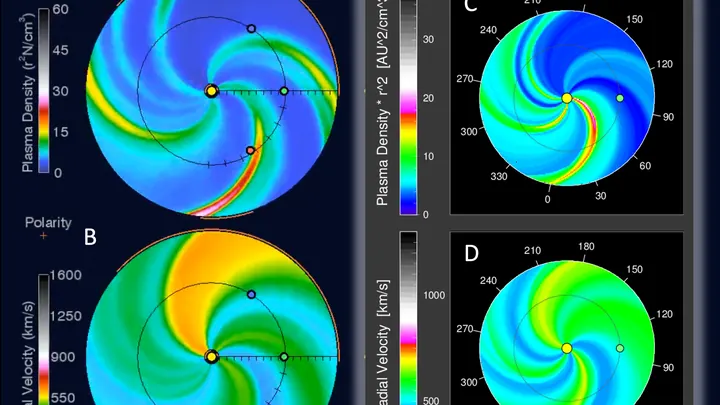
The solar wind, a stream of charged particles from the Sun, slams into the tenuous gas that fills the space between the stars. The collision produces a faint X-ray glow. For astronomers, this is like fog in front of headlights: it obscures distant objects.
In 1987, astronomers saw a supernova flare up in a neighboring galaxy — the Large Magellanic Cloud. It was a rare gift: the explosion was close enough to catch not just light but also neutrinos, those nearly undetectable particles that pass straight through Earth.
The neutron star 4U 1735-44 is gobbling up matter from a companion star. The matter spirals into a flat disk, like water going down a bathtub drain. But this disk shines in X-rays, and astronomers have for the first time measured how "combed" those rays are: that is, how polarized.
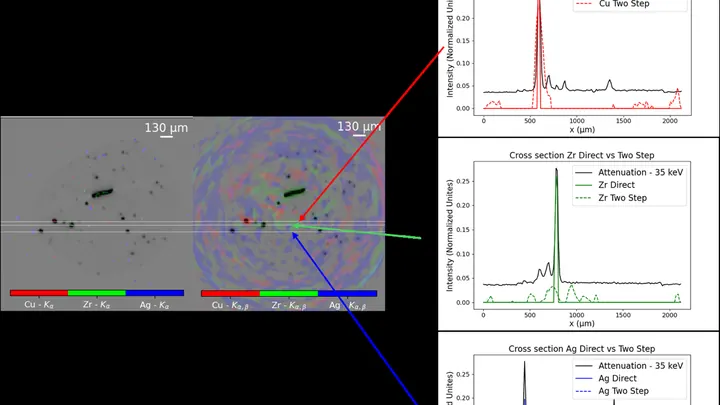
Conventional X-ray fluorescence analysis works like a meticulous scribe: to learn the composition of a picture, it walks over every square centimeter and logs whether lead or copper is present. For a flat sheet, that's tolerable, but for a three-dimensional object, it's torture.
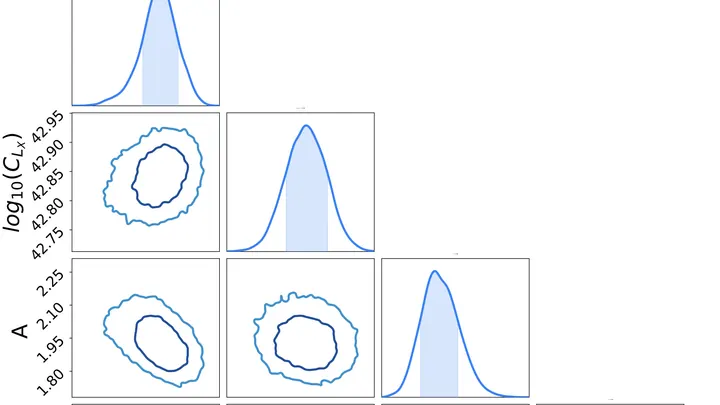
A pot of boiling water sits on the stove: the higher the heat, the hotter the water and the more steam escapes. Hot gas in galaxy clusters behaves much the same way. But in small galaxy groups, this "steam" leaks out faster than you'd expect from the temperature alone.
Cosmic rays are not light but charged particles bombarding Earth from all directions. Most of them are protons (hydrogen nuclei), but heavier nuclei also show up: helium, nitrogen, iron.
An X-ray image usually brings to mind a bulky machine in a hospital. But such a picture can be taken by a device the size of a palm, assembled from hobbyist electronics. The authors took a Raspberry Pi mini-computer, a 12.3-megapixel camera, and a screen that glows under X-rays.
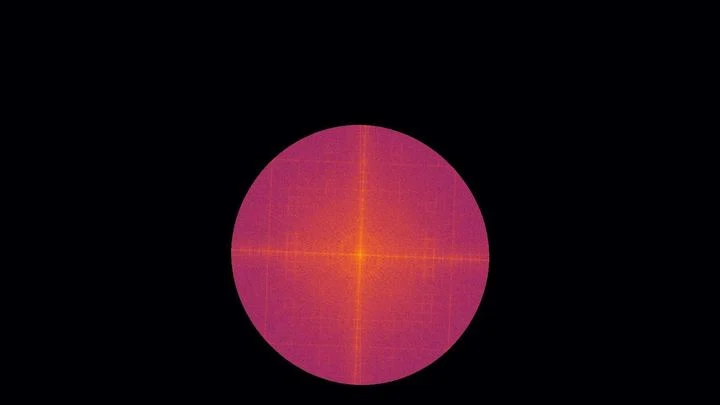
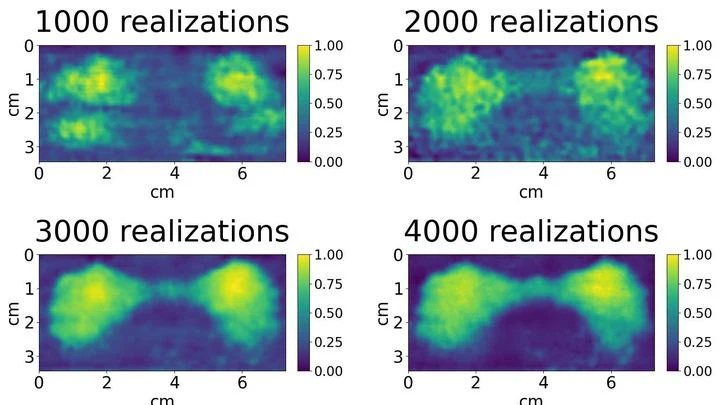
An X-ray image of a battery looks like a photo taken through frosted glass: fine details blur into a gray smudge. The culprit is the detector itself, which cannot distinguish features smaller than its pixel size. Engineers proposed getting around this barrier by illuminating the sample not with a uniform beam but with a striped pattern.
Radioactive tracers are like a courier with a beacon: you inject it into the body, and it highlights the target organ on the scan. But this courier comes with strict rules: you can't send it often, it quickly 'gets tired,' and it costs a lot. Doctors have long dreamed of a way to see an organ without radiation.
You can't catch X-rays from stars with an ordinary mirror: they pass through glass like light through a window pane. To reflect them, you need a mirror almost parallel to the beam: then the X-rays skim along the surface like a flat stone skipping on water, only slightly changing direction.
Twenty years ago, an X-ray image of the Arches cluster resembled a photo of a person in thick fog: the cluster itself was drowned in the glow of a neighboring cloud. The cloud acted like a mirror, reflecting hard radiation from the vicinity of the black hole, and that reflection swamped the faint signal from the stars.
Every second, dozens of particles from space fly through each of us. Most are light protons, but there are also heavier atomic nuclei: carbon, oxygen, iron. They are born in stellar explosions and travel to Earth for millions of years. Their energy can be staggering: a single particle can carry as much as a tennis ball on a serve.