How Dark Matter Reshapes Black Holes express
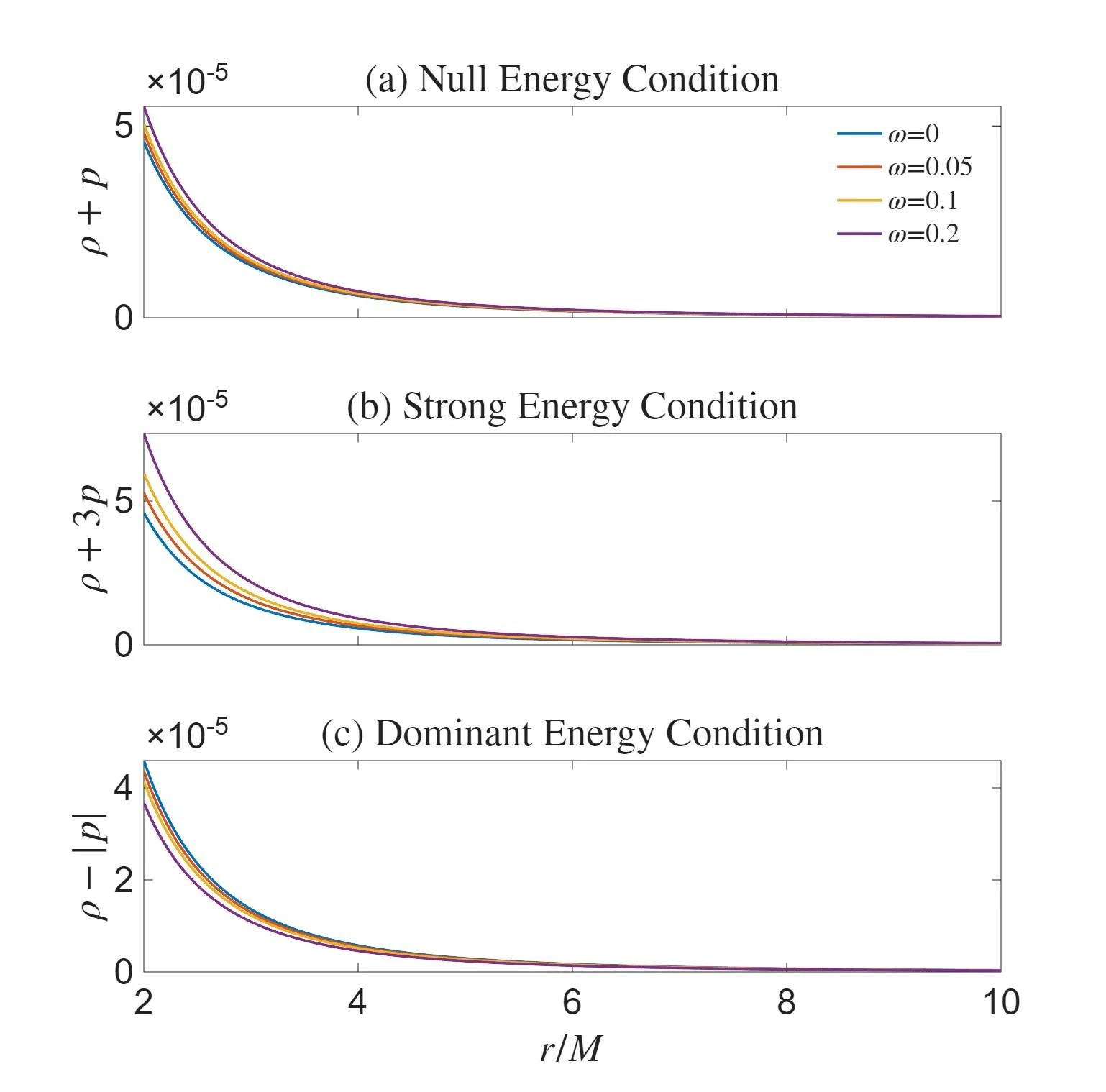
An invisible scaffold holds galaxies together, keeping them from flying apart. This is dark matter — matter that doesn't shine and barely interacts with ordinary stuff. Astrophysicists have long debated what it's made of. In a new study, they tested three leading candidates: an anisotropic perfect fluid, a homogeneous medium with constant pressure, and a Bose-Einstein condensate with a complex equation of state.
Each option wraps around a black hole differently, altering its gravitational field. The authors calculated how key orbits shift in each case: the event horizon, the photon sphere (where light travels in circles), and the shadow: that dark silhouette photographed in 2019 by the Event Horizon Telescope.
Comparing with the actual image of the shadow of galaxy M87* imposed strict constraints. The constant-pressure model survived only in a narrow corridor, the Bose-Einstein condensate showed smooth deviations, and the anisotropic fluid was nearly indistinguishable from a regular black hole without dark matter. Thus, the geometry of curved spacetime becomes a tool for sorting hypotheses about invisible matter.
Original abstract
as written by the authors arXiv:2608.04470v1
We study how three physically motivated dark matter equations of state alter the spacetime geometry of static, spherically symmetric black holes in General Relativity. The models considered are anisotropic perfect fluid dark matter (PFDM), isotropic constant-$$\omega$$ dark matter, and Bose-Einstein condensate (BEC) dark matter with a polytropic equation of state (EoS). For each model, we derive the Einstein field equations and solve for the metric function analytically in the PFDM and constant-$$\omega$$ cases, and numerically via the Tolman-Oppenheimer-Volkoff equations for BEC dark matter. We then compute the key strong gravity observables: event horizon radius, photon sphere radius, black hole shadow radius, innermost stable circular orbit (ISCO), and circular orbital velocity profiles. The shadow radii obtained for each model are compared against the Event Horizon Telescope constraints to place bounds on the dark matter parameters. Physical viability is assessed through the null, weak, dominant, and strong energy conditions, along with causality requirements on the sound speed. Our results show that PFDM produces near Schwarzschild geometry with mild anisotropic corrections, the constant-$$\omega$$ model is strongly restricted by causality to $$0 \leq \omega \leq 1$$, and BEC dark matter generates smooth, bounded deviations governed by the bosonic self-interaction parameter K. Taken together, these findings show that strong gravity observables can serve as practical tools for distinguishing between competing dark matter models through their geometric imprints on black hole space times.
The shadow of M87* is seen from Earth at an angle of 42 microarcseconds — roughly like a coin on the Moon as seen from Earth.
In Vernor Vinge's novel A Fire Upon the Deep, dark matter turns out to be a thinking medium, and black holes are its communication nodes.