Cosmic Light Changes Polarization express
Light from the hottest stage of the universe has been traveling toward us for nearly 14 billion years. This is the cosmic microwave background — a faint glow filling the entire sky. Recently, astronomers noticed something odd: its polarization (the direction of oscillation of the electric field) appears rotated by about 0.3 degrees. As if someone had slightly turned an invisible knob.
The explanation may lie in the nature of dark energy — the mysterious force causing the universe to expand faster and faster. The authors of the study considered dark energy not as the usual scalar field but as a 3-form. This is a mathematical object similar to a field that fills space and, when expanding, behaves like a fluid. Its tensor structure allows it to interact with light in ways ordinary scalar fields cannot. As a result, the polarization of light can rotate — producing cosmic birefringence.
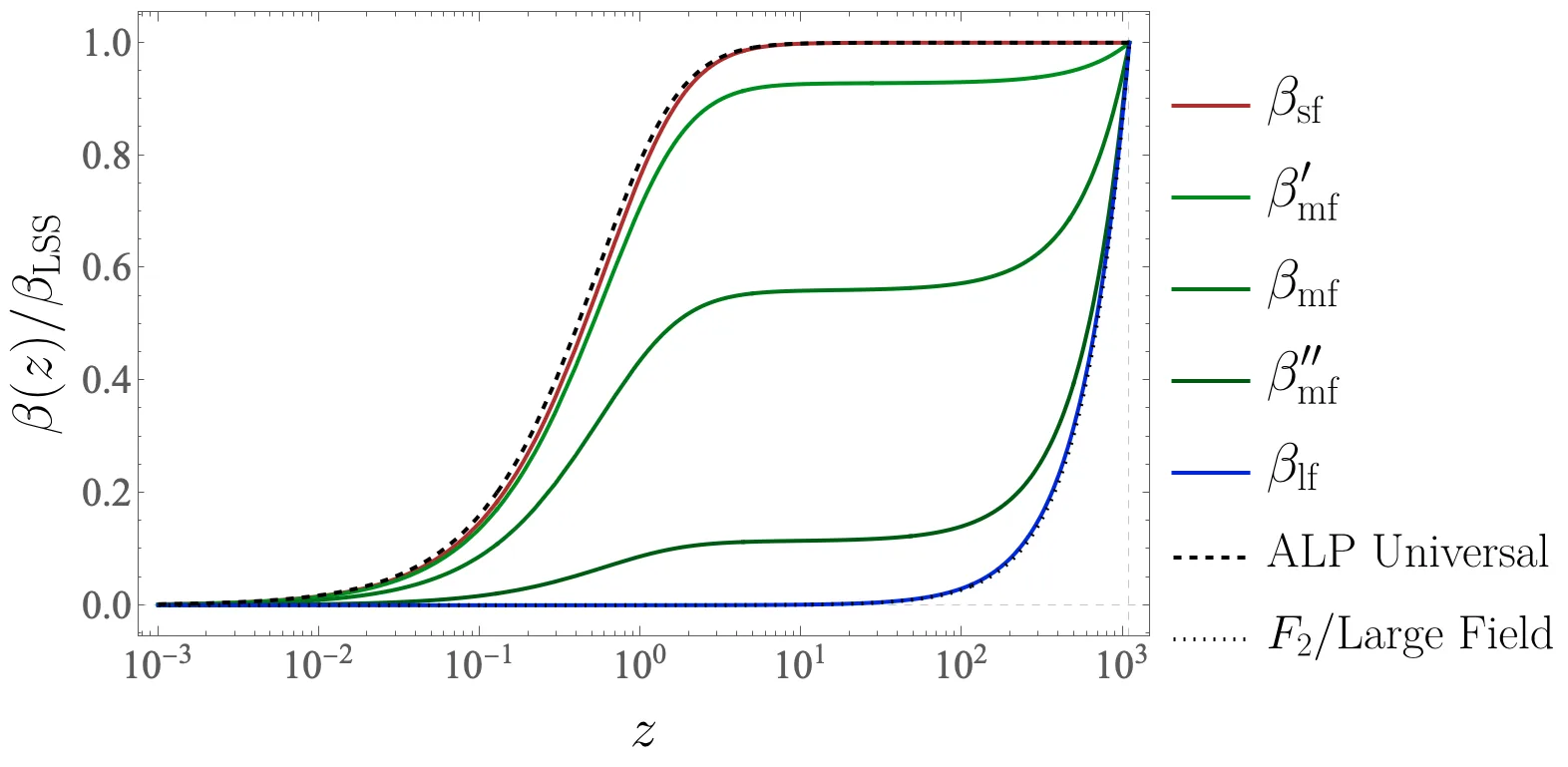
The scientists tested two interaction scenarios between the 3-form and photons — particles of light. The first, more complex (dimension-6 operator), requires an incredibly strong coupling to explain the observed 0.3-degree rotation. The second, simpler (dimension-4 operator), does the job, but at a cost: the photon acquires a tiny mass. This mass turns out to be comparable to the expansion rate of the universe — a quantity astronomers denote as H₀. Interestingly, the rotation profile as a function of distance (or time) in the second case is almost independent of the 3-form's potential shape, but sensitive to initial conditions. In the first case, it's the opposite.
Original abstract
as written by the authors arXiv:2608.05296v1
3-forms are interesting fields to study in the cosmological context for numerous reasons, such as being candidates for explaining inflation and dark energy. The background evolution of a 3-form field is similar to but distinguishable from a scalar field in an expanding universe, and its tensorial structure allows for unique couplings that cannot be experienced by canonical scalars. In this work, we explore the possibility that 3-form dark energy can explain cosmic birefringence. We consider two EFT-inspired couplings between the 3-form and the photon, and compute the birefringence angle $$\beta$$. We find that a dimension-6 gauge-invariant operator necessitates an extremely large coupling to explain $$\beta\sim0.3^\circ$$, the value suggested by observations of recent cosmic microwave background radiation. Conversely, a dimension-4 operator can accommodate $$\beta\sim0.3^\circ$$ at the expense exciting the longitudinal mode of the photon. Interestingly, demanding a self-consistent decoupling limit implies the photon mass lies within a few orders of magnitude of $$H_0$$. We also derive `universal' profiles for $$\beta(z)$$, finding the $$\beta$$ from the dimension-4 operator is insensitive to the form of the 3-form potential but is sensitive to the initial conditions. Contrarily, the dimension-6 operator is highly sensitive to the form of the potential. We finally compare the universal profiles to that of axion-like particle (ALP) dark energy and an ultralight massive 3-form, the latter obtained from numerically integrated cosmological histories consistent with $$\Lambda$$CDM up to low redshift. Our results show that birefringence from 3-form dark energy can both mimic that from an ALP or be distinguishable, depending on the field configuration in the early universe.
The cosmic microwave background was discovered by accident in 1964, when radio engineers trying to find the source of noise in an antenna found a uniform hiss coming from all directions in the sky.
In Carl Sagan's novel "Contact," the protagonist, listening to the sky, finds structure in the radio noise — perhaps the polarization of the cosmic microwave background also hides messages from the early universe.