Atoms in a Sticky Trap Measure Radio Waves Without Coils express
A radio receiver the size of a palm can measure signal power more accurately than expensive lab benches. Inside, there are no coils or antennas, just a glass head and a cloud of rubidium atoms cooled to near absolute zero. The atoms float in the crossing of laser beams, held not by magnets but by the force of light, like a midge in a drop of syrup.
The trapped atoms are transferred into a special Rydberg state — the electron flies far from the nucleus, making the atom a giant by atomic standards. Such an atom becomes extremely sensitive to electric fields. An incoming radio wave slightly changes its energy, and some atoms escape the trap: this is recorded by a camera. Previously, similar sensors required bulky magnetic coils that distorted the measured field. Here, the head is made of a dielectric, like window glass, and the field passes through it unharmed.
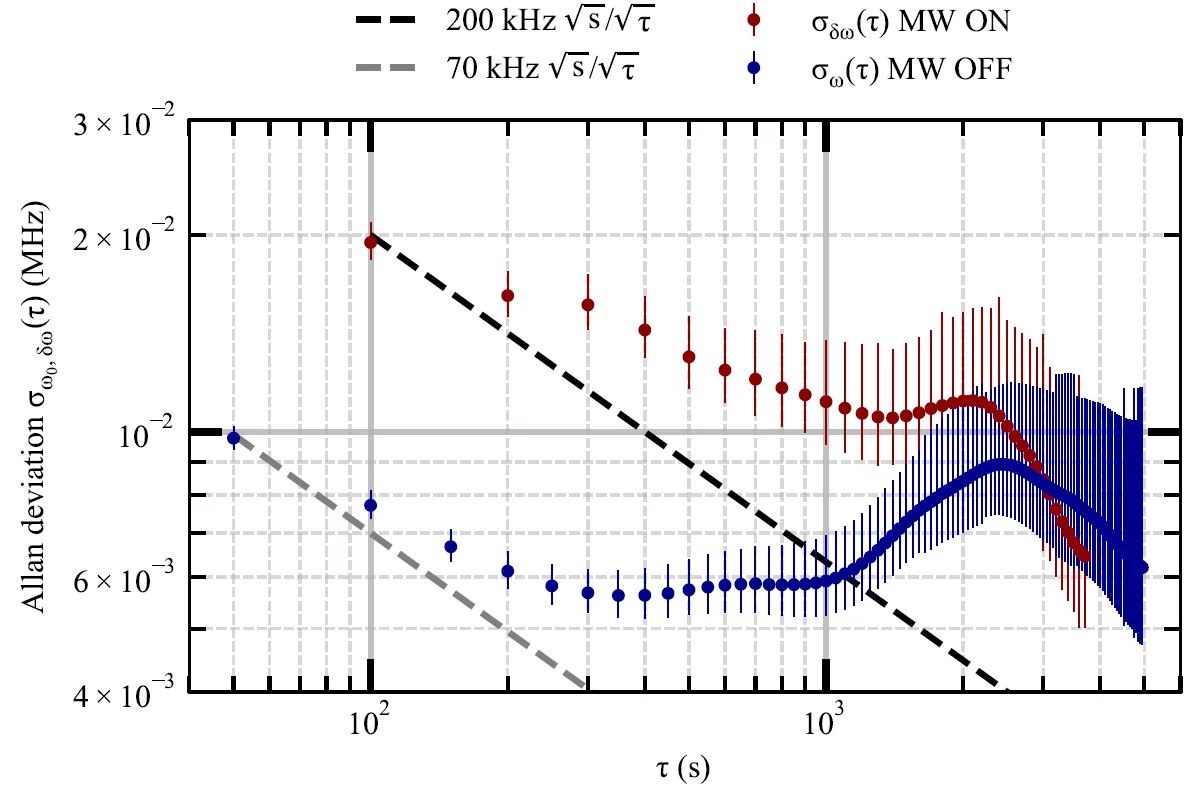
The absence of metal also brought another advantage: the cooling and excitation lasers can be switched faster than in a magnetic trap. The atom-loss signal became ten times narrower in frequency, as if the needle of a scale stopped trembling. This allowed power measurements without external calibrators, with a drift of less than 1% over tens of minutes. The platform paves the way for compact quantum navigators and gravimeters, where cold atoms are already replacing pendulums and gyroscopes.
Original abstract
as written by the authors arXiv:2608.07260v1
We demonstrate the quantum sensing of radiofrequency fields based on cold Rydberg atoms in a super-molasses trap, without the need for magnetic coils. Our approach combines the metrological advantages of cold atoms with a metal-free dielectric sensor head minimizing perturbations to the electromagnetic environment, a feature that was previously restricted to vapor-cell-based devices. Moreover, the absence of inductive loads allows to rapidly alternate between the cooling phase and the Rydberg excitation, leading to trap-loss spectroscopy signals one order of magnitude narrower than for conventional magneto-optical traps. This enables self-calibrated microwave power measurements with an unprecedented dynamic range of 43dB, opening the door to new perspectives of applications in calibration measurements. We also report a scale factor linearity better than 1%, the absence of drifts over several tens of minutes leading to a 3$$\mu$$V/cm resolution, and the possibility to retrieve the ellipticity of the applied microwave field. By demonstrating a cold-atom metrological platform in a compact dielectric sensor head, this work paves the way for new applications in the field of radiofrequency measurements with Rydberg atoms, and in other fields of quantum sensing based on cold atoms such as magnetometry, gravimetry or inertial navigation.
Rydberg atoms are so large that a single atom can be bigger than a virus: its diameter reaches hundredths of a millimeter.
Such sensors resemble the tricorder from Star Trek — a portable scanner that analyzes fields and matter on the fly.